Alles über E-Books | Antworten auf Fragen rund um E-Books, Kopierschutz und Dateiformate finden Sie in unserem Info- & Hilfebereich.
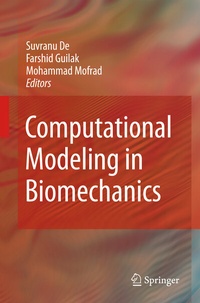
Availability of advanced computational technology has fundamentally altered the investigative paradigm in the field of biomechanics. Armed with sophisticated computational tools, researchers are seeking answers to fundamental questions by exploring complex biomechanical phenomena at the molecular, cellular, tissue and organ levels. The computational armamentarium includes such diverse tools as the ab initio quantum mechanical and molecular dynamics methods at the atomistic scales and the finite element, boundary element, meshfree as well as immersed boundary and lattice-Boltzmann methods at the continuum scales. Multiscale methods that link various scales are also being developed. While most applications require forward analysis, e.g., finding deformations and stresses as a result of loading, others involve determination of constitutive parameters based on tissue imaging and inverse analysis. This book provides a glimpse of the diverse and important roles that modern computational technology is playing in various areas of biomechanics including biofluids and mass transfer, cardiovascular mechanics, musculoskeletal mechanics, soft tissue mechanics, and biomolecular mechanics.
Language
Place of publication
Publishing group
Illustrations
File size
ISBN-13
978-90-481-3575-2 (9789048135752)
DOI
10.1007/978-90-481-3575-2
Schweitzer Classification
Biofluids and Mass Transport.- Immersed Boundary/Continuum Methods.- Computational Modeling of ATP/ADP Concentration at the Vascular Surface.- Development of a Lattice-Boltzmann Method for Multiscale Transport and Absorption with Application to Intestinal Function.- Cardiovasular Biomechanics.- Computational Models of Vascular Mechanics.- Computational Modeling of Vascular Hemodynamics.- Computational Modeling of Coronary Stents.- Computational Modeling of Aortic Heart Valves.- Computational Modeling of Growth and Remodeling in Biological Soft Tissues: Application to Arterial Mechanics.- Musculoskeletal Biomechanics.- Computational Modeling of Trabecular Bone Mechanics.- Computational Modeling of Extravascular Flow in Bone.- Computational Modeling of Cell Mechanics in Articular Cartilage.- Computational Models of Tissue Differentiation.- Soft Tissue Biomechanics.- A Review of the Mathematical and Computational Foundations of Biomechanical Imaging.- Interactive Surgical Simulation Using a Meshfree Computational Method.- Computational Biomechanics of the Human Cornea.- Biomolecular Mechanics and Multiscale Modeling.- Identifying the Reaction Mechanisms of Inteins with QM/MM Multiscale Methods.- Computational Scale Linking in Biological Protein Materials.- How to Measure Biomolecular Forces: A "Tug-of-War" Approach.- Mechanics of Cellular Membranes.