

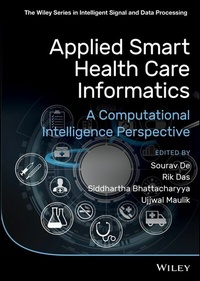
Applied Smart Health Care Informatics
Description

Explores how intelligent systems offer new opportunities for optimizing the acquisition, storage, retrieval, and use of information in healthcare
Applied Smart Health Care Informatics explores how health information technology and intelligent systems can be integrated and deployed to enhance healthcare management. Edited and authored by leading experts in the field, this timely volume introduces modern approaches for managing existing data in the healthcare sector by utilizing artificial intelligence (AI), meta-heuristic algorithms, deep learning, the Internet of Things (IoT), and other smart technologies.
Detailed chapters review advances in areas including machine learning, computer vision, and soft computing techniques, and discuss various applications of healthcare management systems such as medical imaging, electronic medical records (EMR), and drug development assistance. Throughout the text, the authors propose new research directions and highlight the smart technologies that are central to establishing proactive health management, supporting enhanced coordination of care, and improving the overall quality of healthcare services.
* Provides an overview of different deep learning applications for intelligent healthcare informatics management
* Describes novel methodologies and emerging trends in artificial intelligence and computational intelligence and their relevance to health information engineering and management
* Proposes IoT solutions that disseminate essential medical information for intelligent healthcare management
* Discusses mobile-based healthcare management, content-based image retrieval, and computer-aided diagnosis using machine and deep learning techniques
* Examines the use of exploratory data analysis in intelligent healthcare informatics systems
Applied Smart Health Care Informatics: A Computational Intelligence Perspective is an invaluable text for graduate students, postdoctoral researchers, academic lecturers, and industry professionals working in the area of healthcare and intelligent soft computing.
More details
Other editions
Additional editions
Persons
Dr. Sourav De, Associate Professor, Department of Computer Science and Engineering, Cooch Behar Government Engineering College, India.
Dr. Rik Das, Assistant Professor, Department of Information Technology, Xavier Institute of Social Service, India.
Dr. Siddhartha Bhattacharyya, Principal, Rajnagar Mahavidyalaya, India.
Dr. Ujjwal Maulik, Professor, Department of Computer Science and Engineering, Jadavpur University, India.
Content
Preface xiii
About the Editors xix
List of Contributors xxv
1 An Overview of Applied Smart Health Care Informatics in the Context of Computational Intelligence 1 Sourav De and Rik Das
1.1 Introduction 1
1.2 Big Data Analytics in Healthcare 2
1.3 AI in Healthcare 3
1.4 Cloud Computing in Healthcare 4
1.5 IoT in Healthcare 4
1.6 Conclusion 5
References 5
2 A Review on Deep Learning Method for Lung Cancer Stage Classification Using PET-CT 9 Kaushik Pratim Das, Chandra J, and Dr Nachamai M
2.1 Introduction 9
2.1.1 Scope of the Research 10
2.1.2 TNM Staging 11
2.1.2.1 TNM Descriptors for Staging per IASLC Guidelines 11
2.1.2.2 PET-CT Scan in Lung Cancer Imaging 12
2.2 Related Works 12
2.2.1 Artificial Intelligence in Medical Imaging 14
2.2.2 Classification for Medical Imaging 14
2.2.2.1 Deep Learning 15
2.2.2.2 Image Classification Using Deep-learning Techniques 15
2.3 Methods 15
2.3.1 Transfer Learning 15
2.3.2 AlexNet 16
2.3.3 AlexNet Architecture 16
2.3.4 Experimental Setup 17
2.3.4.1 Image Processing 18
2.3.4.2 Data Augmentation 19
2.3.4.3 Training and Validation 19
2.4 Results and Discussion 19
2.4.1 Primary Tumor (T) 19
2.4.2 Metastasis (M) 21
2.4.3 Lymph Node (N) 21
2.4.4 Classification Accuracy of AlexNet 24
2.4.5 Comparative Analysis 25
2.4.6 Limitations 26
2.5 Conclusion 26
References 27
3 Formal Methods for the Security of Medical Devices 31 Srinivas Pinisetty, Nathan Allen, Hammond Pearce, Mark Trew, Manoj Singh Gaur, and Partha Roop
3.1 Introduction 31
3.1.1 Pacemaker Security 33
3.1.2 Overview 34
3.2 Background: Cardiac Pacemakers 34
3.2.1 Pacemakers 35
3.2.1.1 Operation of a DDD Mode Pacemaker 36
3.2.2 The Cardiac System 37
3.2.2.1 Electrograms and Electrocardiograms 38
3.3 State of the Art, Formal Verification Techniques 39
3.3.1 Formal Verification Techniques 40
3.3.1.1 Static Verification Techniques 41
3.3.1.2 Dynamic Verification Techniques 42
3.3.2 Runtime Verification 43
3.3.2.1 A Brief Overview of Some Runtime Verification Frameworks 44
3.3.3 Correcting Execution of a System at Runtime (Runtime Enforcement) 45
3.3.3.1 Runtime Enforcement of Untimed Properties 46
3.3.3.2 Runtime Enforcement Approaches for Timed Properties 46
3.4 Formal Runtime-Based Approaches for Medical Device Security 47
3.4.1 Overview of the Approach 47
3.4.2 Mapping EGM Properties to ECG Properties 48
3.4.3 Security of Pacemakers Using Runtime Verification 49
3.4.3.1 Timed Words, Timed Languages, and Defining Timed Properties 50
3.4.3.2 Runtime Verification Monitor 51
3.4.3.3 Architecture of the Monitoring System 53
3.4.3.4 Implementation of the ECG Processing and RV Monitor Modules 53
3.4.3.5 Summary of Experiments and Results 54
3.4.4 Securing Pacemakers with Runtime Enforcement Hardware 54
3.4.4.1 Preliminaries: Words, Languages, and Defining Properties as DTA 55
3.4.4.2 Runtime Enforcement Monitor 56
3.4.4.3 Verification of the Enforcer Hardware 58
3.4.4.4 How Does the Enforcer Prevent Security Attacks? 58
3.4.4.5 Summary of Experiments and Results 59
3.5 Summary 59
References 60
4 Integrating Two Deep Learning Models to Identify Gene Signatures in Head and Neck Cancer from Multi-Omics Data 67 Suparna Saha, Sumanta Ray, and Sanghamitra Bandyopadhyay
4.1 Introduction 67
4.2 Related Work 68
4.3 Materials and Methods 70
4.3.1 A Brief Introduction of the Capsule Network 70
4.3.2 An Introduction to Autoencoders 71
4.4 Results 72
4.4.1 Data Set Details 72
4.4.1.1 Gene Expression Data (Illumina Hiseq) 72
4.4.1.2 Human Methylation 450K 73
4.4.2 Architecture of Autoencoder Model 73
4.4.3 Architecture of the Proposed Capsule Network Model 74
4.4.4 Validation of Two Deep Learning Models 75
4.4.5 Gene Signatures from Primary Capsules 76
4.5 Discussion 77
Acknowledgments 78
References 79
5 A Review of Computational Learning and IoT Applications to High-Throughput Array-Based Sequencing and Medical Imaging Data in Drug Discovery and Other Health Care Systems 83 Soham Choudhuri, Saurav Mallik, Bhaswar Ghosh, Tapas Si, Tapas Bhadra, Ujjwal Maulik, and Aimin Li
5.1 Introduction 83
5.2 Biological Terms 84
5.3 Single-Cell Sequencing (scRNA-seq) Data 86
5.3.1 Computational Methods for Interpreting scRNA-seq Data 86
5.3.1.1 Visualizing and Clustering Cells 86
5.3.1.2 Inference and Branching Analysis of Cellular Trajectory 86
5.3.1.3 Identifying Highly Variable Genes 86
5.3.1.4 Identifying Marker and Differentially Expressed Genes 90
5.4 Methods of Multi-Omic Data Integration 90
5.4.1 Unsupervised Data Integration Methods 91
5.4.1.1 Matrix Factorization Methods 91
5.4.1.2 Bayesian Methods 91
5.4.1.3 Network-Based Methods 94
5.4.1.4 Multi-Step Analysis and Multiple Kernel Learning 94
5.4.2 Supervised Data Integration 95
5.4.2.1 Network-Based Methods 95
5.4.2.2 Multiple Kernel Learning 95
5.4.2.3 Multi-Step Analysis 95
5.4.3 Semi-Supervised Data Integration 95
5.4.3.1 GeneticInterPred 97
5.5 AI Drug Discovery 97
5.5.1 AI Primary Drug Screening 97
5.5.1.1 Cell Sorting and Classification with Image Analysis 97
5.5.2 AI Secondary Drug Screening 99
5.5.2.1 Physical Properties Predictions 99
5.5.2.2 Predictions of Bio-Activity 99
5.5.2.3 Prediction of Toxicity 99
5.5.3 AI in Drug Design 99
5.5.3.1 Prediction of Target Protein 3D Structures 99
5.5.3.2 Predicting Drug-Protein Interactions 100
5.5.4 Planning Chemical Synthesis with AI 100
5.5.4.1 Retro-Synthesis Pathway Prediction 100
5.5.4.2 Reaction Yield Predictions and Reaction Mechanism Insights 100
5.6 Medical Imaging Data Analysis 100
5.6.1 Analysis: Radio-Mic Quantification 101
5.6.2 Analysis: Bio-Marker Identification 101
5.7 Applying IoT (Internet of Things) to Biomedical Research 102
5.7.1 IoT and IoMT Applications for Healthcare and Well-Being 102
5.7.1.1 Wireless Medical Devices 102
5.8 Conclusions 102
Acknowledgments 102
References 102
6 Association Rule Mining Based on Ethnic Groups and Classification using Super Learning 111 Md Faisal Kabir and Simone A. Ludwig
6.1 Introduction 111
6.2 Background 112
6.3 Motivation and Contribution 114
6.4 Data Analysis 115
6.4.1 Data Description 115
6.4.2 Data Preprocessing 115
6.4.3 Further Preprocessing for Ethnic Group Rule Discovery with Multiple Consequences 115
6.4.3.1 Transaction-Like Database for Association Rule 115
6.4.4 Classification Data Set 116
6.5 Methodology 117
6.5.1 Association Rule Mining 117
6.5.2 Super Learning 118
6.5.2.1 Ensemble or Super Learner Set-Up 118
6.6 Experiments and Results 119
6.6.1 Rules Discovery 120
6.6.1.1 Rules of Breast Cancer Patients Based on Ethnic Groups 120
6.6.1.2 Interpreting Rules 120
6.6.2 Evaluation Criteria of Classification Model 121
6.6.2.1 Super Learner Results 124
6.6.3 Discussion 125
6.7 Conclusion and Future Work 126
References 127
7 Neuro-Rough Hybridization for Recognition of Virus Particles from TEM Images 131 Debamita Kumar and Pradipta Maji
7.1 Introduction 131
7.2 Existing Approaches for Virus Particle Classification 132
7.3 Proposed Algorithm 134
7.3.1 Extraction of Local Textural Features 135
7.3.2 Selection of Class-Pair Relevant Features 135
7.3.3 Extraction of Discriminating Features 138
7.3.4 Classification 139
7.4 Experimental Results and Discussion 140
7.4.1 Experimental Setup 140
7.4.2 Methods Compared 140
7.4.3 Database Considered 141
7.4.4 Effectiveness of Proposed Approach 141
7.4.5 Comparative Performance Analysis 143
7.4.5.1 Comparison with Deep Architectures 144
7.4.5.2 Comparison with Existing Approaches 145
7.5 Conclusion 146
References 147
8 Neural Network Optimizers for Brain Tumor Image Detection 151 T. Kalaiselvi and S.T. Padmapriya
8.1 Introduction 151
8.2 Related Works 152
8.3 Background 153
8.3.1 Types of Neural Networks 153
8.3.2 Tunable Elements of Neural Networks 154
8.3.2.1 Basic Parameters 154
8.3.2.2 Hyperparameters 154
8.3.2.3 Regularization Techniques 155
8.3.2.4 Neural Network Optimizers 156
8.4 Case Study - Brain Tumor Detection 157
8.4.1 Methodology 157
8.4.2 Data Sets and Metrics 157
8.4.3 Results and Discussion 159
8.5 Conclusion 162
References 162
9 Abnormal Slice Classification from MRI Volumes using the Bilateral Symmetry of Human Head Scans 165 N. Kalaichelvi, T. Kalaiselvi, and K. Somasundaram
9.1 Introduction 165
9.1.1 MRIs of the Human Brain 165
9.1.2 Normal and Abnormal Slices 166
9.1.3 Background 167
9.1.3.1 Decision Tree Classifiers 167
9.1.3.2 K-Nearest Neighbours (KNN) Classifiers 168
9.1.3.3 Support Vector Machine (SVM) 168
9.1.3.4 Naive Bayes 169
9.1.3.5 Artificial Neural Network (ANN) 169
9.1.3.6 Back-Propagation Neural Network (BPN) 170
9.1.3.7 Random Forest Classifiers 170
9.2 Literature Review 171
9.3 Methodology 172
9.3.1 Preprocessing 173
9.3.2 Feature Extraction 174
9.3.3 Feature Selection 175
9.3.4 Classification 177
9.3.5 Cross-Validation 177
9.3.6 Training Validation and Testing 178
9.4 Materials and Metrics 179
9.4.1 Confusion Matrix 179
9.5 Results and Discussion 180
9.6 Conclusion 182
References 183
10 Conclusion 187 Siddhartha Bhattacharyya
References 188
Index 191
Preface
Health care informatics, aka medical informatics, refers to the application of information engineering and management to the field of health care, which covers the management and use of patient health care information. By means of a multidisciplinary approach, it uses health information technology to improve health care by migrating to newer and higher quality opportunities. The United States National Library of Medicine (NLM) defines health informatics as "an interdisciplinary study of the design, development, adoption and application of IT-based innovations in health care services delivery, management and planning." Essentially, it affects the optimization of the acquisition, storage, retrieval, and use of information in health and bio-medicine. Intelligent health care informatics augments the purview of existing health care amenities by adapting intelligent technologies to information engineering. Intelligent analysis of the information therein enhances the overall management as far as resource use is concerned.
With the advent of Big Data analysis, intelligent health care informatics has called for the efficient and effective use of healthcare data and the diagnosis thereof. During the next few years, there must be a sea change in the approaches to health care management. Smart pills may come to the foray as Bio-MEMS drug delivery systems or intelligent drug delivery systems. Wearable medical devices could be attached to the patient's body to keep in touch with physicians for real time monitoring. Nano-bots might be used to collect specimens or look for early signs of disease. Content management could also become more intelligent and intricate.
Patients with chronic disease live for decades through modern medication, surgery, close supervision, and other modern treatments. Soon, patients can manage their healthcare conditions. They can also take necessary measures to prevent escalation and deterioration of their health. Curative and reactive healthcare approaches will switch to preventive and proactive health management. Someday, people will be able to control their own lifestyle and future health, and that will bring a revolution.
In this journey, artificial intelligence or computational intelligence will play a pivotal role in improving the quality of services of healthcare systems, and that will bring a better coordination of care. Intelligent health will be the potential solution to keep up with the escalating increase of healthcare cost. Huge amounts of existing data in the healthcare sector can be managed with the tools of intelligent systems like machine learning, meta-heuristic algorithms, big data, deep learning, internet-of-things (IoT), etc. It will be easy and faster for the surgeons, hospital, medical, and emergency staff to find the probable treatment or drug for rare diseases. Innovations of the intelligent systems in the healthcare arena may help society by reducing the cost and time of medical treatments; concrete solutions for a particular disease can be easily found.
This volume, comprising eight well-versed chapters (apart from the introductory and concluding chapters), will entice the readers to engage with major emerging trends in technology that are supporting the advancement of the medical image analysis with the help of artificial intelligence and computational intelligence. This volume elaborates on the fundamentals and advancement of conventional approaches in the field of health care management. The scope of this volume also opens an arena in which researchers propose new approaches and review state-of-the-art machine learning, computer vision, and soft computing techniques as well as relate the same to their applications in medical image analysis. The motivation of this volume is not only to put forward new ideas in technology innovation but also to analyse the effect of the same in the current context of medical healthcare.
Health care informatics, also referred as biomedical or medical informatics, is an application of information engineering and management in the medical field. Health care fundamentally covers the management and employment of patient health care information. It is a multidisciplinary field that studies and pursues the effectual use of biomedical data, knowledge for scientific inquiry, information, problem solving, and decision making. Chapter 1 provides an overview of a few smart healthcare practices.
Lung cancer is a fatal form of cancer around the world. The American Lung Association reports an estimated five-year survival rate in lung cancer patients of 18.6%. The statistics affirm that the survival rate is significantly lower than in other forms of cancer. However, the five-year survival rate stands at 56% when the disease is diagnosed in a localized stage. Some cases do not appear to have symptoms until cancer has reached a later stage. The primary cause of concern is the low percent of early lung cancer detection, which is merely 16%. Lung cancer staging is a procedure associated with the disease's successful prognosis and formulation of an efficient treatment plan. Medical imaging techniques play a vital role in the diagnosis of lung cancer. Accuracy is crucial in treatment as lung cancer is influenced by internal and external factors or mistaken for other pulmonary diseases. The staging of cancer allows for the significant elimination of treatment failures. However, cancer staging is a dynamic process that involves multiple and frequent modifications to recognize organ features. The staging process requires a more robust and automated technique that can provide sensitive and unique input to improve the overall treatment process. Thus, artificial intelligence sub-branches such as deep learning play a vital role in initiating such improvements for an efficient cancer staging process. Chapter 2 uncovers the potential of a deep learning model combined with positron emission tomography-computed tomography (PET-CT) to develop a technique that identifies tumors with more precision. The proposed research will assist doctors in accurately measuring the tumor and identifying the stage of lung cancer that will determine further treatment and an exact prognosis.
Cyber-physical attacks (CP attacks), originating in cyber space but damaging physical infrastructure, are a significant recent research focus. Such attacks have affected many cyber-physical systems (CPSs) such as smart grids, intelligent transportation systems, and medical devices. In Chapter 3, the authors consider techniques for the detection and mitigation of CP attacks on medical devices. It is obvious that such attacks have immense safety implications. This work is based on formal methods, a class of mathematically founded techniques for the specification and verification of safety-critical systems. The interaction of a cardiac pacemaker is discussed. Subsequently, the authors provide an overview of formal methods with particular emphasis on run-time based approaches, which are ideal for the design of security monitors. Two recently developed approaches are illustrated that assist in the detection of attacks as well as mitigation.
Integrating heterogeneous omics data profiles, such as genomics, epigenomics, and transcriptomics may provide new insights into discovering some unknown genomic mechanisms involved in cancer and other related complex diseases. The alterations of multiple omics, including gene mutations, epigenetic changes, and gene regulation modifications, are responsible for tumor initiation and cancer progression. Most of the multi-view data profiles contain a huge number of genes, many of which are redundant, noisy, and irrelevant. It is computationally impractical to use these massive data sets without any filtering of the feature set. High performance (deep) machine learning strategies now appear to be an essential tool to learn the hidden structure from the data. In Chapter 4, the authors have proposed a two-step approach to systematically identify gene signatures from multi-omics head and neck cancer data. First, an autoencoder-based strategy is used to integrate gene expression and methylation data. From this, the features are extracted by using the information from the bottleneck layer of the autoencoder. The features represent the combined representation of the two omics profiles. Next, the features that stem from the integrated data are applied to learn another deep learning model called the capsule network. The coupling coefficients between primary and output capsules are also analysed to interpret the features captured by the capsules.
The last two decades have witnessed unprecedented advancements in computational techniques and artificial intelligence. These new developments are going to greatly impact biological data analysis for the health care system. In fact, the availability of large scale high-throughput biomedical data sets offers a fertile ground for application of these AI-based techniques in to extract valuable information that can be harnessed in the diagnosis and treatment of various diseases. Chapter 5 provides a comprehensive review of computational tools and online resources for high throughput analyses of biomedical data. It focuses on single-cell RNA sequencing data, multi-omics data integration, drug design with AI, medical imaging data analysis, and IoT. After providing a brief overview of the fundamental biological terms, a variety of research problems are described in the health care system and how various high throughput data can help solving...
