

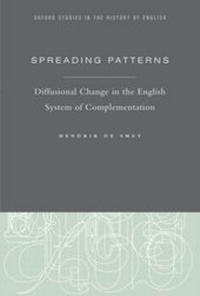
Spreading Patterns
Diffusional Change in the English System of Complementation
1st Edition
Published on 16. November 2012
294 pages
978-0-19-981276-9 (ISBN)
Description

Examines the emergence and spread of three types of complements from the Middle English period to the present day
More details
Other editions
Additional editions
Book
01/2013
Oxford University Press Inc
€155.20
Shipment within 15-20 days
Content
- Cover
- Contents
- Acknowlegments
- List of abbreviations
- 1. Introduction
- 1. Diffusional change
- 2. Gerunds, for . to- infinitives, and participles
- 3. Research questions and suggested answers
- 4. Limitations
- 5. Overview of the following chapters
- 2. The Corpus Data
- 1. Middle English
- 2. Early Modern English
- 3. Late Modern English
- 4. Present-Day English
- 5. General methodology
- 3. Complementation
- 1. One form, one meaning
- 2. A multiplicity of factors
- 3. Constructions
- 3.1. Construction grammar
- 3.2. Construction grammar and complementation
- 4. Conclusions
- 4. Diffusional Change
- 1. General perspectives on diffusion
- 1.1. A brief typology of diffusional changes
- 1.2. Diffusion as actualization
- 1.3. Lexical diffusion in sound change and elsewhere
- 1.4. Drift and the sanctioning principle
- 2. Diffusional change in the system of complementation
- 2.1. Blocking
- 2.2. Analogy
- 2.3. The contingency of history
- 3. Conclusions
- 5. For . to-infinitives
- 1. The rise of for . to-infinitives
- 1.1. Current usage
- 1.2. Historical diffusion
- 2. For . to-infinitives as verb complements
- 2.1. Current usage
- 2.2. Historical diffusion
- 3. Conclusions
- 6. Integrated Participle Clauses
- 1. Synchronic characterization
- 1.1. Disjuncts, adjuncts, and IPCs
- 1.2. IPCs in Present-Day English
- 2. Historical development of IPCs
- 2.1. Diffusion
- 2.2. Mechanisms of change
- 2.3. Diachronic overview and comparison with other diffusional
- 3. Conclusions
- 7. Gerund Complements
- 1. Background
- 1.1. History of the gerund
- 1.2. Gerund complements in Present-Day English
- 1.3. Relevant factors in the history of gerund complements
- 2. An outline of the diffusion of gerund complements
- 3. Detailed investigation of the diffusion of gerund complements: Innovations and their causes
- 3.1. Stage I: Narrow paradigmatic analogy
- 3.2. Stage II: Semantic analogy
- 3.3. Stage III: Indirect paradigmatic analogy
- 3.4. Stage IV: Broad paradigmatic analogy
- 3.5. A bird's-eye view of the diffusion of gerund complements
- 4. Conclusions
- 8. Conclusions
- References
- Index
- A
- B
- C
- D
- E
- F
- G
- H
- I
- J
- K
- L
- M
- N
- O
- P
- Q
- R
- S
- T
- U
- V
- W
- Y
- Z
