

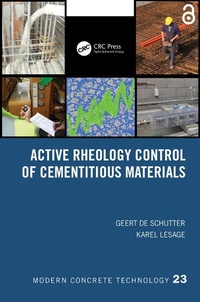
Active Rheology Control of Cementitious Materials
1st Edition
Published on 18. January 2023
298 pages
978-1-000-84414-6 (ISBN)
Description

This book reports on cutting-edge research within the new field of active rheology control of cementitious materials, presenting new ideas developed within the ERC Advanced Grant Project, SmartCast (hosted at Ghent University), which extend the possibilities of admixtures and additions beyond current options.
The research presented here develops a new method of actively controlling the rheology of fresh concrete during casting operations by incorporating specially designed responsive components. This results in real-time changes to the rheological behaviour of the cementitious material, allowing the user to intervene actively after the cementitious material has left the mixing phase. This newly gained agility contributes to increased processing speed and placement reliability in the case of traditional casting methods and can also facilitate advanced 3D concrete printing. The different routes followed to achieve this Active Rheology Control are explained within.
The book suits researchers and innovative practitioners and is the first comprehensive text to present these new findings.
The Open Access version of this book, available at http://www.taylorfrancis.com, has been made available under a Creative Commons Attribution-Non Commercial-No Derivatives 4.0 license.
The research presented here develops a new method of actively controlling the rheology of fresh concrete during casting operations by incorporating specially designed responsive components. This results in real-time changes to the rheological behaviour of the cementitious material, allowing the user to intervene actively after the cementitious material has left the mixing phase. This newly gained agility contributes to increased processing speed and placement reliability in the case of traditional casting methods and can also facilitate advanced 3D concrete printing. The different routes followed to achieve this Active Rheology Control are explained within.
The book suits researchers and innovative practitioners and is the first comprehensive text to present these new findings.
The Open Access version of this book, available at http://www.taylorfrancis.com, has been made available under a Creative Commons Attribution-Non Commercial-No Derivatives 4.0 license.
More details
Series
Edition
1. Auflage
Language
English
Place of publication
London
United Kingdom
Publishing group
Taylor & Francis Ltd
Target group
College/higher education
Professional and scholarly
Illustrations
12 Tables, black and white; 121 Line drawings, color; 23 Line drawings, black and white; 33 Halftones, color; 154 Illustrations, color; 23 Illustrations, black and white
File size
50,02 MB
ISBN-13
978-1-000-84414-6 (9781000844146)
Copyright in bibliographic data and cover images is held by Nielsen Book Services Limited or by the publishers or by their respective licensors: all rights reserved.
Schweitzer Classification
Other editions
Additional editions
Geert De Schutter | Karel Lesage
Active Rheology Control of Cementitious Materials
Book
10/2024
1st Edition
CRC Press
€134.50
Shipment within 10-20 days
Geert De Schutter | Karel Lesage
Active Rheology Control of Cementitious Materials
Book
01/2023
1st Edition
CRC Press
€229.00
Shipment within 10-20 days
Persons
Geert De Schutter is full professor of Concrete Technology and head of the Department of Structural Engineering and Building Materials, Faculty of Engineering and Architecture, Ghent University, Belgium.
Karel Lesage is a part-time professor at the Magnel-Vandepitte Laboratory at the Department of Structural Engineering and Building Materials at Ghent University in Belgium.
Content
1. Introduction to Active Rheology Control of Cementitious Materials. 2. Rheology and Processing of Cementitious Materials. 3. Active Rheology Control of Cementitious Materials with Responsive Mineral Particles. 4. Active Rheology Control of Cementitious Materials with Responsive Polymers. 5. Application of Active Rheology Control to Pumping of Cementitious Materials. 6. Application of Active Rheology Control to Concrete Formwork Leakage. 7. Application of Active Rheology Control to 3D Printing of Cementitious Materials. 8. Numerical Simulation of Active Rheology Control of Cementitious Materials. 9. Overview and Remaining Challenges of Active Rheology Control of Cementitious Materials.
