
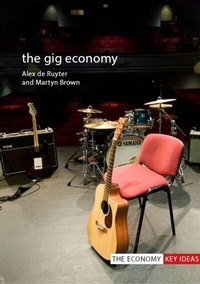
The Gig Economy
Description
Alles über E-Books | Antworten auf Fragen rund um E-Books, Kopierschutz und Dateiformate finden Sie in unserem Info- & Hilfebereich.
The "gig economy" is a relatively recent term coined to describe a range of working arrangements that have previously been denoted as precarious, flexible and contingent. These may include casual workers, temporary agency workers, those on zero-hours contracts and dependent contractors.
This books seeks to get behind the contemporary buzz surrounding the term and provide some theoretical and empirical analysis of the gig work phenomenon. The book seeks to assess more critically some of the rhetorical claims made about gig work and to provide a balanced appraisal of the ramifications for individuals, employers and the economy and society in general of an increasingly insecure workforce. The regulatory framework, in particular, is examined and is shown to have lagged behind crucial developments in the gig economy, with many labour laws still historically rooted to the notion that a worker has to be an employee to be covered by employment rights.
The authors show that in many respects there is nothing new about the gig economy and that its growth in recent years was in some sense predictable. Perhaps its real significance, they argue, is its potential as a business model to "gig-ize" other business operations far beyond relatively low-skilled work. When combined with automation and digitalization, the gig economy presents us with an opportunity to re-evalute our understanding of the nature of work.
All prices
More details
Other editions
Additional editions

Persons
Alex De Ruyter is Professor and Director of the Centre for Brexit Studies at Birmingham City University.
Martyn Brown is Senior Lecturer in Organisation Studies at Birmingham City University and Visiting Lecturer at the University of Birmingham.
Content
1. Introduction2. Theorizing the gig economy3. Working in the gig economy: international trends4. Regulation and the lived experience of the gig economy5. Conclusions and implications: from wage economy to gig economy to automated ("no") economy

System requirements
File format: ePUB
Copy protection: Adobe-DRM (Digital Rights Management)
System requirements:
- Computer (Windows; MacOS X; Linux): Install the free reader Adobe Digital Editions prior to download (see eBook Help).
- Tablet/smartphone (Android; iOS): Install the free app Adobe Digital Editions or the app PocketBook before downloading (see eBook Help).
- E-reader: Bookeen, Kobo, Pocketbook, Sony, Tolino and many more (not Kindle).
The file format ePub works well for novels and non-fiction books – i.e., „flowing” text without complex layout. On an e-reader or smartphone, line and page breaks automatically adjust to fit the small displays.
This eBook uses Adobe-DRM, a „hard” copy protection. If the necessary requirements are not met, unfortunately you will not be able to open the eBook. You will therefore need to prepare your reading hardware before downloading.
Please note: We strongly recommend that you authorise using your personal Adobe ID after installation of any reading software.
For more information, see our ebook Help page.
File format: ePUB
Copy protection: Watermark-DRM (Digital Rights Management)
System requirements:
- Computer (Windows; MacOS X; Linux): Use a reading software that can process the file format ePUB: e.g., Adobe Digital Editions or FBReader – both free (see eBook Help).
- Tablet/Smartphone (Android; iOS): Before downloading, install the free app Adobe Digital Editions (see eBook Help).
- E-reader: Bookeen, Kobo, Pocketbook, Sony, Tolino and many more (not Kindle).
The file format ePUB works well for novels and non-fiction books – i.e., „flowing” text without complex layout. On an e-reader or smartphone, line and page breaks automatically adjust to fit the small displays.
This eBook uses Watermark-DRM, a „soft” copy protection. This means that there are no technical restrictions to prevent illegal distribution. However, there is a personalised watermark embedded in the eBook that can be used to identify the purchaser of the eBook in the event of misuse and to provide evidence for legal purposes.
For more information, see our eBook Help page.