

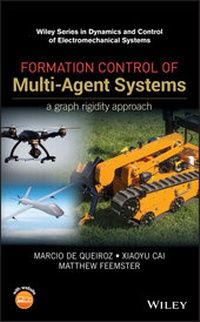
Formation Control of Multi-Agent Systems
Description

This book is the first to provide a comprehensive and unified treatment of the subject of graph rigidity-based formation control of multi-agent systems. Such systems are relevant to a variety of emerging engineering applications, including unmanned robotic vehicles and mobile sensor networks. Graph theory, and rigid graphs in particular, provides a natural tool for describing the multi-agent formation shape as well as the inter-agent sensing, communication, and control topology.
Beginning with an introduction to rigid graph theory, the contents of the book are organized by the agent dynamic model (single integrator, double integrator, and mechanical dynamics) and by the type of formation problem (formation acquisition, formation manoeuvring, and target interception). The book presents the material in ascending level of difficulty and in a self-contained manner; thus, facilitating reader understanding.
Key features:
* Uses the concept of graph rigidity as the basis for describing the multi-agent formation geometry and solving formation control problems.
* Considers different agent models and formation control problems.
* Control designs throughout the book progressively build upon each other.
* Provides a primer on rigid graph theory.
* Combines theory, computer simulations, and experimental results.
Formation Control of Multi-Agent Systems: A Graph Rigidity Approach is targeted at researchers and graduate students in the areas of control systems and robotics. Prerequisite knowledge includes linear algebra, matrix theory, control systems, and nonlinear systems.
More details
Other editions
Additional editions
Persons
MARCIO DE QUEIROZ joined the Department of Mechanical and Industrial Engineering at Louisiana State University in 2000, where he is currently the Roy O. Martin Lumber Company Professor. In 2005, he was the recipient of the NSF CAREER award. He has served as an Associate Editor for the IEEE Transactions on Automatic Control, the IEEE/ASME Transactions on Mechatronics, the ASME Journal of Dynamic Systems, Measurement, and Control, and the IEEE Transactions on Systems, Man, and Cybernetics - Part B. His research interests include nonlinear control, multi-agent systems, robotics, active magnetic and mechanical bearings, and biological/biomedical system modelling and control.
XIAOYU CAI joined the job search group in LinkedIn in 2018, where he is currently a software engineer. He received the 2013 Outstanding Research Assistant Award from the Department of Mechanical and Industrial Engineering at LSU for his doctoral research on formation control of multi-agent systems. His research interests include computer vision, reinforcement learning, nonlinear control theory and applications, multi-agent systems, robotics, process control, control of high-precision servo systems.
MATTHEW FEEMSTER joined the Weapons, Robotics, and Controls Engineering Department of the U.S. Naval Academy in Annapolis, MD, in 2002 and where he is currently an Associate Professor. His research interests are in the utilization of nonlinear control theory to promote mission capabilities in such fielded applications as autonomous air, ground, and marine vehicles.
Content
Preface xi
About the Companion Website xiii
1 Introduction 1
1.1 Motivation 1
1.2 Notation 6
1.3 Graph Theory 7
1.3.1 Graph 7
1.3.2 Framework 9
1.3.3 Rigid Graphs 11
1.3.4 Infinitesimal Rigidity 14
1.3.5 Minimal Rigidity 19
1.3.6 Framework Ambiguities 20
1.3.7 Global Rigidity 22
1.4 Formation Control Problems 23
1.5 Book Overview and Organization 26
1.6 Notes and References 28
2 Single-Integrator Model 29
2.1 Formation Acquisition 29
2.2 Formation Maneuvering 35
2.3 Flocking 36
2.3.1 Constant Flocking Velocity 37
2.3.2 Time-Varying Flocking Velocity 38
2.4 Target Interception with Unknown Target Velocity 40
2.5 Dynamic Formation Acquisition 43
2.6 Simulation Results 45
2.6.1 Formation Acquisition 45
2.6.2 Formation Maneuvering 51
2.6.3 Flocking 56
2.6.4 Target Interception 58
2.6.5 Dynamic Formation 63
2.7 Notes and References 66
3 Double-Integrator Model 71
3.1 Cross-Edge Energy 73
3.2 Formation Acquisition 75
3.3 Formation Maneuvering 76
3.4 Target Interception with Unknown Target Acceleration 77
3.5 Dynamic Formation Acquisition 79
3.6 Simulation Results 80
3.6.1 Formation Acquisition 80
3.6.2 Dynamic Formation Acquisition with Maneuvering 81
3.6.3 Target Interception 84
3.7 Notes and References 87
4 Robotic Vehicle Model 91
4.1 Model Description 91
4.2 Nonholonomic Kinematics 93
4.2.1 Control Design 93
4.2.2 Simulation Results 94
4.3 Holonomic Dynamics 97
4.3.1 Model-Based Control 98
4.3.2 Adaptive Control 100
4.3.3 Simulation Results 102
4.4 Notes and References 102
5 Experimentation 107
5.1 Experimental Platform 107
5.2 Vehicle Equations of Motion 110
5.3 Low-Level Control Design 113
5.4 Experimental Results 114
5.4.1 Single Integrator: Formation Acquisition 117
5.4.2 Single Integrator: Formation Maneuvering 118
5.4.3 Single Integrator: Target Interception 126
5.4.4 Single Integrator: Dynamic Formation 128
5.4.5 Double Integrator: Formation Acquisition 132
5.4.6 Double Integrator: Formation Maneuvering 136
5.4.7 Double Integrator: Target Interception 138
5.4.8 Double Integrator: Dynamic Formation 148
5.4.9 Holonomic Dynamics: Formation Acquisition 149
5.4.10 Summary 153
A Matrix Theory and Linear Algebra 159
B Functions and Signals 163
C Systems Theory 165
C.1 Linear Systems 165
C.2 Nonlinear Systems 166
C.3 Lyapunov Stability 168
C.4 Input-to-State Stability 170
C.5 Nonsmooth Systems 171
C.6 Integrator Backstepping 172
D Dynamic Model Terms 175
References 177
Index 187
