

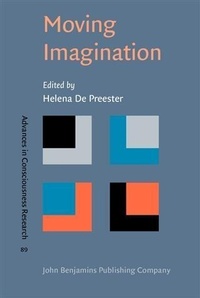
Moving Imagination
Explorations of gesture and inner movement
1st Edition
Published on 29. May 2013
VI, 320 pages
978-90-272-7200-3 (ISBN)
Description

This volume brings together contributions by philosophers, art historians and artists who discuss, interpret and analyse the moving and gesturing body in the arts. Broadly inspired by phenomenology, and taking into account insights from cognitive science, the contribution of the motor body in watching a film, attending a dance or theatre performance, looking at paintings or drawings, and listening to music is explored from a diversity of perspectives. This volume is intended for both the specialist and non-specialist in the fields of art, philosophy and cognitive science, and testifies to the burgeoning interest for the moving and gesturing body, not only in the creation but also in the perception of works of art. Imagination is tied to our capacity to silently resonate with the way a work of art has been or is created.
More details
Other editions
Additional editions
Book
05/2013
John Benjamins Publishing Co
€104.94
Shipment within 10-15 days
Person
Content
- Moving Imagination
- Editiorial page
- Title page
- LCC data
- Table of Contents
- Moving imagination
- Headlines and themes
- Helena De Preester
- Bodily resonance
- Maxine Sheets-Johnstone
- The moving body
- Gestural recreation of the world in drama
- Xavier Escribano
- Movement, gesture, and meaning
- A sensorimotor model for audience engagement with dance
- William P. Seeley
- Achieved spontaneity and spectator's performative experience - The motor dimension of the actor-spectator relationship
- Gabriele Sofia
- The digital body in contemporary American cinema
- Marco Luceri
- Embodiment
- Technologies and musics
- Don Ihde
- Is gesture knowledge? A philosophical approach to the epistemology of musical gestures
- Michael Funk & Mark Coeckelbergh
- Sound in film as an inner movement
- Towards embodied listening strategies
- Martine Huvenne
- Body English
- kinaesthetic empathy, dance and the art of Len Lye
- Michael Parmenter
- The Somatic in Kinetic Sculpture
- from Len Lye to an Introverted Kinetic Sculpture (via Donna Haraway's cyborg)
- Laura Woodward
- Edgar Degas
- Modelling movement. Being in the body
- Boris Wiseman & Jonathan Cole
- Time lines
- The temporal dimension of marking
- David Rosand
- Styles of observation and embodiment
- Using drawing to understand Robert Morris' Untitled 3 L-Beams (1965)
- Francis Halsall
- Cy Twombly
- Gesture, space, and writing
- Rajiv Kaushik
- Pre-motor and motor activities in early medieval handwriting
- Jan W. M. van Zwieten & Koos Jaap van Zwieten
- The neurophenomenology of gesture in the art of Henri Michaux
- Jay Hetrick
- Moving without moving
- A first-person experiential phenomenological approach
- Natalie Depraz
- The "I cannot, but it can" of aesthetic perception
- Erica Harris
- Moving imagination
- Bodily resonance
- 1. Introduction
- 2. Thinking in movement
- 3. The imaginative consciousness of movement
- 4. The question of mirror neurons
- 5. Experiential evidence
- References
- The moving body
- 1. Introduction
- 2. Lecoq and the poetry of motion in space
- 3. Mimism and the dynamics of meaning
- 4. Conclusion
- References
- Movement, gesture, and meaning
- 1. What is the neuroscience of art?
- 2. What is the neuroscience of dance?
- 3. Art, aesthetics, and the neuroscience of dance
- 4. Art, meaning, and perception
- 5. A sensorimotor model for audience engagement with dance
- 6. The neuroscience of dance redux
- References
- Achieved spontaneity and spectator's performative experience - The motor dimension of the actor-spectator relationship
- 1. Introduction
- 2. Entailed hypotheses and methodologies
- 3. Determination of the matter of the research
- 4. The actor's creative processes and their motor dimension
- 5. Motor dynamics of believable action
- 6. Surprising and suspending. The actor's advantage over the spectator
- 7. Foreseeing and anticipating: The spectator's advantage over the actor
- 8. Fragmentation and reconstruction: The artificial body schema
- 9. The spectator's performative experience
- 10. Conclusions
- References
- The digital body in contemporary American cinema
- 1. A transformation of American cinema
- 2. Second lives
- 3. Body, space, movement, image, acting: From theatre to cinema
- 4. To be or not to be: The actor, the spectator and the representation of movement
- 5. Conclusion
- References
- Embodiment
- 1. Introduction
- 2. Where we are
- 3. Where does music come from?
- 4. A phenomenology of instrumentation
- 5. Instrumental trajectories
- 6. Digital postmodernism
- 7. Phenomenological reprise
- 8. Musics from beyond hearing
- References
- Is gesture knowledge? A philosophical approach to the epistemology of musical gestures
- 1. Introduction
- 2. Musical gestures as subject of musical scholarship and interdisciplinary research
- 3. Classical epistemology and propositional knowledge
- 4. Implicit knowledge
- 5. Gesture as critique on cartesian dualism
- 6. Musical gestures and technologies
- 7. Musical gestures as cultural and social phenomenon
- 8. Conclusion
- References
- Sound in film as an inner movement
- 1. Introduction
- 2. Existing views on sound in film
- 3. Sound in film as an audible dynamic energetic movement
- 4. Different listening strategies provoking different kinds of imagination
- 5. Different kinds of images evoked by listening to sound
- 6. Listening to a recorded sound as such
- 7. Conclusion
- References
- Body English
- 1. Len Lye and the dance
- 2. Kinaesthetic empathy in dance
- 3. Len Lye's conception of aesthetic reception
- 4. The double movement of introjection and projection
- References
- The Somatic in Kinetic Sculpture
- 1. Introduction
- 2. The art that moves
- 3. The introverted kinetic sculpture
- 4. From Len Lye to an introverted kinetic sculpture
- 5. In conclusion
- References
- Edgar Degas
- 1. Freezing movement
- 2. Moments of being
- 3. Degas's development
- 4. Lessons from loss
- proprioception and embodiment
- 5. Microscopies
- References
- Time lines
- References
- Styles of observation and embodiment
- 1. Introduction
- 2. Why I can't draw
- 3. Untitled, 3 L-Beams
- 4. Drawing is a process
- 5. Drawing and medium specificity
- 6. Showing drawing as an embodied practice: Morris' Blind Time Drawings
- 7. Conclusion
- References
- Cy Twombly
- 1. Rendering the process of mark-making
- 2. The body's intentions opened up into mark-making
- 3. Language/writing - gesture
- References
- Pre-motor and motor activities in early medieval handwriting
- 1. Introduction - The beatrice saga
- 2. Movements of inner organs
- 3. Handwriting and neuromotor characteristics
- 4. Traces of emotion in a handwritten text
- 5. Historical backgrounds of the text
- 6. Preliminary screening of character size and regularity
- 7. Further analyses, results and conclusions
- 8. Discussion
- 9. Summary
- Acknowledgements
- References
- The neurophenomenology of gesture in the art of Henri Michaux
- 1. From gesture to the pre-gestural
- 2. Michaux's mescaline work as a model for neurophenomenology
- References
- Moving without moving
- 1. Introduction
- 2. Two contrasted third person philosophical phenomenological accounts of the "inner move"
- 2.1 Merleau-Ponty: From kinaesthesia to motricity
- 2.2 Michel Henry and self-affection
- 3. Two first person experiential phenomenological accounts of "inner move"
- 3.1 From a third person to a first person approach
- 3.2 Meditation: Moving while remaining still
- 3.3 Manual fasciatherapy: Experiencing one's inner moves thanks to the other's hand-move
- 4. Crossing third person and first person phenomenological approaches: Emergent subcategories of "inner move"
- References
- The "I cannot, but it can" of aesthetic perception
- 1. The personal body and its spatiality: I can
- 2. Introducing the I cannot
- 3. The I cannot and non-representational art
- 4. A non-dualistic solution to the problem of the I cannot
- References
- Name index
- Subject index
