

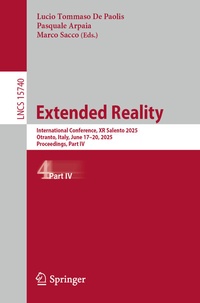
Extended Reality
Description

The seven-volume set LNCS 15737-15743 constitutes the proceedings of the International Conference on Extended Reality, XR Salento 2025, held in Otranto, Italy, during June 17-20, 2025.
The 128 full papers presented together with 65 short papers were carefully reviewed and selected from 256 submissions. The papers are organized in the following topical sections:
Part I: Virtual Reality; and Augmented and Mixed Reality.
Part II: Extended Reality; and Extended Reality in Education and Learning.
Part III: Transforming Research and Clinical Interventions with eXtended Reality.
Part IV: Digital Twin: Innovative Approaches in Industry and Healthcare.
Part V: eXtended Reality for Cultural Tourism Sustainability; eXtended Reality for Art, Design, and Entertainment; and Digital Twin and Smart Virtual Representations for Cultural Heritage.
Part VI: Crafting Virtual Humans for Immersive XR Applications; and eXtended Reality for Serious Games.
Part VII: Artificial Intelligence; Integrating Artificial Intelligence, Computer Vision and Augmented Reality in Computer-Assisted Intervention; and AI-Driven XR Innovations in Healthcare: Bridging Technology and Ethics.
More details
Other editions
Additional editions
Content
.- Digital Twin: Innovative Approaches in Industry and Healthcare .
.- Digital Twins in Industry and Healthcare: Policy Regulation and Future Prospects in Europe.
.- XR-PALS: XR Tool for Loco Positioning System.
.- Digital Twin-Driven Radar for Human Monitoring Optimization.
.- Leveraging Personal Digital Twins to Evaluate and Mitigate Cybersickness within the Industrial Metaverse.
.- Application of Machine Learning and Digital Twin in Smart Farming for Space and Extreme.
.- "Virtual PVD": A Virtual Reality approach to explore PVD Magnetron.
.- A Multisensory eXtended Reality Platform for Food Spoilage Detection.
.- XCOP: an integrated solution for emergency management during incidents in critical infrastructures.
.- 3D vision-based Digital Twin of a Mobile Robot for objects management in Intralogistics scenarios.
.- AI-Driven Virtual Construction Management: Enhancing Digital Building Interactions through Intelligent Assistants and Extended Reality.
.- Enhancing Industrial Workflows with Augmented Reality (AR): AR -Based Poka Yoke Visual Assembly Guide for a Smart Learning Factory.
.- Digitalizing Bank Branches with a New Multichannel Standard to Address Office Closures in Europe.
.- From Virtual to Reality: A Structured Framework to Training Humanoid Robots for Elderly Care Using Learning from Demonstration.
.- Designing a Digital Twin of the Gut Microbiome: A Data-Driven Approach for Personalized Medicine.
.- Extended Reality within Construction Digital Twin for Operators Safety Management: A Case Study.
.- The Role of Data in Digital Twins: Value Creation and Interoperability.
.- Pro-adaptive Cognitive Assistive Technology: Concept and Application in Reading Support for ADHD.
.- NFTs opportunities and challenges for cultural heritage sector: insights from a multiple case study perspective.
