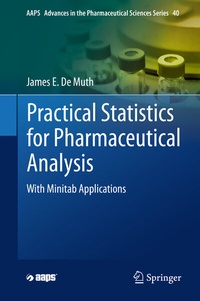
Practical Statistics for Pharmaceutical Analysis
Description

This is an introductory statistics book designed to provide scientists with practical information needed to apply the most common statistical tests to laboratory research data. The book is designed to be practical and applicable, so only minimal information is devoted to theory or equations. Emphasis is placed on the underlying principles for effective data analysis and survey the statistical tests. It is of special value for scientists who have access to Minitab software. Examples are provides for all the statistical tests and explanation of the interpretation of these results presented with Minitab (similar to results for any common software package).
The book is specifically designed to contribute to the AAPS series on advances in the pharmaceutical sciences. It benefits professional scientists or graduate students who have not had a formal statistics class, who had bad experiences in such classes, or who just fear/don't understand statistics .
Chapter 1 focuses on terminology and essential elements of statistical testing. Statistics is often complicated by synonyms and this chapter established the terms used in the book and how rudiments interact to create statistical tests. Chapter 2 discussed descriptive statistics that are used to organize and summarize sample results. Chapter 3 discussed basic assumptions of probability, characteristics of a normal distribution, alternative approaches for non-normal distributions and introduces the topic of making inferences about a larger population based on a small sample from that population. Chapter 4 discussed hypothesis testing where computer output is interpreted and decisions are made regarding statistical significance. This chapter also deasl with the determination of appropriate sample sizes.The next three chapters focus on tests that make decisions about a population base on a small subset of information. Chapter 5 looks at statistical tests that evaluate where a significant difference exists. In Chapter 6 the tests try to determine the extent and importance of relationships. In contrast to fifth chapter, Chapter 7 presents tests that evaluate the equivalence, not the difference between levels being tested. The last chapter deals with potential outlier or aberrant values and how to statistically determine if they should be removed from the sample data.
Each statistical test presented includes an example problem with the resultant software output and how to interpret the results. Minimal time is spent on the mathematical calculations or theory. For those interested in the associated equations, supplemental figures are presented for each test with respective formulas. In addition, Appendix D presents the equations and proof for every output result for the various examples.
Examples and results from the appropriate statistical results are displayed using Minitab 18 Ò . In addition to the results, the required steps to analyze data using Minitab are presented with the examples for those having access to this software. Numerous other software packages are available, including based data analysis with Excel.
More details
Other editions
Additional editions