

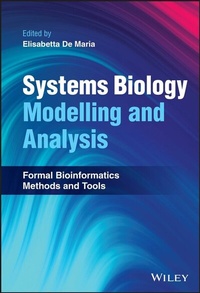
Systems Biology Modelling and Analysis
Description

Describes important modelling and computational methods for systems biology research to enable practitioners to select and use the most suitable technique
Systems Biology Modelling and Analysis provides an overview of state-of-the-art techniques and introduces related tools and practices to formalize models and automate reasoning for systems biology. The authors present and compare the main formal methods used in systems biology for modelling biological networks, including discussion of their advantages, drawbacks, and main applications.
Each chapter includes an intuitive presentation of the specific formalism, a brief history of the formalism and of its applications in systems biology, a formal description of the formalism and its variants, at least one realistic case study, some applications of formal techniques to validate and make deep analysis of models encoded with the formalism, and a discussion on the kind of biological systems for which the formalism is suited, along with concrete ideas on its possible evolution.
Edited by a highly qualified expert with significant experience in the field, some of the methods and techniques covered in Systems Biology Modelling and Analysis include:
* Petri nets, an important tool for studying different aspects of biological systems, ranging from simple signaling pathways to metabolic networks and beyond
* Pathway Logic, a formal, rule-based system and interactive viewer for developing executable models of cellular processes
* Boolean networks, a mathematical model which has been widely used for decades in the context of biological regulation networks
* Answer Set Programming (ASP), which has proven to be a strong logic programming paradigm to deal with the inherent complexity of biological models
For systems biologists, biochemists, bioinformaticians, molecular biologists, pharmacologists, and computer scientists, Systems Biology Modelling and Analysis is a comprehensive all-in-one resource to understand and harness the field's current models and techniques while also preparing for their potential developments in coming years with the help of the author's expert insight.
More details
Other editions
Additional editions

Person
Elisabetta De Maria, PhD, is an Associate Professor at the Université Côte d'Azur. From 2011-13, she was Coordinator of the International Research Master Program "Computational Biology and Biomedicine" at the University of Nice-Sophia Antipolis. Dr. De Maria has expertise in bioinformatics and computational systems biology and served as program chair of the conferences BIOINFORMATICS 2019, CSBio 2019 (International Conference on Computational Systems-Biology and Bioinformatics), and BIOINFORMATICS 2020.
Content
List of Contributors xv
Preface xix
Acknowledgments xxv
1 Introduction 1
Elisabetta De Maria
1.1 Why Writing Models 2
1.2 Modelling and Validating Biological Systems: Three Steps 4
1.2.1 Modelling Biological Systems 4
1.2.2 Specifying Biological Systems 7
1.2.3 Validating Biological Systems 8
References 9
2 Petri Nets for Systems Biology Modelling and Analysis 15
Fei Liu, Hiroshi Matsuno, and Monika Heiner
2.1 Introduction 15
2.2 A Running Example 16
2.3 Petri Nets 16
2.3.1 Modelling 17
2.3.2 Analysis 18
2.3.3 Applications 20
2.4 Extended Petri Nets 20
2.5 Stochastic Petri Nets 20
2.5.1 Modelling 21
2.5.2 Stochastic Simulation 21
2.5.3 CSL Model Checking 22
2.5.4 Applications 23
2.6 Continuous Petri Nets 24
2.6.1 Modelling 24
2.6.2 Deterministic Simulation 24
2.6.3 Simulative Model Checking 25
2.6.4 Applications 27
2.7 Fuzzy Stochastic Petri Nets 27
2.7.1 Modelling 27
2.7.2 Fuzzy Stochastic Simulation 27
2.7.3 Applications 29
2.8 Fuzzy Continuous Petri Nets 29
2.8.1 Modelling 29
2.8.2 Fuzzy Deterministic Simulation 29
2.8.3 Applications 30
2.9 Conclusions 30
Acknowledgment 31
References 31
3 Process Algebras in Systems Biology 35
Paolo Milazzo
3.1 Introduction 35
3.2 Process Algebras in Concurrency Theory 36
3.2.1 p-Calculus 38
3.3 Analogies between Biology and Concurrent Systems 42
3.3.1 Elements of Cell Biology 43
3.3.2 Cell Pathways 44
3.3.3 "Molecules as Processes" Abstraction 48
3.4 Process Algebras for Qualitative Modelling 51
3.4.1 Formal Analysis Techniques 51
3.5 Process Algebras for Quantitative Modelling 53
3.5.1 Chemical Kinetics 54
3.5.2 Stochastic Process Algebras 59
3.6 Conclusions 61
Acknowledgments 61
References 62
4 The Rule-Based Model Approach: A Kappa Model for Hepatic Stellate Cells Activation by TGFB1 69
Matthieu Bouguéon, Pierre Boutillier, Jérôme Feret, Octave Hazard, and Nathalie Théret
4.1 Introduction 69
4.1.1 Modelling Systems of Biochemical Interactions 69
4.1.2 Modelling Languages 70
4.1.3 Kappa 71
4.1.3.1 Overview 71
4.1.3.2 Semantics of Kappa 72
4.1.3.3 Kappa Ecosystem 73
4.1.3.4 Main Limitations 75
4.1.4 Modelling a Population of Hepatic Stellate Cells 76
4.1.5 Outline 78
4.2 Kappa 78
4.2.1 Site Graphs 78
4.2.1.1 Signature 79
4.2.1.2 Complexes 81
4.2.1.3 Patterns 82
4.2.1.4 Embeddings Between Patterns 84
4.2.2 Site Graph Rewriting 86
4.2.2.1 Interaction Rules 86
4.2.2.2 Reactions Induced by an Interaction Rule 87
4.2.2.3 Underlying Reaction Network 88
4.3 Model of Activation of Stellate Cells 91
4.3.1 Overview of Model 91
4.3.2 Some Elements of Biochemistry 91
4.3.2.1 Reaction Half-Time 92
4.3.2.2 Conversion 93
4.3.2.3 Production Equilibrium 93
4.3.2.4 Erlang Distributions 94
4.3.3 Interaction Rules 94
4.3.3.1 Behavior of TGFB1 Proteins 95
4.3.3.2 Renewal of Quiescent HSCs 96
4.3.3.3 Activation and Differentiation 97
4.3.3.4 Proliferation of Activated Hepatic Stellate Cells 99
4.3.3.5 Proliferation of Myofibroblasts 100
4.3.3.6 Apoptosis and Senescence of Myofibroblasts 101
4.3.3.7 Inactivation of Myofibroblasts 102
4.3.3.8 Behavior of Inactivated Hepatic Stellate Cells 102
4.3.3.9 Proliferation of Reactivated Cells 105
4.3.3.10 Degradation of Reactivated MFB 106
4.3.3.11 Behavior of Receptors 106
4.3.4 Parameters 108
4.4 Results 109
4.4.1 Static Analysis 109
4.4.2 Underlying Reaction Network 111
4.4.3 Simulations 111
4.5 Conclusion 113
References 116
5 Pathway Logic: Curation and Analysis of Experiment-Based Signaling Response Networks 127
Merrill Knapp, Keith Laderoute, and Carolyn Talcott
5.1 Introduction 127
5.2 Pathway Logic Overview 130
5.3 PL Representation System 133
5.3.1 Rewriting Logic and Maude 133
5.3.2 Pathway Logic Language 134
5.3.3 Petri Net Representation 140
5.3.4 Computing with Petri Nets 142
5.4 Pathway Logic Assistant 144
5.5 Datum Curation and Model Development 150
5.5.1 Datum Curation 150
5.5.2 Model Development - Inferring Rules 153
5.6 STM8 155
5.6.1 LPS Response Network 156
5.6.2 Combining Network Analyses 158
5.6.3 Death Map: A Review Model 159
5.6.3.1 Review Map as a Summary of the State of the Art 163
5.7 Conclusion 163
Acknowledgments 164
Appendix 5.A: Summary of STM8 Networks 164
References 168
6 Boolean Networks and Their Dynamics: The Impact of Updates 173
Loïc Paulevé and Sylvain Sené
6.1 Introduction 173
6.1.1 General Notations and Definitions 178
6.2 Boolean Network Framework 179
6.2.1 On the Simplicity of Boolean Networks 179
6.2.2 Boolean Network Specification 181
6.2.3 Boolean Network Dynamics 183
6.2.3.1 Updates 183
6.2.3.2 Transitions and Trajectories 185
6.2.3.3 Updating Mode and Transition Graph 186
6.2.3.4 Deterministic Updating Modes 187
6.2.3.5 Non-deterministic Updating Modes 199
6.3 Biological Case Studies 208
6.3.1 Floral Morphogenesis of A. thaliana 209
6.3.2 Cell Cycle 211
6.3.3 Vegetal and Animal Zeitgebers 212
6.3.4 Abstraction of Quantitative Models 214
6.4 Fundamental Knowledge 216
6.4.1 Structural Properties and Attractors 216
6.4.1.1 Fixed Points Stability 216
6.4.1.2 Feedback Cycles as Engines of Dynamical Complexity 217
6.4.1.3 About Signed Feedback Cycles 219
6.4.2 Computational Complexity 224
6.4.2.1 Existence of a Fixed Point 225
6.4.2.2 Reachability Between Configurations 227
6.4.2.3 Limit Configurations 229
6.5 Conclusion 232
6.5.1 Updating Modes and Time 232
6.5.1.1 Modelling Durations 233
6.5.1.2 Modelling Precedence 234
6.5.1.3 Modelling Causality 234
6.5.2 Toward an Updating Mode Hierarchy 235
6.5.2.1 Software Tools 235
6.5.3 Opening on Intrinsic Simulations 236
Acknowledgments 238
References 238
7 Analyzing Long-Term Dynamics of Biological Networks With Answer Set Programming 251
Emna Ben Abdallah, Maxime Folschette, and Morgan Magnin
7.1 Introduction 251
7.2 State of the Art 253
7.2.1 Qualitative Modelling of Biological Systems 253
7.2.2 Identifying Attractors: A Major Challenge 255
7.2.3 Answer Set Programming for Systems Biology 257
7.2.4 Enumerating Attractors of a Biological Model Using Answer Set Programming 258
7.3 Basic Notions of Answer Set Programming 259
7.3.1 Syntax and Rules 259
7.3.2 Predicates 261
7.3.3 Scripting 263
7.4 Dynamic Modelling Using Asynchronous Automata Networks 264
7.4.1 Motivation: Using ASP to Analyze the Dynamics 264
7.4.2 Definition of Asynchronous Automata Networks 264
7.4.3 Semantics and Dynamics of Asynchronous Automata Networks 267
7.4.4 Stable States and Attractors in Asynchronous Automata Networks 271
7.5 Encoding into Answer Set Programming 275
7.5.1 Translating Asynchronous Automata Networks into Answer Set Programs 276
7.5.2 Stable-State Enumeration 278
7.5.3 Attractors 280
7.5.3.1 Cycle Enumeration 281
7.5.3.2 Attractor Enumeration 285
7.5.3.3 Python Scripting 288
7.6 Case Studies 290
7.6.1 Toy Example 290
7.6.2 Bacteriophage Lambda 292
7.6.3 Benchmarks on Models Coming from the Literature 293
7.7 Conclusion 297
Acknowledgments 299
References 299
8 Hybrid Automata in Systems Biology 305
Alberto Casagrande, Raffaella Gentilini, Carla Piazza, and Alberto Policriti
8.1 Introduction 305
8.2 Basics 307
8.2.1 Languages and Theories 308
8.3 Events 313
8.3.1 Temporal Logics 316
8.3.2 Model Checking 318
8.4 Events and Time 318
8.4.1 Hybrid Automata and Gene Regulatory Networks 319
8.4.2 Expressibility and Decidability Issues 323
8.5 Events, Time, and Uncertainty 327
8.6 Conclusions 331
Acknowledgement 332
References 332
9 Kalle Parvinen: Ordinary Differential Equations 339
Kalle Parvinen
9.1 Introduction 339
9.2 Analyzing and Solving Ordinary Differential Equations 340
9.2.1 Solving Ordinary Differential Equations Analytically 340
9.2.2 Equilibria and Their Stability 341
9.2.3 Solving Differential Equations Numerically 344
9.3 Mechanistic Derivation of Ordinary Differential Equations 345
9.3.1 Elementary Unimolecular Reaction (EUR) 346
9.3.2 Elementary Bimolecular Reaction (EBR) 347
9.3.3 Elementary Bimolecular Reaction of Two Identical Molecules 348
9.3.4 Reaction Networks 348
9.4 Classical Lotka-Volterra Differential Equation 350
9.4.1 Model Formation and History 350
9.4.2 Phase-Plane Analysis and Equilibria 351
9.4.3 Constant of Motion 352
9.4.4 Average Population Densities 353
9.4.5 Effect of Fishing on the Population Densities 353
9.5 Model of Killer T-Cell and Cancer Cell Dynamics 354
9.5.1 Model Definition 354
9.5.1.1 Resource Dynamics 354
9.5.1.2 Cancer Cell Dynamics 355
9.5.1.3 Killer T-Cell Dynamics 356
9.5.2 Model DynamicsWithout Treatment 357
9.5.3 Treatment Effects 358
9.6 Conclusion 359
Acknowledgments 359
References 360
10 Network Modelling Methods for Precision Medicine 363
Elio Nushi, Victor-Bogdan Popescu, Jose-Angel Sanchez Martin, Sergiu Ivanov, Eugen Czeizler, and Ion Petre
10.1 Introduction 363
10.2 Network Modelling Methods 364
10.2.1 Network Centrality Methods 364
10.2.1.1 Running Example 366
10.2.1.2 Degree Centralities 366
10.2.1.3 Proximity Centralities 368
10.2.1.4 Path Centrality: Betweenness 373
10.2.1.5 Spectral Centralities 377
10.2.2 System Controllability Methods 383
10.2.2.1 Network Controllability 384
10.2.2.2 Minimum Dominating Sets 387
10.2.3 Software 388
10.2.3.1 NetworkX 389
10.2.3.2 Cytoscape 390
10.2.3.3 NetControl4BioMed 390
10.3 Applications of Network Modelling in Personalized Medicine 392
10.3.1 Constructing Personalized Disease Networks 392
10.3.2 Analysis Methods 393
10.3.3 Results 398
10.3.3.1 Structural Controllability Analysis 398
10.3.3.2 Minimum Dominating Set Analysis 406
10.4 Conclusion 412
References 413
11 Conclusion 425
Elisabetta De Maria
Index 427
Preface
Overview
Formal methods of computer science are nowadays unavoidable to model, study, and make advanced analysis of biological systems. Several formalisms are suitable to model biological systems: Petri nets, Boolean networks, reaction rules, process algebras, ordinary differential equations, timed and hybrid automata, etc. Once a biological system is encoded using one of these formalisms, some formal techniques such as model checking can be used to specify some expected properties of the system and verify whether they hold or not in the model at issue. This greatly helps in validating/refuting biological hypothesis, making predictions, and associating parameters with biological phenomena. In this book, we present and compare the main formalisms used in systems biology to model biological networks.
Organization and Features
Some crucial formal approaches used in systems biology are presented in detail, along with their advantages/drawbacks and main applications. Apart from Chapters 1 (Introduction) and 11 (Conclusion), each chapter of the book is devoted to one of the key formalisms used in the literature to model (and verify) biological systems. Each chapter includes an intuitive presentation of the targeted formalism, a brief history of the formalism and of its applications in systems biology, a formal description of the formalism and its variants, at least one realistic case study, some applications of formal techniques to validate and make deep analysis of models encoded with the formalism, and a discussion on the kind of biological systems for which the formalism is suited, along with concrete ideas on its possible evolutions. Some chapters also include the description of a tool implementing the formalism and a sort of how-to practical guide about using the tool. The networks chosen to serve as case studies span the field of systems biology in a large way (they range from gene regulatory networks to prey-predatory networks).
Some chapters are quite technical and make use of an involved formal notation, but other chapters are more focused on the biological applications (in particular, the last chapter before the conclusion opens to some applications in precision medicine). For each chapter, the notation has been carefully chosen so that it looks the most natural and suited one to represent the formalism at issue. Please note that the authors of some chapters are the ones who first introduced the corresponding formalisms and/or tools in the literature. Also, note that all the chapters are thought to be self-contained: the reader will find in each chapter all the elements that are useful to understand and learn, without having to read other works. Some chapters contain references to other chapters to make comparisons, but there are no strong dependencies among chapters, and the reader can decide to read chapters in a different order than the one chosen in this book.
Some approaches appeared some decades ago, others are quite recent, but all of them are presented from a current and groundbreaking point of view. We describe how each formalism answers today needs in systems biology, which makes a real contribution to the scientific community.
The book is organized as follows.
Chapter 1 focuses on the necessity of using formal methods in the domain of systems biology. It introduces the main formal approaches to the modelling of biological systems and the steps to follow to improve and validate the obtained models.
Chapter 2 is devoted to Petri nets, an important tool for studying different aspects of biological systems, ranging from simple signaling pathways, metabolic networks, and genetic networks to tissues and organs. To explore such varieties of biological systems, many variants of Petri nets have been proposed. This chapter explains how these different net classes are applied to modelling and analysis of these different types of biological systems with the illustrative example of the yeast polarization model describing the pheromone-induced G-protein cycle in Saccharomyces cerevisiae.
Chapter 3 describes the development of Process Algebras and related analysis methods in the context of systems biology. It presents concepts that are at the basis of the application of this class of formalisms in the biological context, providing the relevant notions of biochemistry and cell biology, and discussing both qualitative and quantitative approaches. The -calculus is chosen as representative Process Algebra in order to give modelling examples and clarify the relationships of the process algebraic approach with the traditional modelling of cell pathways as sets of chemical reactions.
Chapter 4 describes Kappa, a site graph rewriting language. As a realistic case study, a population of hepatic stellate cells under the effect of the tgfb protein is modeled. Kappa offers a rule-centric approach, inspired from chemistry, where interaction rules locally modify the state of a system that is defined as a graph of components, connected or not. In this case study, the components are occurrences of hepatic stellate cells in different states and occurrences of the protein tgfb. The protein tgfb induces different behaviors of hepatic stellate cells, thereby contributing either to tissue repair or to fibrosis. Better understanding the overall behavior of the mechanisms that are involved in these processes is a key issue to identify markers and therapeutic targets likely to promote the resolution of fibrosis at the expense of its progression.
Chapter 5 introduces Pathway Logic, a formal, rule-based system and interactive viewer for developing executable models of cellular processes. It includes a curated evidence knowledge base and a diverse collection of models for evaluation by users. This chapter presents the Pathway Logic representation system and the algorithms used by the Pathway Logic Assistant. The overview discusses rewriting logic and its implementation in the Maude system, the formal basis of Pathway Logic. Other sections in the chapter present the STM8 collection of signaling response networks, provide overviews of the curation process and how rules are inferred, and illustrate the utility of Pathway Logic using the Lps (lipopolysaccharide) and Cell Death models.
Chapter 6 presents Boolean networks, a mathematical model that has been widely used since decades in the context of biological regulation networks qualitative modelling. They consist in collections of entities, each having two possible local states (1 - active and 0 - inactive), which interact with each other over discrete time. The simplicity of their setting together with their high abstraction level are especially convenient to focus on foundations of information transmission in genetic regulation, and on mathematical explanation and prediction of phenomenological observations. This chapter aims to present the Boolean modelling framework by developing its theoretical bases and emphasizing its usefulness for capturing biological regulation phenomena. But it goes beyond that by covering their ability to capture the information transmission and its consequences depending on the ways the entities update their local state over time.
Chapter 7 deals with Answer Set Programming (ASP), which has proven to be a strong logic programming paradigm to deal with the inherent complexity of the biological models, allowing us to quickly investigate a wide range of configurations. ASP can efficiently enumerate a large number of answer sets, as well as easily filter the results thanks to constraints based on certain properties. This chapter first motivates the merits of ASP in biological studies based on the state of the art. Then, it introduces the basic concepts about ASP and its use in systems biology. After having given an overview of the different issues that can be tackled using ASP, it then focuses on one problem that is of critical importance: model-checking with ASP, and more specifically, the identification of attractors. The merits of this study are illustrated using case studies.
Chapter 8 focuses on hybrid automata, a formalism introduced and developed with the aim of integrating discrete and continuous ingredients in a single simulation tool. This chapter introduces some key logic formalisms for systems biology; illustrates some automata-based simulation tools; discusses the role, potential, and complexity of the notion of time in automata; and presents several methodologies to integrate discrete and continuous, time-oriented, formal instruments for systems biology. Several realistic case studies are treated.
Chapter 10 discusses several network modelling methods and their applicability to precision medicine. The chapter introduces a certain number of network centrality methods (degree centrality, closeness centrality, eccentricity centrality, betweenness centrality, and eigenvector-based prestige) and two systems controllability methods (minimum dominating sets and network structural controllability). Their applicability to precision medicine on three multiple myeloma patient disease networks is demonstrated. Each network consists of protein-protein interactions built around a specific patient's mutated genes, around the targets of the drugs used in the standard of care in multiple myeloma, and around multiple myeloma-specific essential genes. For each network, it is demonstrated how the discussed network methods can be used to identify personalized, targeted drug combinations uniquely suited to that patient.
Finally, Chapter 11...
