

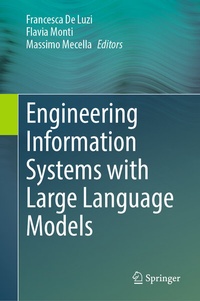
Engineering Information Systems with Large Language Models
Description

The rapid advancement of generative AI and specifically large language models (LLMs) is transforming the landscape of information systems (IS) engineering by offering unprecedented opportunities to support their design, development, maintenance, and reengineering.
Starting with an overview of LLM history and foundational concepts, the book delves into practical applications for IS design and development, including prompt engineering, retrieval augmented generation, and multi-agent systems. Through a detailed survey and step-by-step programming guidance, readers will learn how to implement tools leveraging LLMs effectively. The book also addresses ethical considerations, offering insights and guidelines for responsible AI integration.
The book provides a comprehensive and unified framework for exploiting LLMs in IS engineering. It aims at both researchers in information systems or LLM development and advanced professionals who would like to know how to potentially apply LLMs in the development or maintenance of information systems.
More details
Other editions
Additional editions
Persons
Francesca De Luzi is a postdoctoral researcher at Sapienza Università di Roma, Italy. Her recent research projects have focused on the use of AI techniques, particularly through the development of writing assistants to support operators in performing complex linguistic tasks by leveraging large language models.
Flavia Monti is a postdoctoral researcher at Sapienza Università di Roma, Italy. Her research interests focus on Industry 4.0 and smart manufacturing, particularly the integration of computer vision, machine learning, and generative artificial intelligence to improve production quality, reduce costs, increase machinery uptime, and achieve zero-defect manufacturing.
Massimo Mecella is a full professor at Sapienza Università di Roma, where he conducts research in the fields of information systems engineering, service-oriented computing, mobile and pervasive computing, process management, data and process mining, big data analytics and human-computer interaction, focusing on smart applications, environments and communities. He was the General Chair of CAiSE 2019, BPM 2021, and ICSOC 2023. In 2025, he is the PC co-Chair of IEEE CAI 2025. He is currently a member of the Steering Committees of the conference series CAiSE, ICSOC and SummerSOC.
Content
1. Introduction.- 2. History of LLMs.- 3. LLMs for Dummies.- 4. A Reference Framework for Information Systems.- 5. Exploring Large Language Models in Information Systems: A Survey.- 6. Programming LLMs.- 7. Retrieval Augmented Generation.- 8. Large Language Model Agents.- 9. Applications of Large Language Models in Information Systems.- 10. Ethics and Governance of Large Language Models.- 11. Epilogue.
