

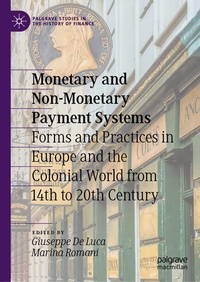
Monetary and Non-Monetary Payment Systems
Description

This book analyses how preindustrial monetary practices functioned, focusing on Europe and some selected colonial areas between the fourteenth and twentieth centuries. It explores the major contexts in which monetary circulation operated and provides a fascinating range of case studies from experts in the field.
A primary context for this edited volume is the raft of challenges associated with cash in the preindustrial period. Covering issues such as the slow circulation of coins, the risk of debasement, clipping, the first proto currency, and parallel circulation of several currencies, the book offers insight into the ways in which people dealt with the need to transact and exchange payment. It focuses on cash-equivalent goods and commodity currencies as well as traditional cash methods, looking at the physical development of money as well as exploring the structure of payment methods and financial systems in past societies.
Grounded in extensive archival research, chapters use a range of sources such as notary deeds, wills, rent-books, expenditure accounts and public ledgers to analyse the dynamics of circulation and transaction in various settings, from the city to the countryside, regional to international contexts, and different European states. This will be highly valuable reading for scholars interested in financial and monetary history.
More details
Other editions
Additional editions
Persons
Giuseppe De Luca is Professor of Economic History at the University of Milan, Italy. He has published several books and many journal articles in the areas of financial and economic history, infrastructure financing, and economic growth. He is also Honorary Professor at The Bartlett School of Sustainable Construction, University College London, and Associate to the National Research Council of Italy, Institute of History of Mediterranean Europe (ISEM).
Marina Romani is Associate Professor of Economic History at the University of Genoa, Italy. She specializes in financial history during the early modern period, Jewish history, and historical demography.
Content
1. Introduction, Giuseppe De Luca and Marina Romani.- 2. The Gold Florin of Florence in the Age of Dante: Beyond the Macroeconomic Paradigm, Stefano Locatelli (University of Milan).- 3. Microcredit and Monetary Circulation in the 14th Century, Luciano Maffi (University of Parma) and Antonio Olivieri (University of Turin).- 4. Luxury goods and their esteem: Lombardy, 15th century, Maria Nadia Covini (University of Milan).- 5. Neither pledge nor cash: The role of money-equivalent goods in the Renaissance Venetian credit market, Rachele Scuro (University of Venice).- 6. The Fiduciary Value of Money and the Rationalization of the European Violence, Giacomo Todeschini (University of Trieste).- 7. A Virtual Currency Before the Virtual Currencies: The Exchange Fairs' International Money in Renaissance Europe, Tommaso Brollo and Giuseppe De Luca (University of Milan).- 8. It Is a Misfortune That We Describe Money by a Noun . Monetary Practices in the Ancient Regime between History and Economics (15th-17th Centuries), Marina Romani (University of Genoa).- 9. TBD, D'Maris Coffman, University College London.- 10. Money of account and Money of exchange: The role of silk cocoons at the origin of Italian capitalism (18th-19th Centuries), Lorenzo Avellino (University of Geneve).- 11. A Restricted sovereignty. Colonial currencies and the Maria Theresa Empress's thaler in Eritrea and Ethiopia, Gian Luca Podestà (University of Parma).- 12. Monetary plurality and Empire: Some Theoretical thoughts on French Pondicherry after the Seven Years War, Juliette Françoise (Université de Genève, Université Paris 1 Panthéon-Sorbonne).
