

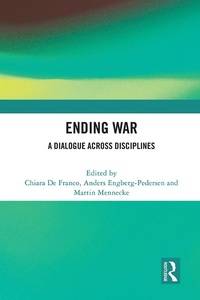
Ending War
A Dialogue across Disciplines
1st Edition
Published on 29. November 2021
146 pages
978-1-000-50679-2 (ISBN)
Description

Ending War: A Dialogue across Disciplines examines how wars end from a multidisciplinary perspective and includes enquiries into the politics of war, the laws of war, and the military and intellectual history of war.
In recent years, the changes in the character of contemporary warfare have created uncertainties across different disciplines about how to identify and conceptualise the end of war. A whole constellation of questions arises from such uncertainties: How do philosophers define ethical responsibilities in bello and post bellum if the boundary between war and peace is ever so blurred? How do strategists define their objectives if the teleology of action becomes uncertain? How do historians bracket the known endings of war and delve into the arguments that preceded them? Which answers can international law provide for the ending of wars - and which challenges remain or have recently arisen?
This volume addresses these questions and enables both an understanding of how 'the end' as a concept informs the understanding of war in international relations, in international law, and in history, as well as a reconsideration of the nature of scientific method in the field of war studies as such.
The chapters in this book were originally published as a special issue of The Journal of Strategic Studies.
In recent years, the changes in the character of contemporary warfare have created uncertainties across different disciplines about how to identify and conceptualise the end of war. A whole constellation of questions arises from such uncertainties: How do philosophers define ethical responsibilities in bello and post bellum if the boundary between war and peace is ever so blurred? How do strategists define their objectives if the teleology of action becomes uncertain? How do historians bracket the known endings of war and delve into the arguments that preceded them? Which answers can international law provide for the ending of wars - and which challenges remain or have recently arisen?
This volume addresses these questions and enables both an understanding of how 'the end' as a concept informs the understanding of war in international relations, in international law, and in history, as well as a reconsideration of the nature of scientific method in the field of war studies as such.
The chapters in this book were originally published as a special issue of The Journal of Strategic Studies.
More details
Edition
1. Auflage
Language
English
Place of publication
London
United Kingdom
Publishing group
Taylor & Francis Ltd
Target group
College/higher education
Product notice
Reflowable
ISBN-13
978-1-000-50679-2 (9781000506792)
Copyright in bibliographic data and cover images is held by Nielsen Book Services Limited or by the publishers or by their respective licensors: all rights reserved.
Schweitzer Classification
Other editions
Additional editions
Chiara De Franco | Anders Engberg-Pedersen | Martin Mennecke
Ending War
A Dialogue across Disciplines
Book
09/2023
1st Edition
Routledge
€64.60
Shipment within 10-20 days
Chiara De Franco | Anders Engberg-Pedersen | Martin Mennecke
Ending War
A Dialogue across Disciplines
Book
11/2021
1st Edition
Routledge
€205.70
Shipment within 10-20 days
Persons
Chiara De Franco is Associate Professor of International Relations and Co-Director of the Center for War Studies at the University of Southern Denmark. Her research focuses on conflict warning, protection of civilians, and language in international practices. She won the 2021 ISA Best Book Award with Warning about War: Conflict, Persuasion and Foreign Policy (2019).
Anders Engberg-Pedersen is Professor of Comparative Literature in the Department for the Study of Culture at the University of Southern Denmark. His research focuses on the relations between war, aesthetics, and the history of knowledge. He is, among other works, the author of Empire of Chance. The Napoleonic Wars and the Disorder of Things (2015).
Martin Mennecke is Associate Professor of International Law at the University of Southern Denmark. His research focuses on atrocity prevention, the United Nations, and transitional justice. Among his recent books is Implementing the Responsibility to Protect: A Future Agenda (2020).
Anders Engberg-Pedersen is Professor of Comparative Literature in the Department for the Study of Culture at the University of Southern Denmark. His research focuses on the relations between war, aesthetics, and the history of knowledge. He is, among other works, the author of Empire of Chance. The Napoleonic Wars and the Disorder of Things (2015).
Martin Mennecke is Associate Professor of International Law at the University of Southern Denmark. His research focuses on atrocity prevention, the United Nations, and transitional justice. Among his recent books is Implementing the Responsibility to Protect: A Future Agenda (2020).
Content
Foreword Introduction: How do wars end? A multidisciplinary enquiry 1. Nobody wins: The victory taboo in just war theory 2. How do wars end? A strategic perspective 3. In pursuit of accountability during and after war 4. The Joint Chiefs of Staff, the atom bomb, the American military mind and the end of the Second World War 5. Slow failure: Understanding America's quagmire in Afghanistan
