

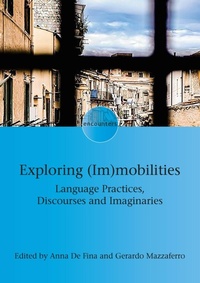
Exploring (Im)mobilities
Language Practices, Discourses and Imaginaries
Published on 23. November 2021
296 pages
978-1-78892-531-0 (ISBN)
Description

The impact of mobility and superdiversity in recent sociolinguistic research is well-established, yet very few studies deal with issues related to immobility. The chapters in this book focus on the sociolinguistic investigation of the dynamics between mobility and immobility as experienced by migrants, asylum seekers and members of minority or exploited groups. Central to the book is an exploration of how mobilities are affected by and in turn affect power relations and of the kinds of resources used by people to deal with (im)mobility processes. The book brings to light a new critical sociolinguistic imagination that is responsive to 21st century processes of (im)mobilities as socially, discursively and emotionally constructed and negotiated.
Reviews / Votes
This is an extremely timely book that reminds us of some of the neglected aspects of the new mobility paradigm in sociolinguistic research. It covers research contexts that have not been previously explored. Its conceptual and methodological innovations ensure the book's lasting impact on theory, research design, policy and practice. * Li Wei, University College London, UK * This book treats the notion of (im)mobilization in a competent and nuanced manner. It considers at least four competing but complementary perspectives: (1) language resources and repertoires, (2) language practices and technologies, (3) control, mobility and resistance, and (4) subjectivity, identity and agency, drawing from examples in different regions of the globe. This is a welcome and timely addition to the expanding scholarship on the topic. * Sinfree Makoni, Pennsylvania State University, USA and Laikipia University, Kenya * Among the large animals, humans stand out for their propensity to migrate, their social stratification, and their complex symbolic communication. The authors of this volume explore the intersection of mobilities, inequalities, and discourses in a powerful set of contemporary case studies from around the world. * Ingrid Piller, Macquarie University, Australia * Exploring (Im)mobilities is certainly an interesting read for those who want to know more about the role of language in contexts of (im)mobilization and processes of (im)mobility. It is written in a style that is accessible to undergraduate and more senior scholars as well as to the informed reader with an interest in language-on-the-move. -- Noel B. Salazar, KU Leuven, Belgium * Journal of Sociolinguistics, 2022 * Speaking from my own collaboration (Holsapple 2022) with Multilingual Matters, I can affirm that Exploring (Im)mobilities: Language Practices, Discourses and Imaginaries is no exception to their commitment to publishing critically-engaged scholarship that hinges on challenging and shaking up, rather than assuming and reifying normative patterns of analysis. Addressing the widespread fallacy of considering mobility primarily through a positivist lens, the volume's eleven sociolinguistic case studies bring to the forefront agentive meaning-making practices through which (im)mobility is reconfigured, as experienced by asylum-seekers, migrants, and other minoritized mobile groups. * Christiana Decheva, University of Tartu, Estonia, Tertium Linguistic Journal 8 (1) (2023) *More details
Series
Language
English
Place of publication
Bristol
United Kingdom
Target group
College/higher education
Product notice
Reflowable
Dimensions
Height: 210 mm
Width: 149 mm
ISBN-13
978-1-78892-531-0 (9781788925310)
Copyright in bibliographic data and cover images is held by Nielsen Book Services Limited or by the publishers or by their respective licensors: all rights reserved.
Schweitzer Classification
Other editions
Additional editions
Anna De Fina | Gerardo Mazzaferro
Exploring (Im)mobilities
Language Practices, Discourses and Imaginaries
Book
11/2021
Multilingual Matters
€55.80
Shipment within 3-4 weeks
Anna De Fina | Gerardo Mazzaferro
Exploring (Im)mobilities
Language Practices, Discourses and Imaginaries
E-Book
11/2021
1st Edition
Multilingual Matters
€24.49
Available for download
Persons
Anna De Fina is Professor of Language and Linguistics and Chair of the Italian Department, Georgetown University, USA. She has published widely in sociolinguistics and narrative analysis. Her most recent publication is The Cambridge Handbook of Discourse Studies, edited with Alexandra Georgakopoulou (2020, Cambridge University Press).
Gerardo Mazzaferro is Senior Lecturer in Linguistics at the University of Turin, Italy. He is the author of Translanguaging as Everyday Practice (2018, Springer).
Gerardo Mazzaferro is Senior Lecturer in Linguistics at the University of Turin, Italy. He is the author of Translanguaging as Everyday Practice (2018, Springer).
Content
Contributors
Acknowledgements
Anna De Fina and Gerardo Mazzaferro: Introduction
Part 1: The (Im)mobilization of Language Resources, Repertoires and Practices
Chapter 1. Mari D'Agostino: Multilingual Young African Migrants: Between Mobility and Immobility
Chapter 2. Necia Stanford Billinghurst: Sociolinguistic (Im)mobilities in Spaces of Migration
Chapter 3. Katrijn Maryns and Stef Slembrouck: Categorization and the Use of English as an (Im)mobile Resource in Service Encounters with Migrants in Flanders
Part 2: (Im)mobilities, Technologies and Control
Chapter 4. Maria Sabate-Dalmau: Controlling Migrants' (Im)mobilities through Telecommunications: Technopolitical Governance in Telephony Advertising Discourse
Chapter 5. Massimiliano Spotti: On Being Enregistered into the Matrix of Online Knowledge: An Ethnographic Exploration of an Internet-based Dismissal in an Asylum-seeking Procedure
Chapter 6. Marco Jacquemet: From Language to Politics: Communication, Power, and Migration in the Central Mediterranean
Part 3: Spaces of (Im)mobility and Resistance
Chapter 7. Anna De Fina and Gerardo Mazzaferro: Everyday Communicative Practices and Repertoires in Contexts of Involuntary and Enforced Immobility
Chapter 8. Ana Deumert: Beachspaces: Racism and Settler-Colonial (Im)mobilities at the Shoreline
Chapter 9. Birgul Yilmaz: Language and Humanitarian Governmentality in a Refugee Camp on Lesvos Island
Part 4: (Im)mobilities, Subjectivity, Identity and Agency
Chapter 10. Mike Baynham, Bahiru Shewaye and Gomes O. Kayode: Estrangement and Home in Queer Asylum Stories
Chapter 11. Roberta Piazza: The Power of (Im)mobility: Irish Travellers' Agentive Identities in Transit and Permanency
Chapter 12. Jan Blommaert: Postscript: Immobilities Normalized
Index
Acknowledgements
Anna De Fina and Gerardo Mazzaferro: Introduction
Part 1: The (Im)mobilization of Language Resources, Repertoires and Practices
Chapter 1. Mari D'Agostino: Multilingual Young African Migrants: Between Mobility and Immobility
Chapter 2. Necia Stanford Billinghurst: Sociolinguistic (Im)mobilities in Spaces of Migration
Chapter 3. Katrijn Maryns and Stef Slembrouck: Categorization and the Use of English as an (Im)mobile Resource in Service Encounters with Migrants in Flanders
Part 2: (Im)mobilities, Technologies and Control
Chapter 4. Maria Sabate-Dalmau: Controlling Migrants' (Im)mobilities through Telecommunications: Technopolitical Governance in Telephony Advertising Discourse
Chapter 5. Massimiliano Spotti: On Being Enregistered into the Matrix of Online Knowledge: An Ethnographic Exploration of an Internet-based Dismissal in an Asylum-seeking Procedure
Chapter 6. Marco Jacquemet: From Language to Politics: Communication, Power, and Migration in the Central Mediterranean
Part 3: Spaces of (Im)mobility and Resistance
Chapter 7. Anna De Fina and Gerardo Mazzaferro: Everyday Communicative Practices and Repertoires in Contexts of Involuntary and Enforced Immobility
Chapter 8. Ana Deumert: Beachspaces: Racism and Settler-Colonial (Im)mobilities at the Shoreline
Chapter 9. Birgul Yilmaz: Language and Humanitarian Governmentality in a Refugee Camp on Lesvos Island
Part 4: (Im)mobilities, Subjectivity, Identity and Agency
Chapter 10. Mike Baynham, Bahiru Shewaye and Gomes O. Kayode: Estrangement and Home in Queer Asylum Stories
Chapter 11. Roberta Piazza: The Power of (Im)mobility: Irish Travellers' Agentive Identities in Transit and Permanency
Chapter 12. Jan Blommaert: Postscript: Immobilities Normalized
Index
