

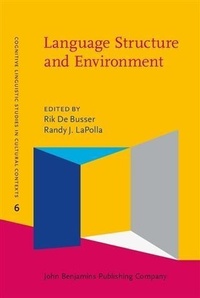
Language Structure and Environment
Social, cultural, and natural factors
1st Edition
Published on 15. May 2015
VI, 351 pages
978-90-272-6873-0 (ISBN)
Description

Language Structure and Environment is a broad introduction to how languages are shaped by their environment. It makes the argument that the social, cultural, and natural environment of speakers influences the structures and development of the languages they speak. After a general overview, the contributors explain in a number of detailed case studies how specific cultural, societal, geographical, evolutionary and meta-linguistic pressures determine the development of specific grammatical features and the global structure of a varied selection of languages. This is a work of meticulous scholarship at the forefront of a burgeoning field of linguistics.
More details
Other editions
Additional editions
Rik De Busser | Randy J. LaPolla
Language Structure and Environment
Social, cultural, and natural factors
Book
06/2015
John Benjamins Publishing Co
€104.94
Shipment within 10-15 days
Persons
Content
- Language Structure and Environment
- Editorial page
- Title page
- LCC data
- Table of contents
- The influence of social, cultural, and natural factors on language structure
- 1. Introduction
- 1.1 Non-autonomous syntax
- 1.2 Linguistic relativity
- 2. Related fields
- 2.1 Functional grammar
- 2.2 Sociolinguistics
- 2.3 Ecolinguistics
- 2.4 Ethnosyntax
- 3. Relevant environmental parameters
- 3.1 Cultural factors
- 3.2 Social factors
- 3.3 Geographical factors
- 3.4 Natural factors
- 3.5 Human biology
- 3.6 Meta-perception of language
- Bibliography
- Part 1. Grammar and culture
- On the logical necessity of a cultural and cognitive connection for the origin of all aspects of linguistic structure
- 1. Cognition: Inference in understanding our surroundings
- 2. The nature of communication: Ostension and inference
- 3. The nature of language: Language is culture
- 4. How the grammars of languages differ
- Do they constrain or not constrain the interpretation of a particular semantic domain?
- If they constrain the interpretation of a particular domain, how much do they constrain it?
- If they constrain the interpretation of a particular domain, how do they constrain it?
- 5. Final remarks
- References
- The body, the universe, society and language
- 1. Introduction
- 2. Modern Germanic in the grip of the unknown
- 3. Changes in PG grammar as enactments of the Anabaptist worldview
- 3.1 The grammaticalization of zehle: From 'counting' to 'predicting'
- 3.2 The degrammaticalization of wotte from subjunctive modal to 'desire'
- 3.3 The rise of fer 'for' in purposive complement clauses
- 4. The speed of changes in PG grammar
- 5. Early Germanic in the grip of the unknown
- 6. Experiencing illness
- 6.1 The impersonal verb construction and its variants
- 6.2 The construction of inalienability and its variants
- 6.3 Other oblique curiosities
- 6.4 The accusative subject in Middle Dutch
- 7. In sum
- 8. The decline of the dative-marked participant
- 9. A final note on the expression of sickness and disease in Modern English
- 10. In conclusion
- Bibliography
- Middle Dutch sources
- Old and Middle English sources
- When culture grammaticalizes
- 1. The Onya Darat language and its speakers
- 2. Encoding social information in pronouns: A Southeast Asian phenomenon
- 3. The pronominal system of Onya Darat
- 4. The origins of generational affiliation marking
- 5. Conclusion
- In Memoriam
- Bibliography
- The cultural bases of linguistic form
- 1. Introduction
- 1.1 Culture and linguistic form
- 1.2 Linguistic and ethnographic background
- 2. Towards a sociocultural theory of linguistic form
- 3. Quotatives evidentials and reported speech constructions
- 3.1 Lexical quotative construction
- 3.2 Quotative evidentials
- 4. Reported speech in Nanti communicative practice
- 4.1 Talking about others' actions
- 4.2 Talking about others' internal states
- 4.3 Conflict, intimacy, and the evidential ethic
- 5. A practice-based account of the grammaticalization of Nanti quotatives and reportives
- 6. Discussion and conclusion
- Bibliography
- Part 2. Grammar and society
- Societies of intimates and linguistic complexity
- 1. Introduction
- 2. Cross-linguistically dispensable categories: Dual (plus) number
- 3. Cross-linguistically dispensable categories: Large pronominal systems
- 4. Cross-linguistically dispensable categories: Generationally-marked pronouns
- 5. Cross-linguistically dispensable categories: Evidentials
- 6. Conclusion
- Bibliography
- On the relation between linguistic and social factors in migrant language contact
- 1. Introduction
- 2. The Australian context
- 2.1 The functions of language
- 3. Facilitation of code-switching through language contact
- 4. Pragmatic effects in the expression and performance of speech acts and social relations
- 4.1 Modal particles and discourse markers
- 4.2 Address
- 5. Standardisation and codification
- 6. Pluricentric languages
- 7. Diglossia
- 8. Language as a core value
- 9. Concluding remarks
- Bibliography
- Part 3. Grammar and geography
- Topography in language
- 1. Introduction
- 2. Frames of Reference
- 3. Static and dynamic relations
- 4. Frame of Reference typology
- 4.1 Intrinsic FoR
- 4.2 Relative FoR
- 4.3 Absolute FoR
- 4.4 Operationalizing each FoR
- 4.5 Diversity in absolute systems
- 5. Re-examining absolute FoR
- 5.1 Binary vs. ternary relations
- 5.2 Fixedness
- 5.3 Radial and curved axes
- 5.4 Unpredictable bearings
- 5.5 Abstractness and arbitrariness
- 5.6 The external world in absolute FoR
- 5.7 Ad hoc references
- 6. Landmarks
- 7. Three case studies
- 7.1 Balinese
- 7.2 Upsun and downsun
- 7.3 The ship as an external world
- 8. Logical properties of each FoR
- 8.1 Transitivity
- 8.2 Converseness
- 8.3 Constancy under rotation
- 8.4 Summary of logical properties
- 8.5 Logical properties of systems examined here
- 9. Topographic Correspondence Hypothesis
- 9.1 Predictions
- 9.2 Correlation between urban/rural environment and FoR choice
- 9.3 Correlation between hunter-gatherer lifestyle and FoR choice
- 9.4 The Environment Variable Method
- 9.5 Pilot findings
- 9.6 Testing the method: Absolute FoR in atoll-based languages
- 10. Conclusions
- Bibliography
- Walk around the clock
- 1. The Siar language
- 2. Siar demonstratives
- 2.1 Demonstrative determiners
- 2.2 Demonstrative pronouns
- 2.3 Demonstrative existentials
- 2.4 Locative adverbs
- 2.5 Allative adverbs
- 2.6 Semantics
- 3. Clockwise and counterclockwise demonstratives
- 4. A historical account
- 4.1 Stage 0: Proto-Oceanic (1500 BC)
- 4.2 Siar on the east coast (before 1750)
- 4.3 Stage 2a: Settlement of Lambóm Island (1750-1900)
- 4.4 Stage 2b: Settlement on Lamassa Island (1750-1900)
- 4.5 Stage 3: Occupation of the southwest coast of New Ireland (1900-today)
- 5. An etymological account
- 6. Other (counter)clockwise systems
- 7. Conclusion
- Bibliography
- Types of spread zones
- 1. Introduction
- 2. Mountains: Vertical spreads
- 2.1 Central crest
- 2.2 Altiplano
- 3. Flatland spread zones
- 3.1 Open spread zones
- 3.2 Closed spread zones
- 4. Discussion and conclusions
- Bibliography
- Part 4. Grammar and evolution
- The role of adaptation in understanding linguistic diversity
- 1. Introduction
- 2. Why are there so many languages?
- 3. How different are languages, really?
- 3.1 Simulating the role of drift and selection pressures in linguistic diversity
- 4. The role of drift and selection in explaining linguistic diversity
- 5. The fit of languages to their environments: The importance of learning mechanisms
- 6. The child-adult learnability trade-off
- 7. Ecological constraints on language structures
- 8. Conclusion
- Bibliography
- Part 5. Grammar and the field of linguistics
- On becoming an object of study
- 1. Introduction
- 2. Viewing language through experiences and assumptions
- 3. Creating language boundaries
- 3.1 Linguistic creation of languages
- 3.2 Community creation of languages
- 3.3 Processes in the creation of languages
- 4. What might linguistics be missing?
- 4.1 Language and place
- 4.2 Language and spirituality
- 5. What could linguistics do with this information?
- 5.1 Multiple perspectives on language
- 5.2 Practising cultural safety
- 5.3 Other ways of creating language
- 6. Conclusion
- Bibliography
- Subjects and Languages Index
- Author Index
