

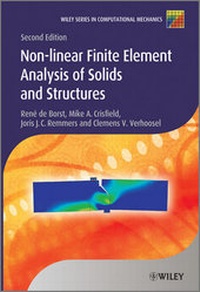
Nonlinear Finite Element Analysis of Solids and Structures
Description

More details
Other editions
Additional editions
Persons
Mike Crisfield (deceased), Imperial College, London; René de Borst, Joris Remmers & Clemens Verhoosel, TU Eindhoven, Netherlands
Professor Mike Crisfield (deceased) joined the Transport & Road Research Laboratory (TRRL) in 1971, where he rose to the rank of Deputy Chief Scientific Officer. In 1989 he was appointed as first holder of the FEA Chair in Computational Mechanics in the aeronautics department at Imperial College, London, the department that had pioneered FEA in the 1950s and 1960s. Shortly before he died, a list of the most cited engineering researchers in the UK was published included Mike in the top 20, and he received an IACM Research Achievement Award in recognition of his extraordinary achievements in the field of non-linear computational mechanics. An eminent researcher and a scholar, he was reputed as an innovative thinker who adopted a 'hands-on' approach.
René de Borst was appointed Dean and Distinguished University Professor of the Faculty of Mechanical Engineering of TU Eindhoven in May 2007 after a long tenure as Professor and deputy Dean at TU Delft. He is Editor for the International Journal for Numerical Methods in Engineering and International Journal for Numerical and Analytical Methods in Geomechanics and Editor for the Encyclopedia of Computational Mechanics. His many awards and the outstanding assessment of his work by the scientific community attest to his reputation as a world leading scientist and researcher within the field of computational mechanics.
Joris Remmers is an assistant professor within René de Borst's group at TU Eindhoven.
Clemens Verhoosel is an assistant professor within René de Borst's group at TU Eindhoven.
Content
Preface xi
Series Preface xiii
Notation xv
About the Code xxi
PART I BASIC CONCEPTS AND SOLUTION TECHNIQUES
1 Preliminaries 3
1.1 A Simple Example of Non-linear Behaviour 3
1.2 A Review of Concepts from Linear Algebra 5
1.3 Vectors and Tensors 12
1.4 Stress and Strain Tensors 17
1.5 Elasticity 23
1.6 The PyFEM Finite Element Library 25
References 29
2 Non-linear Finite Element Analysis 31
2.1 Equilibrium and Virtual Work 31
2.2 Spatial Discretisation by Finite Elements 33
2.3 PyFEM: Shape Function Utilities 38
2.4 Incremental-iterative Analysis 41
2.5 Load versus Displacement Control 50
2.6 PyFEM: A Linear Finite Element Code with Displacement Control 53
References 62
3 Geometrically Non-linear Analysis 63
3.1 Truss Elements 64
3.2 PyFEM: The Shallow Truss Problem 76
3.3 Stress and Deformation Measures in Continua 85
3.4 Geometrically Non-linear Formulation of Continuum Elements 91
3.5 Linear Buckling Analysis 100
3.6 PyFEM: A Geometrically Non-linear Continuum Element 103
References 110
4 Solution Techniques in Quasi-static Analysis 113
4.1 Line Searches 113
4.2 Path-following or Arc-length Methods 116
4.3 PyFEM: Implementation of Riks' Arc-length Solver 124
4.4 Stability and Uniqueness in Discretised Systems 129
4.5 Load Stepping and Convergence Criteria 134
4.6 Quasi-Newton Methods 138
References 141
5 Solution Techniques for Non-linear Dynamics 143
5.1 The Semi-discrete Equations 143
5.2 Explicit Time Integration 144
5.3 PyFEM: Implementation of an Explicit Solver 149
5.4 Implicit Time Integration 152
5.5 Stability and Accuracy in the Presence of Non-linearities 156
5.6 Energy-conserving Algorithms 161
5.7 Time Step Size Control and Element Technology 164
References 165
PART II MATERIAL NON-LINEARITIES
6 Damage Mechanics 169
6.1 The Concept of Damage 169
6.2 Isotropic Elasticity-based Damage 171
6.3 PyFEM: A Plane-strain Damage Model 175
6.4 Stability, Ellipticity and Mesh Sensitivity 179
6.5 Cohesive-zone Models 185
6.6 Element Technology: Embedded Discontinuities 190
6.7 Complex Damage Models 198
6.8 Crack Models for Concrete and Other Quasi-brittle Materials 201
6.8.1 Elasticity-based Smeared Crack Models 201
6.8.2 Reinforcement and Tension Stiffening 206
6.9 Regularised Damage Models 210
References 215
7 Plasticity 219
7.1 A Simple Slip Model 219
7.2 Flow Theory of Plasticity 223
7.3 Integration of the Stress-strain Relation 239
7.4 Tangent Stiffness Operators 249
7.5 Multi-surface Plasticity 252
7.6 Soil Plasticity: Cam-clay Model 267
7.7 Coupled Damage-Plasticity Models 270
7.8 Element Technology: Volumetric Locking 271
References 277
8 Time-dependent Material Models 281
8.1 Linear Visco-elasticity 281
8.2 Creep Models 287
8.3 Visco-plasticity 289
References 303
PART III STRUCTURAL ELEMENTS
9 Beams and Arches 307
9.1 A Shallow Arch 307
9.2 PyFEM: A Kirchhoff Beam Element 317
9.3 Corotational Elements 321
9.4 A Two-dimensional Isoparametric Degenerate Continuum Beam Element 328
9.5 A Three-dimensional Isoparametric Degenerate Continuum Beam Element 333
References 341
10 Plates and Shells 343
10.1 Shallow-shell Formulations 344
10.2 An Isoparametric Degenerate Continuum Shell Element 351
10.3 Solid-like Shell Elements 356
10.4 Shell Plasticity: Ilyushin's Criterion 357
References 361
PART IV LARGE STRAINS
11 Hyperelasticity 365
11.1 More Continuum Mechanics 365
11.2 Strain Energy Functions 374
11.3 Element Technology 389
References 398
12 Large-strain Elasto-plasticity 401
12.1 Eulerian Formulations 402
12.2 Multiplicative Elasto-plasticity 407
12.3 Multiplicative Elasto-plasticity versus Rate Formulations 411
12.4 Integration of the Rate Equations 414
12.5 Exponential Return-mapping Algorithms 418
References 422
PART V ADVANCED DISCRETISATION CONCEPTS
13 Interfaces and Discontinuities 427
13.1 Interface Elements 428
13.2 Discontinuous Galerkin Methods 436
References 439
14 Meshless and Partition-of-unity Methods 441
14.1 Meshless Methods 442
14.2 Partition-of-unity Approaches 451
References 470
15 Isogeometric Finite Element Analysis 473
15.1 Basis Functions in Computer Aided Geometric Design 473
15.2 Isogeometric Finite Elements 483
15.3 PyFEM: Shape Functions for Isogeometric Analysis 487
15.4 Isogeometric Analysis in Non-linear Solid Mechanics 490
References 506
Index 509
