

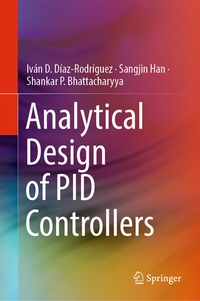
Analytical Design of PID Controllers
Description

This monograph presents a new analytical approach to the design of proportional-integral-derivative (PID) controllers for linear time-invariant plants. The authors develop a computer-aided procedure, to synthesize PID controllers that satisfy multiple design specifications. A geometric approach, which can be used to determine such designs methodically using 2- and 3-D computer graphics is the result.
The text expands on the computation of the complete stabilizing set previously developed by the authors and presented here. This set is then systematically exploited to achieve multiple design specifications simultaneously. These specifications include classical gain and phase margins, time-delay tolerance, settling time and H-infinity norm bounds. The results are developed for continuous- and discrete-time systems. An extension to multivariable systems is also included.
Analytical Design of PID Controllers
provides a novel method of designing PID controllers, which makes it ideal for both researchers and professionals working in traditional industries as well as those connected with unmanned aerial vehicles, driverless cars and autonomous robots.
Reviews / Votes
"The techniques covered in this book form a substantial contribution to the field of control, and this book is recommended for students and practitioners of control theory." (Lee H. Keel, IEEE Control Systems Magazine, Vol. 41 (1), February, 2021)
More details
Other editions
Additional editions
Persons
Iván D. Díaz-Rodríguez
received a B.S. and M.S. Degrees in Electronic Engineering from Universidad Autónoma de Tamaulipas, Reynosa, Tamaulipas, México, in 2005 and 2009 respectively, and a Ph.D. degree in Electrical Engineering from Texas A&M University, College Station, Texas, USA in 2017. At present, he is an Instructional Assistant Professor at Texas A&M University, McAllen Higher Education Center, McAllen, Texas, USA. His research interests include linear systems, classical controller design based on desired performance, multivariable controller design, robust control, controller design based on frequency response, and controller design with applications to the renewable energy field.
Sangjin Han
received his M.S. degree in Electrical and Computer Engineering from University of Maryland in 2014 and Ph.D. degree in Electrical and Computer Engineering from Texas A & M University in 2019. His research interests include linear control theory.
Shankar P. Bhattacharyya is the Robert M. Kennedy Professor of Electrical Engineering at Texas A & M University. He was born in 1946 in Yangon, Myanmar and educated at IIT Bombay and Rice University. His contributions to Control Theory span 50 years and include the geometric solution of the servomechanism problem, an algorithm for eigenvalue assignment, the demonstration of fragility of high order controllers, new approaches to PID control and a measurement based approach to linear systems.
In the 1970's he established the first PhD program in Control in Brazil at the Federal University, Rio de Janeiro where he also served as Head of Department of Electrical Engineering. He has held an NRC-Research Associateship at NASA's Marshall Space Flight Center, a Welliver Faculty Fellowship at Boeing and a Senior Fullbright Lecturership in India.
Bhattacharyya is an IEEE Fellow, an IFAC Fellow, a Foreign Member of the Brazilian Academy of Sciences and a Foreign Member of the Brazilian National Academy of Engineering.
Content
Introduction to Control.- Stabilizing Sets for Linear Time Invariant Continuous-Time Plants.- Stabilizing Sets for Ziegler-Nichols Plants.- Stabilizing Sets for Linear Time Invariant Discrete-Time Plants.- Computation of Stabilizing Sets From Frequency Response Data.- Gain and Phase Margin Based Design for Continuous-Time Plants.- Gain-Phase Margin Based Design of Discrete Time Controllers.- PID Control of Multivariable Systems.- H 8 Optimal Synthesis for Continuous-Time Systems.- H 8 Optimal Synthesis for Discrete-Time Systems.
