

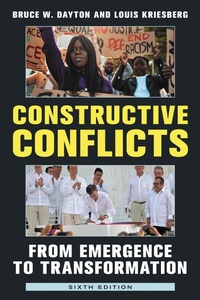
Constructive Conflicts
From Emergence to Transformation
6th Edition
Published on 22. July 2022
378 pages
978-1-5381-6101-2 (ISBN)
Description

Substantially revised for the sixth edition, Constructive Conflicts explains how large-scale political and social conflicts can be waged more constructively, with more positive consequences and fewer destructive consequences for those involved. Drawing on research from political science, sociology, social-psychology, neuroscience, cultural studies, and other disciplines, Dayton and Kriesberg follow the lifecycle of social and political conflicts as they emerge, escalate, de-escalate, become settled, and often emerge again in new forms.
The sixth edition presents numerous new examples and cases of conflict episodes that have avoided extreme coercion or violence and which have resulted in the advancement of the interests of most parties involved. The book gives policymakers, concerned citizens, and students a powerful analytical framework, supported by data, for understanding and constructively intervening in conflicts of different type and scale, offering a way out of the destructive cycles of conflict management which have come to characterize contemporary social and political relations.
Key revisions and features include:
Increased attention to changes in the social and political landscape including the rise of nationalism, the erosion of liberal internationalism, conflicts related to COVID response, political polarization, and the Black Lives Matter movementThoroughly revised cases and examples throughoutKey content revisions such as the growth of bottom-up strategies for peace and conflict management, the rise of misinformation in a 'post-truth' era, and insights from neuroscience Table of contents now organized around three distinct book sections and chapter titles revised to reflect new contentNumerous new figures and tables in every chapterEnd-of-chapter summaries, discussion questions, and activitiesNew ancillary teaching materials, including experiential exercises, simulations, and lecture outlines with teaching tips
The sixth edition presents numerous new examples and cases of conflict episodes that have avoided extreme coercion or violence and which have resulted in the advancement of the interests of most parties involved. The book gives policymakers, concerned citizens, and students a powerful analytical framework, supported by data, for understanding and constructively intervening in conflicts of different type and scale, offering a way out of the destructive cycles of conflict management which have come to characterize contemporary social and political relations.
Key revisions and features include:
Increased attention to changes in the social and political landscape including the rise of nationalism, the erosion of liberal internationalism, conflicts related to COVID response, political polarization, and the Black Lives Matter movementThoroughly revised cases and examples throughoutKey content revisions such as the growth of bottom-up strategies for peace and conflict management, the rise of misinformation in a 'post-truth' era, and insights from neuroscience Table of contents now organized around three distinct book sections and chapter titles revised to reflect new contentNumerous new figures and tables in every chapterEnd-of-chapter summaries, discussion questions, and activitiesNew ancillary teaching materials, including experiential exercises, simulations, and lecture outlines with teaching tips
More details
Edition
6th edition
Language
English
Place of publication
New York
United States
Publishing group
Bloomsbury Publishing Plc
Illustrations
6 tables; 10 charts
ISBN-13
978-1-5381-6101-2 (9781538161012)
Copyright in bibliographic data and cover images is held by Nielsen Book Services Limited or by the publishers or by their respective licensors: all rights reserved.
Schweitzer Classification
Other editions
Additional editions
Book
08/2022
6th Edition
Rowman & Littlefield Publishers
€128.30
Shipment within 3-4 weeks
Book
07/2022
6th Edition
Rowman & Littlefield Publishers
€64.40
Shipment within 3-4 weeks
Persons
Bruce W. Dayton (Ph.D., Syracuse University) serves as associate professor and chair of the Master of Peace and Justice Leadership, the Master of Diplomacy and International Relations, and Director of the CONTACT Peacebuilding Institute at the School for International Training in Brattleboro, Vermont, USA. Professor Dayton has been active in peacebuilding and conflict transformation work for over twenty years as a practitioner, a researcher, and an educator. His other books include Perspectives in Waging Conflicts Constructively and Peacebuilding and Conflict Transformation, each co-authored with Louis Kriesberg. Bruce also served for six years as Executive Director of the International Society for Political Psychology and as Associate at the Center for Policy Negotiation in Boston, Massachusetts where he ran policy-dialogues on pressing public policy controversies.
Louis Kriesberg (Ph.D., University of Chicago) is professor emeritus of Sociology, Maxwell Professor Emeritus of Social Conflict Studies, and founding director of the Program on the Analysis and Resolution of Conflicts (1986-1994), all at Syracuse University. In addition to over 160 book chapters and articles, he is the author or editor of numerous books on conflict studies. He was President of the Society for the Study of Social Problems (1983-1984), and he lectures, consults, and provides training regarding conflict resolution, security issues, and peace studies.
Louis Kriesberg (Ph.D., University of Chicago) is professor emeritus of Sociology, Maxwell Professor Emeritus of Social Conflict Studies, and founding director of the Program on the Analysis and Resolution of Conflicts (1986-1994), all at Syracuse University. In addition to over 160 book chapters and articles, he is the author or editor of numerous books on conflict studies. He was President of the Society for the Study of Social Problems (1983-1984), and he lectures, consults, and provides training regarding conflict resolution, security issues, and peace studies.
Content
List of Figures and Tables
Preface
PART ONE: CONFLICT ANALYSIS AND CONFLICT THEORY
Chapter 1. The Constructive Conflicts Approach
Plan for the Book and Intended Audience
Conflict Definitions
Six Foundational Ideas
Varieties of Conflicts
Combinations Constituting Destructiveness and Constructiveness
Summary and Discussion Questions
Chapter 2. Preconditions: Three Perspectives on the Origin of Conflicts
Human Nature
Sociocultural Relations
System Attributes
Synthesis
Summary and Discussion Questions
PART TWO: CONFLICT EMERGENCE AND CONFLICT STRATEGIES
Chapter 3. Emergence
Identity
Grievance
Forming Contentious Goals
Believing Redress is Possible
Summary and Discussion Questions
Chapter 4. Alternative Conflict Strategies: Coercion, Reward, and Persuasion
Choosing Strategies
Coercion, Reward, and Persuasion
Strategies and Modes of Struggle
Illustrative Strategies
Summary and Discussion Questions
Chapter 5. Adopting Conflict Strategies
Conflict Style
Partisan Goals
Partisan Characteristics
Relations between Adversaries
Social Context
Summary and Discussion Questions
PART THREE: CONFLICT ESCALATION AND DE-ESCALATION
Chapter 6. Escalation
Processes of Escalation
Summary and Discussion Questions
Chapter 7. De-Escalation
Social-Psychological Dynamics
Organizational and Tactical Dynamics
Systemic and Structural Dynamics
De-Escalation Strategies
Summary and Discussion Questions
PART FOUR: MEDIATION, NEGOTIATION, AND POST-CONFLICT OUTCOMES
Chapter 8. Mediation
Definitions, Applications, and Benefits
Social Roles
Shapers of Mediator Roles
Assessing Mediator Contributions
Summary and Discussion Questions
Chapter 9. Negotiated and Non-Negotiated Settlements
Non-Negotiated Settlements
Negotiated Settlements
Forms and Stages of Negotiation
Summary and Discussion Questions
Chapter 10. Post-Settlement Outcomes
Variations in Post-Settlement Outcomes
Constructive Transformations
Summary and Discussion Questions
Chapter 11. Toward Constructive Conflict Transformation
Appendix A: Selected Organizations in the Field of Constructive Conflicts
Preface
PART ONE: CONFLICT ANALYSIS AND CONFLICT THEORY
Chapter 1. The Constructive Conflicts Approach
Plan for the Book and Intended Audience
Conflict Definitions
Six Foundational Ideas
Varieties of Conflicts
Combinations Constituting Destructiveness and Constructiveness
Summary and Discussion Questions
Chapter 2. Preconditions: Three Perspectives on the Origin of Conflicts
Human Nature
Sociocultural Relations
System Attributes
Synthesis
Summary and Discussion Questions
PART TWO: CONFLICT EMERGENCE AND CONFLICT STRATEGIES
Chapter 3. Emergence
Identity
Grievance
Forming Contentious Goals
Believing Redress is Possible
Summary and Discussion Questions
Chapter 4. Alternative Conflict Strategies: Coercion, Reward, and Persuasion
Choosing Strategies
Coercion, Reward, and Persuasion
Strategies and Modes of Struggle
Illustrative Strategies
Summary and Discussion Questions
Chapter 5. Adopting Conflict Strategies
Conflict Style
Partisan Goals
Partisan Characteristics
Relations between Adversaries
Social Context
Summary and Discussion Questions
PART THREE: CONFLICT ESCALATION AND DE-ESCALATION
Chapter 6. Escalation
Processes of Escalation
Summary and Discussion Questions
Chapter 7. De-Escalation
Social-Psychological Dynamics
Organizational and Tactical Dynamics
Systemic and Structural Dynamics
De-Escalation Strategies
Summary and Discussion Questions
PART FOUR: MEDIATION, NEGOTIATION, AND POST-CONFLICT OUTCOMES
Chapter 8. Mediation
Definitions, Applications, and Benefits
Social Roles
Shapers of Mediator Roles
Assessing Mediator Contributions
Summary and Discussion Questions
Chapter 9. Negotiated and Non-Negotiated Settlements
Non-Negotiated Settlements
Negotiated Settlements
Forms and Stages of Negotiation
Summary and Discussion Questions
Chapter 10. Post-Settlement Outcomes
Variations in Post-Settlement Outcomes
Constructive Transformations
Summary and Discussion Questions
Chapter 11. Toward Constructive Conflict Transformation
Appendix A: Selected Organizations in the Field of Constructive Conflicts
