

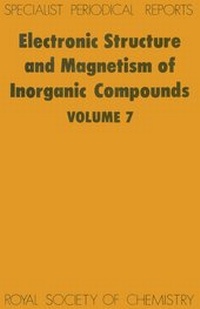
Electronic Structure and Magnetism of Inorganic Compounds
Volume 7
1st Edition
Published on 31. October 2007
216 pages
978-1-84755-597-7 (ISBN)
Description

Specialist Periodical Reports provide systematic and detailed review coverage of progress in the major areas of chemical research. Written by experts in their specialist fields the series creates a unique service for the active research chemist, supplying regular critical in-depth accounts of progress in particular areas of chemistry. For over 80 years the Royal Society of Chemistry and its predecessor, the Chemical Society, have been publishing reports charting developments in chemistry, which originally took the form of Annual Reports. However, by 1967 the whole spectrum of chemistry could no longer be contained within one volume and the series Specialist Periodical Reports was born. The Annual Reports themselves still existed but were divided into two, and subsequently three, volumes covering Inorganic, Organic and Physical Chemistry. For more general coverage of the highlights in chemistry they remain a 'must'. Since that time the SPR series has altered according to the fluctuating degree of activity in various fields of chemistry. Some titles have remained unchanged, while others have altered their emphasis along with their titles; some have been combined under a new name whereas others have had to be discontinued. The current list of Specialist Periodical Reports can be seen on the inside flap of this volume.
More details
Series
Edition
1. Auflage
Language
English
Place of publication
Cambridge
United Kingdom
Target group
Professional and scholarly
ISBN-13
978-1-84755-597-7 (9781847555977)
DOI
10.1039/9781847555977
Copyright in bibliographic data and cover images is held by Nielsen Book Services Limited or by the publishers or by their respective licensors: all rights reserved.
Schweitzer Classification
Other editions
Additional editions
Book
01/1982
Royal Society of Chemistry
€398.50
Shipment within 3-4 weeks
Person
Content
- Electronic Structure and Magnetism of Inorganic Compounds
- Contents
- Chapter 1 Gas-phase Photoelectron Spectroscopy and Related Techniques
- 1 Introduction
- 2 Experimental Aspects
- Spectrometer Systems
- Electron-energy Analysers
- Deconvolution
- Radiation Sources
- U.v. Discharge Sources
- X-Ray Sources
- Laser Sources
- Synchrotron Radiation
- Techniques of Sample Generation
- Supersonic Beams
- High-temperature Species
- Gas-phase Pyrolysis Reactions
- Inlet-system Chemical Reactions
- Atom-Molecule Reactions
- Variable-temperature Photoelectron Spectroscopy
- Weakly Associated Species
- Negative-ion Photoelectron Spectroscopy
- Condensed Phases
- Associated Techniques
- Electronic Spectroscopy of Molecular Ions
- Penning Ionization Spectroscopy
- (e, 2e) Spectroscopy
- Threshold Photoelectron Spectroscopy
- Atomic Photoionization
- One-electron Models
- Many-electron Models
- Experimental Studies
- Molecular Photoionization
- Valence-level Photoionization Cross-sections
- Molecularr Valence-level Photoelectron Angular Distributions
- Core-level Excitation
- 4 The Calculation of Ionization Energies
- Valence Levels
- Semi-empirical Methods
- Pseudo-potential Methods
- Xa Calculations
- ASCF and Cl Approaches
- Green's Function and Other Perturbation Techniques
- Electron Affinities
- Molecular Core Levels
- 5 Fine Structure in Photoelectron Spectra
- Vibrational Fine Structure
- Valence Levels
- Core Levels
- Multiplet Effects
- Many-electron (Shake-up) Structure
- Atomic Valence Levels
- Molecular Valence Levels
- Atomic Core Levels
- Molecular Core Levels
- 6 Applications of Photoelectron Spectroscopy
- Group IA
- Group IIA
- Group III
- Group IV
- Group V
- Group VI
- Group VII
- Group IIB
- Transition-metal Compounds
- Core-level Jf-Ray Photoelectron Spectroscopy
- Chapter 2 Magnetic Susceptibility Measurements
- 1 Introduction
- 2 Reviews
- 3 Instrumentation
- 4 Theory
- 5 Magnetic Anistropy of Crystalline Materials
- 6 Spin-equilibrium Compounds
- 7 Exchange Interactions Between Paramagnetic Ions
- Ferromagnetism
- Ferrimagnetism and Weak Ferromagnetism
- Antiferromagnetism
- Titanium
- Vanadium
- Chromium
- Manganese
- Iron
- Cobalt
- Nickel
- Copper
- Miscellaneous
- Heteronuclear Exchange Coupling
- 8 Other Susceptibility Measurements
