

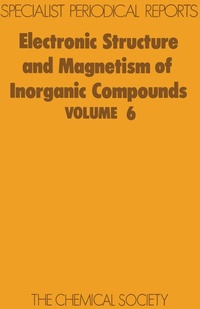
Electronic Structure and Magnetism of Inorganic Compounds
Volume 6
1st Edition
Published on 31. October 2007
324 pages
978-1-84755-596-0 (ISBN)
Description

Specialist Periodical Reports provide systematic and detailed review coverage of progress in the major areas of chemical research. Written by experts in their specialist fields the series creates a unique service for the active research chemist, supplying regular critical in-depth accounts of progress in particular areas of chemistry. For over 80 years the Royal Society of Chemistry and its predecessor, the Chemical Society, have been publishing reports charting developments in chemistry, which originally took the form of Annual Reports. However, by 1967 the whole spectrum of chemistry could no longer be contained within one volume and the series Specialist Periodical Reports was born. The Annual Reports themselves still existed but were divided into two, and subsequently three, volumes covering Inorganic, Organic and Physical Chemistry. For more general coverage of the highlights in chemistry they remain a 'must'. Since that time the SPR series has altered according to the fluctuating degree of activity in various fields of chemistry. Some titles have remained unchanged, while others have altered their emphasis along with their titles; some have been combined under a new name whereas others have had to be discontinued. The current list of Specialist Periodical Reports can be seen on the inside flap of this volume.
More details
Series
Edition
1. Auflage
Language
English
Place of publication
Cambridge
United Kingdom
Target group
Professional and scholarly
ISBN-13
978-1-84755-596-0 (9781847555960)
DOI
10.1039/9781847555960
Copyright in bibliographic data and cover images is held by Nielsen Book Services Limited or by the publishers or by their respective licensors: all rights reserved.
Schweitzer Classification
Other editions
Additional editions
Book
01/1980
Royal Society of Chemistry
€398.50
Shipment within 3-4 weeks
Person
Content
- Electronic Structure and Magnetism of Inorganic Compounds
- Contents
- Chapter 1 Gas-phase Photoelectron Spectroscopy
- 1 Introduction
- 2 Advances in Experimental Techniques
- Electron Energy Analysers
- Detection Systems and Resolution Enhancement
- Photon Sources
- U.v. Sources
- X-Ray Sources
- Synchrotron Radiation
- Laser Sources
- Transmission Functions
- High-temperature and Transient Species
- High Temperatures
- Metastable and Transient Species
- Photoelectron Spectroscopy of Negative Ions
- Associated Techniques
- Fluorescence Measurements
- Photoelectron-Photoion Coincidence
- Electron Transmission Spectroscopy
- Penning Ionization Electron Spectroscopy (PIES)
- (e, 2e) Coincidence Spectroscopy
- 3 Photoionization Cross-sections and Photoelectron Angular Distributions
- Atomic Photoionization Cross-sections
- Studies of Subshell Ionization Cross-sections in the Noble Gases
- Studies of B-Metal Atoms
- Techniques Complementary to Gas-phase P.E.S.
- Atomic Photoelectron Angular Distribution
- Molecular Photoionization
- Theoretical Models
- Discussion of Selected Molecular Cross-section Data
- Plane-wave Models
- The Gelius Model
- 4 Theoretical Aspects
- The Calculation of Valence-level Ionization Energies
- Open-shell Systems
- Correlated Wavefunctions
- ?SCF Calculations
- Perturbation Calculations
- Xa Calculations
- The Calculation of Core-level Ionization Energies
- Spin-Orbit Coupling
- Vibrational Fine Structure
- Valence Levels
- Core Levels
- Many-electron (Shake-up) Structure
- Valence Ionization
- Core Ionization
- 5 Electronic Structure and Photoelectron Spectroscopy
- Introduction
- Diatomic Molecules
- Triatomic Molecules
- Tetra-, Penta-, and Hexa-atomic Molecules
- Group III Compounds
- Group IV Compounds
- Group V Compounds
- Group VI Compounds
- B-Metal Compounds
- Organic Molecules of General Interest
- Transition-metal Compounds
- Core-level Studies
- Chapter 2 Electronic Spectra of Transition-metal Compounds
- 1 Introduction
- 2 Polarized and Low-temperature Crystal Spectra
- Discrete Complexes in Crystals
- Monoatomic Ligands
- Polyatomic Ligands
- Continuous Lattices
- Doped Crystals
- Pure Compounds
- Vibronic Effects
- Far- and Extreme-u.v. Spectra
- 3 Co-operative Phenomena
- Mixed-valence Compounds
- Single-valence Metal Chains
- Magnetic Interaction Effects
- Pairs of Ions in Continuous Lattices
- One-dimensional Magnetic Compounds
- Two-dimensional Magnetic Compounds
- Three-dimensional Magnetic Systems
- 4 Complexes of Conjugated Ligands
- Porphyrins
- Corrins
- Phthalocyanines
- 2,2'-Bipyridyl and Related Ligands
- 5 Organometallic Compounds
- 6 Pressure and Solvent Effects
- 7 Spectra in Melts and Glasses
- 8 Theoretical Aspects
- 9 Radiationless Processes
- Intermolecular
- Intramolecular
- Experimental
- 10 Spectra of Transition-metal Compounds
- Studies Involving Two or More Transition Elements
- Scandium and Yttrium
- Titanium, Zirconium, and Hafnium
- Vanadium, Niobium, and Tantalum
- Chromium, Molybdenum, and Tungsten
- Manganese, Technetium, and Rhenium
- Iron, Ruthenium, and Osmium
- Cobalt, Rhodium, and Iridium
- Nickel, Palladium, and Platinum
- Copper, Silver, and Gold
- 11 Table of Compounds not Referred to in Detail
- Chapter 3 Natural and Magnetic Optical Activity
- 1 Introduction
- 2 Natural Optical Activity
- Theory
- Experimental Studies
- Complexes of CoIII and CrIII
- Other Metals
- 3 Reviews
- 4 Instrumentation
- 5 Magnetic Optical Activity
- Theory
- Physical Applications
- Assignments
- Chemical Applications
- Chapter 4 Magnetic Susceptibility Measurements
- 1 Introduction
- 2 Reviews
- 3 Instrumentation
- 4 Theory
- 5 Magnetic Anisotropy of Crystalline Materials
- 6 Spin Equilibrium Compounds
- 7 Exchange coupling in Inorganic Solids
- Ferromagnetism
- Weak Ferromagnetism and Ferrimagnetism
- Antiferromagnetism
- Titanium
- Vanadium
- Chromium
- Manganese
- Iron
- Cobalt
- Nickel
- Copper
- Miscellaneous
- 8 Other Average Susceptibility Measurements
- Author Index
