

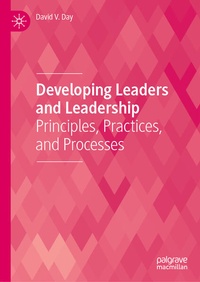
Developing Leaders and Leadership
Description

This book offers a unique perspective on the principles and developmental pathways (i.e., practices, and processes) associated with developing leaders and leadership. Unlike most offerings on the topic of leadership development, it adopts an evidence-based approach to the scientific study of developing leaders and leadership, including the underlying theories that support this study.
Focused on the processes associated with development within and across levels, the author presents a comprehensive summary of what we know about the developmental pathways associated with developing leaders and leadership, practices that motivate effective processes, and the theoretical principles that guide the study and understanding how individuals and collectives develop (i.e., change over time) in ways that increase their respective capacities for leadership.
This book will appeal to those interested in understanding how leaders develop and the differences between developing leaders and developing leadership. It draws from theory and research from management, psychology, sociology, and education.
Reviews / Votes
" Developing Leaders and Leadership: Principles, Practices, and Processes is a significant contribution to the field of leadership development. David V. Day offers a comprehensive, evidence-based exploration of how organizations can cultivate both individual leaders and systemic leadership capacity. ... For scholars, the book provides a robust theoretical foundation and clear research pathways. For practitioners, it offers practical frameworks and strategies to design, implement and evaluate effective leadership development programs." (Jomar Lozano Aban, European Journal of Training and Development, Vol. 49 (9), 2025)
More details
Other editions
Additional editions
Person
David V. Day holds appointments as Professor of Psychological Science and Academic Director of the Kravis Leadership Institute at Claremont McKenna College, USA. He is also the Steven L. Eggert '82 P'15 Professor of Leadership and a George R. Roberts Research Fellow at the College. He has published more than 100 peer-reviewed journal articles, books, and book chapters. He serves on numerous editorial boards and is the past editor of The Leadership Quarterly Yearly Review . Day received the Walter F. Ulmer Research Award from the Center for Creative Leadership in 2010 for outstanding, career-long contributions to applied leadership research.
Content
1 Overview and First Principles of Developing Leaders and Leadership.- 2 Developmental Systems.- 3 Individual Leader Development.- 4 Self-Views and Leader Development.- 5 Considering Adult Development in Leader Development.- 6 Developing a Collective Capacity for Leadership.- 7 Networks and Leadership Development.- 8 Advancing the Science of Developing Leaders and Leadership.
