

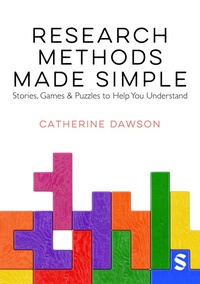
Research Methods Made Simple
Stories, Games & Puzzles to Help You Understand
1st Edition
Published on 30. October 2024
312 pages
978-1-5296-7879-6 (ISBN)
Description

Practical. Interactive. Engaging. This book provides an imaginative alternative to doing research methods. With visual prompts and easy-to-follow activities, it will help you understand the basic foundations of the research process in bite-sized pieces that suit your way of learning.
Including activities such as word searches, crosswords, spider charts and puzzles, this book will help you gain a wider understanding of how, and why, specific research methods are used.
Complete with a variety of learning features, this book will:
Build your understanding of the core principles of research.
Help you to interpret different methods and their practicalities.
Aid you in identifying your weakness and adapting useful techniques to combat these.
Stand as a visual toolkit that sets content out in bite-sized pieces.
Perfect for beginners, this user-friendly guide will give you a deeper understanding of research methods through action, images, and visualization.
Including activities such as word searches, crosswords, spider charts and puzzles, this book will help you gain a wider understanding of how, and why, specific research methods are used.
Complete with a variety of learning features, this book will:
Build your understanding of the core principles of research.
Help you to interpret different methods and their practicalities.
Aid you in identifying your weakness and adapting useful techniques to combat these.
Stand as a visual toolkit that sets content out in bite-sized pieces.
Perfect for beginners, this user-friendly guide will give you a deeper understanding of research methods through action, images, and visualization.
More details
Edition
1. Auflage
Language
English
Place of publication
London
United Kingdom
Publishing group
Sage Publications Ltd (Digital)
Target group
College/higher education
Product notice
Reflowable
ISBN-13
978-1-5296-7879-6 (9781529678796)
Copyright in bibliographic data and cover images is held by Nielsen Book Services Limited or by the publishers or by their respective licensors: all rights reserved.
Schweitzer Classification
Other editions
Additional editions
Book
11/2024
1st Edition
SAGE Publications Ltd
€194.60
Shipment within 3-4 weeks
Book
11/2024
1st Edition
SAGE Publications Ltd
€42.54
Shipment within 3-4 weeks
Person
Dr Catherine Dawson is a freelance researcher and writer, specializing in study skills, research methods and digital research methods. She writes books aimed at undergraduate and postgraduate students, and at university educators. She also writes online courses in study skills, research methods and digital research methods.
Catherine studied at university in the United Kingdom for an undergraduate degree in Combined Humanities, a master's degree in Social Research and a PhD researching the learning choices of adults returning to education. She has worked as a research assistant, research associate and educator at various UK universities and as a research and training officer in both the public and private sectors. Over the years she has developed and taught research methods courses for undergraduate and postgraduate students and has designed and delivered bespoke research methods courses to employees in the private sector.
Catherine studied at university in the United Kingdom for an undergraduate degree in Combined Humanities, a master's degree in Social Research and a PhD researching the learning choices of adults returning to education. She has worked as a research assistant, research associate and educator at various UK universities and as a research and training officer in both the public and private sectors. Over the years she has developed and taught research methods courses for undergraduate and postgraduate students and has designed and delivered bespoke research methods courses to employees in the private sector.
Content
Chapter 1: Reflection. Let's think about this thing called research...
Chapter 2: Expansion. Before we begin, let's consider the philosophy of research...
Chapter 3: Collaboration. Let's think about working together on research...
Chapter 4: Regulations. Let's consider (and adhere to) policy, rules and requirements...
Chapter 5: Ethics. Let's make sure we consider ethical and moral issues...
Chapter 6: Planning. Let's consider the practicalities...
Chapter 7: Selection. Let's choose our methodology and methods...
Chapter 8: Preparation. Let's get ready to start...
Chapter 9: Action. Let's begin our research...
Chapter 10: Investigation. Let's think about analysing research data...
Chapter 11: Protection. Let's ensure we protect our research data...
Chapter 12: Completion. Let's write up and pass the course...
Chapter 13: Recap. Let's check on what we know...
Chapter 2: Expansion. Before we begin, let's consider the philosophy of research...
Chapter 3: Collaboration. Let's think about working together on research...
Chapter 4: Regulations. Let's consider (and adhere to) policy, rules and requirements...
Chapter 5: Ethics. Let's make sure we consider ethical and moral issues...
Chapter 6: Planning. Let's consider the practicalities...
Chapter 7: Selection. Let's choose our methodology and methods...
Chapter 8: Preparation. Let's get ready to start...
Chapter 9: Action. Let's begin our research...
Chapter 10: Investigation. Let's think about analysing research data...
Chapter 11: Protection. Let's ensure we protect our research data...
Chapter 12: Completion. Let's write up and pass the course...
Chapter 13: Recap. Let's check on what we know...
