

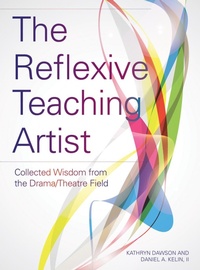
The Reflexive Teaching Artist
Collected Wisdom from the Drama/Theatre Field
1st Edition
Published on 1. October 2014
336 pages
978-1-78320-222-5 (ISBN)
Description

The Reflexive Teaching Artist invites Teaching Artists at all levels of experience to consider the power of reflective practice. Kathryn Dawson and Daniel A. Kelin, II offer a reflective framework - a series of foundational concepts, including intentionality, quality, artistic perspective, assessment and praxis - illuminated through reflexive case-study examples from Teaching Artists in a wide range of settings. The authors write from the dual perspectives of artist and educator to raise fundamental questions about the complex intentions, relationships and function of the teaching artist in school, community and professional theatre settings. Through questions, guided reflection activities, collected wisdom from the field, and an introductory action-research model, Dawson, Kelin and their contributors closely examine the practice of teaching in, through and about drama and theatre.
Reviews / Votes
'There's so much here that can be adopted, adapted, and used by teaching artists, no matter where they practice. This is a very well done, practical, and important addition to the field.' -- Education Update This study includes high-quality reflection on the issues surrounding the role of the teaching artist in the drama/theatre sector, while reflective exercises offer practical ways to embed these ideas and concepts into an existing teaching practice.' -- Laura Bissell, The Scottish Journal of PerformanceMore details
Series
Edition
1. Auflage
Language
English
Place of publication
Bristol
United Kingdom
Publishing group
Intellect
Target group
Professional and scholarly
ISBN-13
978-1-78320-222-5 (9781783202225)
Copyright in bibliographic data and cover images is held by Nielsen Book Services Limited or by the publishers or by their respective licensors: all rights reserved.
Schweitzer Classification
Other editions
Additional editions
Kathryn Dawson | Daniel A. Kelin, II
The Reflexive Teaching Artist
Collected Wisdom from the Drama/Theatre Field
Book
09/2014
Intellect Books
€44.50
Shipment within 3-4 weeks
Persons
Kathryn Dawson is assistant professor in the Department of Theater and Dance at the University of Texas at Austin and serves as director of the Drama for Schools program.
Daniel A. Kelin II is director of drama education at the Honolulu Theater for Youth and teaching artist on the national roster of the John F. Kennedy Center for the Performing Arts.
Daniel A. Kelin II is director of drama education at the Honolulu Theater for Youth and teaching artist on the national roster of the John F. Kennedy Center for the Performing Arts.
Content
Introduction
Part 1: A Teaching Artist Reflects
Chapter 1: The Teaching Artist
Chapter 2: Reflective Practice
Part 2: Collected Wisdom
Chapter 3: Intentionality
Intentionality Case Studies
Learning to listen: Lessons for Teaching Artists from a Minneapolis mosque - Sarah Myers
Stories of my life: A Teaching Artist reflects on cultural consciousness - Roxanne Schroeder-Arce
Devised performance in a gender-specific juvenile probation program - Amanda Hashagen
Audition notice(d): Taking steps to align mission and admission - Lisa M. Barker
Remaking how a site is perceived and experienced: The ghosts of Waller Creek Project - Michelle Dahlenburg
Chapter 4: Quality
Quality Case Studies
What does quality theatre for young audiences look like? - Tamara Goldbogen
Suit My Heart: Staging foster youth narratives that hit home - Michelle Hayford
How do we find relevance? - Gary Minyard
On both shores: Teaching across personal/political distance - Nicole Gurgel
Balancing artistic and language-learning goals in Lincoln Center Theater's Learning English and Drama Project - Kati Koerner
Chapter 5: Artistic Perspective
Artistic Perspective Case Studies
Developing 'dramatic metaphor' to teach concepts of science - Jo Beth Gonzalez
The art of relationship: Intergenerational theatre - Marsha Gildin
Bridging the divide with Shakespeare: Theatre as moral education in Bosnia and Herzegovina - Andrew Garrod
Dramaturgy by students - Carol T. (Jones) Schwartz and Kim Bowers-Rheay-Baran
What's Happened to Queen Fancy Fish? Deconstructing an applied theatre lesson for the early childhood classroom - Karina Naumer
Chapter 6: Assessment
Assessment Case Studies
Capturing the story: A Teaching Artist's attempt to assess a documentary theatre project in rural Alaska - Ryan Conarro
The applications of theatre as pedagogical and research methodologies: Scenes and waves of investigative dialogues across the Nordsjoen (North Sea) - Heli Aaltonen and Stephanie Knight
Engaging the outliers: One theatre educator's journey to reach her most challenging students through choice, rigor and empowerment - Tracy Kane
Reflection as a bridge between program evaluation and instruction - Cory Wilkerson and Jennifer Ridgway
Naming our learning along the way through arts-based assessment - Bridget Kiger Lee
Chapter 7: Praxis
Praxis Case Studies
The vagabond's dilemma: Representing host culture as a guest - Jamie Simpson Steele
Activating community: Process-centered philosophy in a product-oriented world - Gillian McNally
Playing at praxis: Locating youth voices in history - Megan Alrutz
Enacting liderazgo: Where drama praxis and Latino leadership intersect - Christina Marin
Essentializing residencies: Collecting trophies of the oppressed - Peter B. Duffy
Part 3: The Reflexive Practitioner
Chapter 8: Participatory Action Research
Final Reflections
Part 1: A Teaching Artist Reflects
Chapter 1: The Teaching Artist
Chapter 2: Reflective Practice
Part 2: Collected Wisdom
Chapter 3: Intentionality
Intentionality Case Studies
Learning to listen: Lessons for Teaching Artists from a Minneapolis mosque - Sarah Myers
Stories of my life: A Teaching Artist reflects on cultural consciousness - Roxanne Schroeder-Arce
Devised performance in a gender-specific juvenile probation program - Amanda Hashagen
Audition notice(d): Taking steps to align mission and admission - Lisa M. Barker
Remaking how a site is perceived and experienced: The ghosts of Waller Creek Project - Michelle Dahlenburg
Chapter 4: Quality
Quality Case Studies
What does quality theatre for young audiences look like? - Tamara Goldbogen
Suit My Heart: Staging foster youth narratives that hit home - Michelle Hayford
How do we find relevance? - Gary Minyard
On both shores: Teaching across personal/political distance - Nicole Gurgel
Balancing artistic and language-learning goals in Lincoln Center Theater's Learning English and Drama Project - Kati Koerner
Chapter 5: Artistic Perspective
Artistic Perspective Case Studies
Developing 'dramatic metaphor' to teach concepts of science - Jo Beth Gonzalez
The art of relationship: Intergenerational theatre - Marsha Gildin
Bridging the divide with Shakespeare: Theatre as moral education in Bosnia and Herzegovina - Andrew Garrod
Dramaturgy by students - Carol T. (Jones) Schwartz and Kim Bowers-Rheay-Baran
What's Happened to Queen Fancy Fish? Deconstructing an applied theatre lesson for the early childhood classroom - Karina Naumer
Chapter 6: Assessment
Assessment Case Studies
Capturing the story: A Teaching Artist's attempt to assess a documentary theatre project in rural Alaska - Ryan Conarro
The applications of theatre as pedagogical and research methodologies: Scenes and waves of investigative dialogues across the Nordsjoen (North Sea) - Heli Aaltonen and Stephanie Knight
Engaging the outliers: One theatre educator's journey to reach her most challenging students through choice, rigor and empowerment - Tracy Kane
Reflection as a bridge between program evaluation and instruction - Cory Wilkerson and Jennifer Ridgway
Naming our learning along the way through arts-based assessment - Bridget Kiger Lee
Chapter 7: Praxis
Praxis Case Studies
The vagabond's dilemma: Representing host culture as a guest - Jamie Simpson Steele
Activating community: Process-centered philosophy in a product-oriented world - Gillian McNally
Playing at praxis: Locating youth voices in history - Megan Alrutz
Enacting liderazgo: Where drama praxis and Latino leadership intersect - Christina Marin
Essentializing residencies: Collecting trophies of the oppressed - Peter B. Duffy
Part 3: The Reflexive Practitioner
Chapter 8: Participatory Action Research
Final Reflections
