

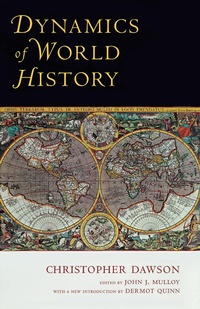
Dynamics of World History
Published on 20. May 2014
450 pages
978-1-4976-5140-1 (ISBN)
Description

In scope and in vision Christopher Dawson's historiography ranks with the work of men like Spengler, Northrop, and Toynbee. Several major themes run through Dawson's work, but perhaps his most unique contribution was his insistence on the importance of religion in shaping and sustaining civilizations.
Religion, Dawson believed, is the great creative force in any culture, and the loss of a society's historic religion therefore portends a process of social dissolution. For this reason, Dawson concluded that Western society must find a way to revitalize its spiritual life if it is to avoid irreversible decay. Progress, the real religion of modernity, is insufficient to sustain cultural health. And an ahistorical, secularized Christianity is an oxymoron, a pseudo-religion only nominally related to the historic religion of the West.
Dawson maintained that the hope of the present age lay in the reconciliation of the religious tradition of Christianity with the intellectual tradition of humanism and the new knowledge about man and nature provided by modern science. Dynamics of World Historyshows that though such a task may be difficult, it is not impossible.
Religion, Dawson believed, is the great creative force in any culture, and the loss of a society's historic religion therefore portends a process of social dissolution. For this reason, Dawson concluded that Western society must find a way to revitalize its spiritual life if it is to avoid irreversible decay. Progress, the real religion of modernity, is insufficient to sustain cultural health. And an ahistorical, secularized Christianity is an oxymoron, a pseudo-religion only nominally related to the historic religion of the West.
Dawson maintained that the hope of the present age lay in the reconciliation of the religious tradition of Christianity with the intellectual tradition of humanism and the new knowledge about man and nature provided by modern science. Dynamics of World Historyshows that though such a task may be difficult, it is not impossible.
More details
Other editions
Additional editions

Christopher Dawson
The Dynamics Of World History
Book
10/2018
Franklin Classics
€42.04
No shipping information available

Christopher Dawson
The Dynamics of World History
Book
09/2011
Nabu Press
€38.39
No shipping information available
Person
Christopher Dawson is widely regarded as one of the most important historians of the twentieth century. Commended for his sophisticated approach to history, Dawson focused much of his writing on the important relationship between religion and culture. He is the author of such seminal works as
Religion and the Rise of Western Culture (Sheed & Ward, 1950),
Religion and Culture (Sheed & Ward, 1948), and the
Crisis of Western Education (Sheed & Ward, 1961).
Content
- Intro
- Title Page
- Contents
- Introduction by Dermot Quinn
- Preface to the 1978 edition, by John J. Mulloy
- Introduction to the 1958 edition, by John J. Mulloy
- PART ONE: TOWARD A SOCIOLOGY OF HISTORY
- SECTION I: THE SOCIOLOGICAL FOUNDATIONS OF HISTORY
- 1. The Sources of Culture Change
- 2. Sociology as a Science
- 3. Sociology and the Theory of Progress
- 4. Civilization and Morals
- 5. Progress and Decay in Ancient and Modern Civilization
- 6. Art and Society
- 7. Vitality or Standardization in Culture
- 8. Cultural Polarity and Religious Schism
- 9. Prevision in Religion
- 10. T. S. Eliot on the Meaning of Culture
- SECTION II: THE MOVEMENT OF WORLD HISTORY
- 1. Religion and the Life of Civilization
- 2. The Warrior Peoples and the Decline of the Archaic Civilization
- 3. The Origins of Classical Civilization
- 4. The Patriarchal Family in History
- 5. Stages in Mankind's Religious Experience
- SECTION III: URBANISM AND THE ORGANIC NATURE OF CULTURE
- 1. The Evolution of the Modern City
- 2. Catholicism and the Bourgeois Mind
- 3. The World Crisis and the English Tradition
- 4. Bolshevism and the Bourgeoisie
- PART TWO: CONCEPTIONS OF WORLD HISTORY
- SECTION I: CHRISTIANITY AND THE MEANING OF HISTORY
- 1. The Christian View of History
- 2. History and the Christian Revelation
- 3. Christianity and Contradiction in History
- 4. The Kingdom of God and History
- SECTION II: THE VISION OF THE HISTORIAN
- 1. The Problem of Metahistory
- 2. St. Augustine and the City of God
- 3. Edward Gibbon and the Fall of Rome
- 4. Karl Marx and the Dialectic of History
- 5. H. G. Wells and the Outline of History
- 6. Oswald Spengler and the Life of Civilizations
- 7. Arnold Toynbee and the Study of History
- 8. Europe in Eclipse
- Afterword by John J. Mulloy: Continuity and Development in Christopher Dawson's Thought
- Sources
- Notes
- Index
- Copyright Page
