

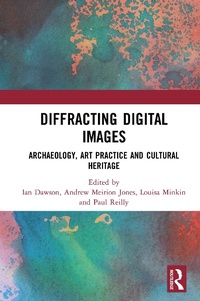
Diffracting Digital Images
Archaeology, Art Practice and Cultural Heritage
1st Edition
Published on 27. December 2021
224 pages
978-1-000-50945-8 (ISBN)
Description

Digital imaging techniques have been rapidly adopted within archaeology and cultural heritage practice for the accurate documentation of cultural artefacts. But what is a digital image, and how does it relate to digital photography? The authors of this book take a critical look at the practice and techniques of digital imaging from the stance of digital archaeologists, cultural heritage practitioners and digital artists.
Borrowing from the feminist scholar Karen Barad, the authors ask what happens when we diffract the formal techniques of archaeological digital imaging through a different set of disciplinary concerns and practices. Diffracting exposes the differences between archaeologists, heritage practitioners and artists, and foregrounds how their differing practices and approaches enrich and inform each other. How might the digital imaging techniques used by archaeologists be adopted by digital artists, and what are the potentials associated with this adoption? Under the gaze of fine artists, what happens to the fidelity of the digital images made by archaeologists, and what new questions do we ask of the digital image? How can the critical approaches and practices of fine artists inform the future practice of digital imaging in archaeology and cultural heritage?
Diffracting Digital Images will be of interest to students and scholars in archaeology, cultural heritage studies, anthropology, fine art, digital humanities, and media theory.
Borrowing from the feminist scholar Karen Barad, the authors ask what happens when we diffract the formal techniques of archaeological digital imaging through a different set of disciplinary concerns and practices. Diffracting exposes the differences between archaeologists, heritage practitioners and artists, and foregrounds how their differing practices and approaches enrich and inform each other. How might the digital imaging techniques used by archaeologists be adopted by digital artists, and what are the potentials associated with this adoption? Under the gaze of fine artists, what happens to the fidelity of the digital images made by archaeologists, and what new questions do we ask of the digital image? How can the critical approaches and practices of fine artists inform the future practice of digital imaging in archaeology and cultural heritage?
Diffracting Digital Images will be of interest to students and scholars in archaeology, cultural heritage studies, anthropology, fine art, digital humanities, and media theory.
More details
Edition
1. Auflage
Language
English
Place of publication
London
United Kingdom
Publishing group
Taylor & Francis Ltd
Target group
College/higher education
Illustrations
70 Halftones, black and white; 70 Illustrations, black and white
ISBN-13
978-1-000-50945-8 (9781000509458)
Copyright in bibliographic data and cover images is held by Nielsen Book Services Limited or by the publishers or by their respective licensors: all rights reserved.
Schweitzer Classification
Other editions
Additional editions
Ian Dawson | Andrew Meirion Jones | Louisa Minkin
Diffracting Digital Images
Archaeology, Art Practice and Cultural Heritage
Book
10/2023
1st Edition
Routledge
€69.51
Shipment within 10-20 days
Ian Dawson | Andrew Meirion Jones | Louisa Minkin
Diffracting Digital Images
Archaeology, Art Practice and Cultural Heritage
Book
12/2021
1st Edition
Routledge
€179.51
Shipment within 15-20 days
Persons
Ian Dawson has exhibited worldwide and lectures at Winchester School of Art. His background in sculpture (Making Contemporary Sculpture, Crowood Press, 2012) has led to research focusing on the intersection between 3D additive processes and digital imaging technologies. He has recently collaborated with the Compound 13 Lab to explore 3D printing and plastic recycling in Dharavi, Mumbai, India (2020).
Andrew Meirion Jones is Professor of Archaeology, Department of Archaeology and Classics, Stockholm University, Sweden. His research interests include the archaeology of Stone Age Europe, art and material culture, and digital imaging. He is currently working on the Concepts Have Teeth project with Ian Dawson and Louisa Minkin.
Louisa Minkin is Reader in Visual Art Practices, University of the Arts, London; and Course Leader for MA Fine Art at Central Saint Martins. She is Principal Investigator on the AHRC networking project Concepts Have Teeth and Teeth that Bite through Time: digital imaging and Blackfoot material culture in UK museums.
Paul Reilly is Senior Research Fellow of Digital Archaeology, Department of Archaeology, University of Southampton, UK. His research interests include creative digital archaeology and art/archaeology. His most recent research explores the theoretical implications of the growing intersection of physical and digital (or phygital), practices for art, archaeology, and cultural heritage.
Andrew Meirion Jones is Professor of Archaeology, Department of Archaeology and Classics, Stockholm University, Sweden. His research interests include the archaeology of Stone Age Europe, art and material culture, and digital imaging. He is currently working on the Concepts Have Teeth project with Ian Dawson and Louisa Minkin.
Louisa Minkin is Reader in Visual Art Practices, University of the Arts, London; and Course Leader for MA Fine Art at Central Saint Martins. She is Principal Investigator on the AHRC networking project Concepts Have Teeth and Teeth that Bite through Time: digital imaging and Blackfoot material culture in UK museums.
Paul Reilly is Senior Research Fellow of Digital Archaeology, Department of Archaeology, University of Southampton, UK. His research interests include creative digital archaeology and art/archaeology. His most recent research explores the theoretical implications of the growing intersection of physical and digital (or phygital), practices for art, archaeology, and cultural heritage.
Content
List of Figures; List of Contributors; Foreword and Acknowledgements; Chapter 1 What is a diffractive digital image?; Chapter 2 Interstitial Images; Chapter 3 Engaging audiences with digital Blackfoot objects online and in the art gallery; Chapter 4 Structure from motion: the movement and digital modelling of an artefact from the Blackfoot collections, British Museum; Chapter 5 The Paranoiac-Critical Method of Reflectance Transformation Imaging; Chapter 6 The work of the miniature in the age of digital reproduction; Chapter 7 Temporal Ripples in Art/Archaeology Images; Chapter 8 The Inhabited Frame: Examining the Archaeological Image in the Era of Interactive Media; Chapter 9 Digitalising ephemerality: Preserving and utilising the transient trace in Athens urban landscape through digital approaches in the field of fine art; Chapter 10 Four-dimensional and multi-dimensional images: diffracting archaeological images and computational imagings; Chapter 11 Commentary; Chapter 12 Making the Image a Process - On Commitment and Care in Entangled Worlds; Glossary; Index.
