

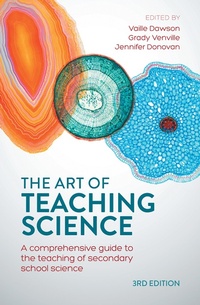
The Art of Teaching Science
A comprehensive guide to the teaching of secondary school science
3rd Edition
Published on 16. July 2020
272 pages
978-1-000-24784-8 (ISBN)
Description

The Art of Teaching Science has proven itself to be one of the most popular introductory texts for Australian pre-service and in-service teachers, providing guidance on engaging students and helping develop scientifically literate citizens.
Beginning with an examination of the nature of science, constructivist and socio-cultural views of teaching and learning and contemporary science curricula in Australian schools, the expert authors go on to explore effective teaching and learning strategies, approaches to assessment and provide advice on the use of ICT in the classroom. Fully revised and updated, this edition also reflects the introduction of the AITSL professional standards for teachers and integrates them throughout the text. New chapters explore:
aEURca range of teaching strategies including explicit instruction, active learning and problem-based learning;
aEURcthe effective integration of STEM in schools;
aEURcapproaches to differentiation in science education; and
aEURccontemporary uses of ICT to improve student learning.
Those new to this text will find it is deliberately written in user-friendly language. Each chapter stands alone, but collectively they form a coherent picture of the art (in the sense of creative craft) and science (as in possessing the knowledge, understanding and skills) required to effectively teach secondary school science.
'Helping each new generation of school science teachers as they begin their careers is crucial to education. This is the updated, third edition of this valuable textbook. It contains a wonderful range of inspirational chapters. All science teachers, not only those at the start of the profession, would benefit from it, in Australia and beyond.'
Michael J. Reiss, Professor of Science Education, University College, London
Beginning with an examination of the nature of science, constructivist and socio-cultural views of teaching and learning and contemporary science curricula in Australian schools, the expert authors go on to explore effective teaching and learning strategies, approaches to assessment and provide advice on the use of ICT in the classroom. Fully revised and updated, this edition also reflects the introduction of the AITSL professional standards for teachers and integrates them throughout the text. New chapters explore:
aEURca range of teaching strategies including explicit instruction, active learning and problem-based learning;
aEURcthe effective integration of STEM in schools;
aEURcapproaches to differentiation in science education; and
aEURccontemporary uses of ICT to improve student learning.
Those new to this text will find it is deliberately written in user-friendly language. Each chapter stands alone, but collectively they form a coherent picture of the art (in the sense of creative craft) and science (as in possessing the knowledge, understanding and skills) required to effectively teach secondary school science.
'Helping each new generation of school science teachers as they begin their careers is crucial to education. This is the updated, third edition of this valuable textbook. It contains a wonderful range of inspirational chapters. All science teachers, not only those at the start of the profession, would benefit from it, in Australia and beyond.'
Michael J. Reiss, Professor of Science Education, University College, London
Reviews / Votes
'It manages to strike the right balance between the abstract, theoretical, detailed, and practical, in a way that supports the reader to be critical and informed... This book will provide preservice teachers with a very handy reference as they progress through their degrees and well into their first years of teaching.' - Research in Science EducationMore details
Edition
3rd edition
Language
English
Place of publication
London
United Kingdom
Publishing group
Taylor & Francis Ltd
Target group
College/higher education
Product notice
Reflowable
ISBN-13
978-1-000-24784-8 (9781000247848)
Copyright in bibliographic data and cover images is held by Nielsen Book Services Limited or by the publishers or by their respective licensors: all rights reserved.
Schweitzer Classification
Other editions
Additional editions
Vaille Dawson | Jennifer Donovan
The Art of Teaching Science
A comprehensive guide to the teaching of secondary school science
Book
03/2021
3rd Edition
Routledge
€189.70
Shipment within 15-20 days
Vaille Dawson | Jennifer Donovan
The Art of Teaching Science
A comprehensive guide to the teaching of secondary school science
Book
07/2019
3rd Edition
A&U Academic
€46.20
Shipment within 3-4 weeks
Previous edition
Jack Hassard | Michael Dias
The Art of Teaching Science
Inquiry and Innovation in Middle School and High School
E-Book
07/2013
2nd Edition
Routledge
€101.99
Available for download
Persons
Vaille Dawson is Professor of Science Education at the University of Western Australia. Grady Venville is Pro-Vice Chancellor (Education) at the Australian National University. Jennifer Donovan is Lecturer in Science Education at the University of Southern Queensland. All three editors have many years' experience in teaching, researching and publishing in science education.
Content
Figures, tables and snapshots
Contributors
About the editors
Part 1 Understanding the Art of Teaching Science
1 What is science?
2 Facts, laws and theories: The three dimensions of science?
3 Constructivist and sociocultural theories of learning
4 Conceptual change teaching and learning
Part 2 Implementing the Art of Teaching Science
5 Contemporary science curricula in Australian schools
6 Planning in secondary-school science
7 Principles of effective science teaching and learning
8 Science inquiry: Thinking and working like a scientist
9 Assessment, learning and teaching: A symbiotic relationship
10 Diversity and differentiation in science
Part 3 Extending the Art of Teaching Science
11 A toolkit of additional teaching strategies and procedures
12 Science and safety inside and outside school laboratories
13 Teaching and learning science with digital technologies
14 Integrating STEM
Index
Contributors
About the editors
Part 1 Understanding the Art of Teaching Science
1 What is science?
2 Facts, laws and theories: The three dimensions of science?
3 Constructivist and sociocultural theories of learning
4 Conceptual change teaching and learning
Part 2 Implementing the Art of Teaching Science
5 Contemporary science curricula in Australian schools
6 Planning in secondary-school science
7 Principles of effective science teaching and learning
8 Science inquiry: Thinking and working like a scientist
9 Assessment, learning and teaching: A symbiotic relationship
10 Diversity and differentiation in science
Part 3 Extending the Art of Teaching Science
11 A toolkit of additional teaching strategies and procedures
12 Science and safety inside and outside school laboratories
13 Teaching and learning science with digital technologies
14 Integrating STEM
Index
