

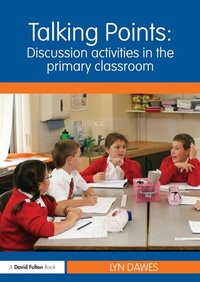
Talking Points: Discussion Activities in the Primary Classroom
1st Edition
Published on 1. March 2013
144 pages
978-1-136-73795-4 (ISBN)
Description

Talking Points: Discussion Activities in the Primary Classroom encourages and supports classroom discussion on a range of topics, enabling children to develop the important life-skill of effective group communication. Children who can explain their own ideas and take account of the points of view and reasons of others are in the process of becoming truly educated. This book offers a straightforward way of teaching children discussion skills within the framework of a creative curriculum.
The book provides an introduction on how to help children learn the skills of group discussion, offering six essential Talk Lessons to use in the classroom, alongside suggestions on how teachers can plan their lessons with a talk focus, set learning outcomes and create their own Talking Points to suit topics they are teaching. The main body of the book contains the Talking Points resources which are an excellent, tried and tested way of stimulating and supporting extended talk about a topic. The Talking Points in this book offer model for teachers to create further Talking Points for their own classes. The Talking Points included here offer discussion in several curriculum areas including:-
Science
Literacy
Philosophy and creativity for children
History
Mathematics
Art and Music
This invaluable book offers engaging, stimulating and thought provoking ideas for children to pit their wits against, promoting skills in discussion, analysis, reasoning and interaction. It is highly beneficial reading for teachers working in Key Stage 2, head teachers and those responsible for staff development, as well as students on teacher training courses and graduate training programmes.
The book provides an introduction on how to help children learn the skills of group discussion, offering six essential Talk Lessons to use in the classroom, alongside suggestions on how teachers can plan their lessons with a talk focus, set learning outcomes and create their own Talking Points to suit topics they are teaching. The main body of the book contains the Talking Points resources which are an excellent, tried and tested way of stimulating and supporting extended talk about a topic. The Talking Points in this book offer model for teachers to create further Talking Points for their own classes. The Talking Points included here offer discussion in several curriculum areas including:-
Science
Literacy
Philosophy and creativity for children
History
Mathematics
Art and Music
This invaluable book offers engaging, stimulating and thought provoking ideas for children to pit their wits against, promoting skills in discussion, analysis, reasoning and interaction. It is highly beneficial reading for teachers working in Key Stage 2, head teachers and those responsible for staff development, as well as students on teacher training courses and graduate training programmes.
More details
Language
English
Place of publication
London
United Kingdom
Publishing group
Taylor & Francis Ltd
Target group
College/higher education
Professional and scholarly
Illustrations
2 s/w Tabellen, 4 s/w Photographien bzw. Rasterbilder, 55 s/w Zeichnungen
2 Tables, black and white; 55 Line drawings, black and white; 4 Halftones, black and white
File size
1,81 MB
ISBN-13
978-1-136-73795-4 (9781136737954)
Copyright in bibliographic data and cover images is held by Nielsen Book Services Limited or by the publishers or by their respective licensors: all rights reserved.
Schweitzer Classification
Other editions
Additional editions
Lyn Dawes
Talking Points: Discussion Activities in the Primary Classroom
Discussion Activities in the Primary Classroom
Book
10/2011
1st Edition
Routledge
€193.45
Shipment within 15-20 days
Lyn Dawes
Talking Points: Discussion Activities in the Primary Classroom
Discussion Activities in the Primary Classroom
Book
10/2011
1st Edition
Routledge
€60.91
Shipment within 15-20 days
Person
Lyn Dawes has extensive teaching experience and is currently Senior Lecturer in Education at the University of Northampton, UK, and visiting lecturer at Cambridge University, UK. Her previous publications include Creating a Speaking and Listening Classroom: Integrating Talk for Learning at Key Stage 2 and The Essential Speaking and Listening: Talk for Learning at Key Stage 2, both published by David Fulton.
Paul Warwick, author of the science information notes which accompany the Talking Points, is Senior Lecturer in Education at Cambridge University, UK, specialising in science education.
Paul Warwick, author of the science information notes which accompany the Talking Points, is Senior Lecturer in Education at Cambridge University, UK, specialising in science education.
Content
Talking Points Introduction Page 3
Talking Points for Science Page 16
Small creatures
Micro-organisms
The air and breathing
In the garden
Problems for the Earth
Seeds
Force
Magnetism
Light and Shadow
Sound
Our Place in Space
Solids, Liquids and Gases
Finding out about a range of materials
Materials and the senses
Water
Talking Points for History Page 53
The Georgians
The Vikings
The Incas
Lots to Talk About Page 60
Ways of learning
Listening
Friends
Hands
Places we like
Money
Time
Play
Pets
Hedgehogs
Recycling
Music
Works of Art Talking Points: Weeping Woman by Pablo Picasso
Works of Art Talking Points: The Bedroom at Arles by Vincent Van Gogh
Works of Art Talking Points: The Singing Butler by Jack Vettriano
Works of Art Talking Points: Farbstudie Quadrate by Wassily Kandinski
Talking Points: All the Children of the World
5. Talking Points for Poems and Stories Page 80
In the Station of the Metro by Ezra Pound
Flanking Sheep in Mosedale by David Scott
High Flight (An airman's ecstasy) by John Gillespie Magee
Bruce Ismay's Soliloquy by Derek Mahon
The Door by Richard Edwards
The Invisible Beast by Jack Prelutsky
The quarrel by Eleanor Farjeon
Helping's Easy by I. Yates
Waking at Night by J. Kenward
Spring Pools by Robert Frost
Loveliest of Trees, the Cherry Now by A. E. Housman
Trout Leaping in the River Arun
Where a Juggler was Drowned by Charles Dalman
Tall nettles by Edward Thomas
The Vixen by John Clare
Open all the cages by Richard Edwards
Snow by Louis McNeice
Why Brownlee Left
by Paul Muldoon
Gorilla by Martin Honeysett
The Pied Piper by Robert Browning
The Highwayman by Alfred Noyes
Peter Pan by J. M. Barrie
The Once and Future King by T. H. White
6. Talking Points: Lists Page 105
List 1. Things that are a waste of time
List 2. Things that are always enjoyable
List 3. Things that we would like to change
List 4. Things that we would like to keep the same
List 5. Things that should be round
List 6. Things to think of when lying awake in the middle of the night
List 7. Things that are going to go wrong in the future
List 8. Things about being an adult that are better than being a child
List 10. Things that we aim to do
7. Talking Points for Mathematics Page 115
2D & 3D shapes
About the number 3
About the number 5
Prime Numbers
Circles
Probability
Further Reading Page 123
Talking Points for Science Page 16
Small creatures
Micro-organisms
The air and breathing
In the garden
Problems for the Earth
Seeds
Force
Magnetism
Light and Shadow
Sound
Our Place in Space
Solids, Liquids and Gases
Finding out about a range of materials
Materials and the senses
Water
Talking Points for History Page 53
The Georgians
The Vikings
The Incas
Lots to Talk About Page 60
Ways of learning
Listening
Friends
Hands
Places we like
Money
Time
Play
Pets
Hedgehogs
Recycling
Music
Works of Art Talking Points: Weeping Woman by Pablo Picasso
Works of Art Talking Points: The Bedroom at Arles by Vincent Van Gogh
Works of Art Talking Points: The Singing Butler by Jack Vettriano
Works of Art Talking Points: Farbstudie Quadrate by Wassily Kandinski
Talking Points: All the Children of the World
5. Talking Points for Poems and Stories Page 80
In the Station of the Metro by Ezra Pound
Flanking Sheep in Mosedale by David Scott
High Flight (An airman's ecstasy) by John Gillespie Magee
Bruce Ismay's Soliloquy by Derek Mahon
The Door by Richard Edwards
The Invisible Beast by Jack Prelutsky
The quarrel by Eleanor Farjeon
Helping's Easy by I. Yates
Waking at Night by J. Kenward
Spring Pools by Robert Frost
Loveliest of Trees, the Cherry Now by A. E. Housman
Trout Leaping in the River Arun
Where a Juggler was Drowned by Charles Dalman
Tall nettles by Edward Thomas
The Vixen by John Clare
Open all the cages by Richard Edwards
Snow by Louis McNeice
Why Brownlee Left
by Paul Muldoon
Gorilla by Martin Honeysett
The Pied Piper by Robert Browning
The Highwayman by Alfred Noyes
Peter Pan by J. M. Barrie
The Once and Future King by T. H. White
6. Talking Points: Lists Page 105
List 1. Things that are a waste of time
List 2. Things that are always enjoyable
List 3. Things that we would like to change
List 4. Things that we would like to keep the same
List 5. Things that should be round
List 6. Things to think of when lying awake in the middle of the night
List 7. Things that are going to go wrong in the future
List 8. Things about being an adult that are better than being a child
List 10. Things that we aim to do
7. Talking Points for Mathematics Page 115
2D & 3D shapes
About the number 3
About the number 5
Prime Numbers
Circles
Probability
Further Reading Page 123
