

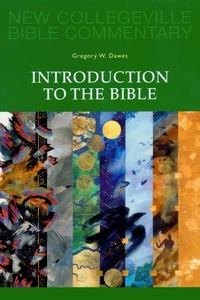
Introduction to the Bible
Description

When we first pick it up and open it, the Bible can seem confusing and perhaps even frightening. Here is this bulky book, made up of seventy-three sections with unfamiliar titles such as Deuteronomy, Ecclesiastes, Colossians, and Corinthians, with numbers in front of almost every sentence, rarely any pictures, and perhaps a few maps of ancient areas such as Mesopotamia, Assyria, and Judah. Since the Bible looks like a book, we may start to read it as we would any other book, hoping to move from cover to cover. Then we begin to wonder, Who wrote this? When was it written? What kind of writing is this: History? Science? Biography? Fiction? What am I supposed to get out of it? As (or if) we keep reading the Bible page by page, section by section, we soon realize that this is no ordinary run-of-the-bookshelf volume. Without a guide the Bible is likely to remain the book most often purchased but not very often read and even less often understood.
To rescue Bible readers and students from turning their initial enthusiasm into boredom, Gregory Dawes gives us this Introduction to the Bible, the indispensable prologue to the entire series of the New Collegeville Bible Commentary. Dividing the contents into two parts, the author first describes how the Old and New Testaments came to be put together, and then explores how their stories have been interpreted over the centuries. In the words of Dawes, this very broad overview of a very complex history offers the general reader a helpful framework within which to begin to understand the Bible. The author writes clearly, frequently seasoning his explanations with crisp examples. This book anchors individual and group Bible study on the solid foundation of basic biblical vocabulary and concepts.
Gregory W. Dawes is senior lecturer in both religious studies and philosophy at the University of Otago (New Zealand). He undertook graduate study at the Pontifical Biblical Institute in Rome, where he completed the Licentiate degree, before receiving a PhD from the University of Otago in 1995. He has written several books, the most recent being The Historical Jesus Question: The Challenge of History to Religious Authority (Westminster John Knox, 2001). He is currently researching Christian responses to the work of Charles Darwin.
More details
Other editions
Additional editions
Person
Content
- Intro
- Titlepage
- Copyright
- Contents
- Abbreviations
- Introduction
- THE ORIGINS OF THE BIBLE
- The Biblical Canon
- The Formation of the Old Testament Canon
- (a) The crisis of the Exile
- (b) The growth of the canon
- (c) Canonical and deuterocanonical books
- The Formation of the New Testament Canon
- (a) The Old Testament as Christian Scripture
- (b) Stages in the development of a canon
- Texts and Translations
- (a) The transmission of the biblical text
- (b) Ancient translations
- (c) Modern translations
- (d) Division into chapters and verses
- THE INTERPRETATION OF THE BIBLE
- The Task of Interpretation
- Patristic and Medieval Interpretation (ca. 200-1500)
- Principles of Patristic and Medieval Interpretation
- (a) Old and New Testaments
- (b) Bible and church
- (c) Sacred and secular knowledge
- Patristic and Medieval Exegesis
- (a) The regula fidei (rule of faith)
- (b) The spiritual sense of Scripture
- (c) The four senses of Scripture
- Reformation and Counter-Reformation (ca. 1500-1650)
- The Bible and the Church
- (a) The Bible interprets itself
- (b) The Bible authenticates itself
- (c) The Bible has a single meaning
- The Catholic Response
- The Bible in the Modern Era (ca. 1650-today)
- The Development of Historical Criticism
- The Reception of Historical Criticism
- (a) The Protestant Churches
- (b) The Catholic Church
- Postmodern Biblical Interpretation
- The Indeterminacy of Meaning
- (a) Part and whole
- (b) The historical context
- (c) The "intentional fallacy"
- (d) Text and reader
- (e) A hermeneutics of suspicion
- Conclusions
- Review Aids and Discussion Topics
- Maps
