

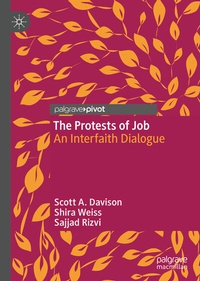
The Protests of Job
Description

This book explores the protests of Job from the perspectives of Jewish, Christian, and Islamic religious and philosophical traditions. Shira Weiss examines how challenges to divine justice are understood from a Jewish theological perspective, including the pro-protest and anti-protest traditions within rabbinic literature, in an effort to explicate the ambiguous biblical text and Judaism's attitude towards the suffering of the righteous. Scott Davison surveys Christian interpretations of the book of Job and the nature of suffering in general before turning to a comparison of the lamentations of Jesus and Job, with special attention to the question of whether complaints against God can be expressions of faith. Sajjad Rizvi presents the systematic ambiguity of being present in monistic approaches to reality as one response to evil and suffering in Islam, along with approaches that attempt a resolution through the essential erotic nature of the cosmos, and explores the suggestionthat Job is the hero of a metaphysical revolt that is the true sign of a friend of God. Each author also provides a response essay to the essays of the other two authors, creating an interfaith dialogue around the problem of evil and the idea of protest against the divine.
Reviews / Votes
"This book is a charming exchange of ideas between three superb scholars from the three main Abrahamic faiths. Officially it is a discussion of the Biblical and Quranic figure of Job. As with any discussion of Job, it is also a discussion of the problem of evil, theodicy, and protest against God. But the book is much more than this. It is also a showcase of a very particular form of interfaith dialogue-or better still, interfaith encounter: a form of interfaith dialogue that doesn't settle for trite comparison, nor fears respectful disagreement. It is the meeting of three minds, three traditions, three scholars, and three people, in an atmosphere of mutual respect."-Samuel Lebens , University of Haifa, Israel
More details
Other editions
Additional editions
Persons
Scott A. Davison is Professor of Philosophy at Morehead State University, USA. He is the author of On the Intrinsic Value of Everything (2011), Petitionary Prayer: A Philosophical Investigation (2017), and God and Prayer (2022), and serves as the associate editor for the journal Faith and Philosophy .
Shira Weiss teaches Jewish Thought at Yeshiva University, USA. She is the author of Joseph Albo on Free Choice: Exegetical Innovation in Medieval Jewish Philosophy (2017) and Ethical Ambiguity in the Hebrew Bible (2018). Her current project explores the ethics of violence in biblical narrative.
Sajjad Rizvi is Professor of Islamic Intellectual History and Director of the Institute of Arab and Islamic Studies at the University of Exeter, UK. A specialist on Islamic philosophical traditions since 1600, he is currently working on a monograph on philosophy in contemporary Iran.
