

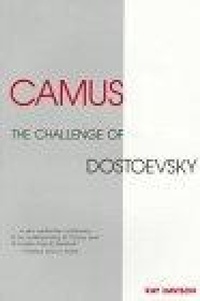
Camus
The Challenge of Dostoevsky
Published on 1. August 2024
254 pages
978-1-80413-150-3 (ISBN)
Description

This is the first full-length study in English of Camus's life-long fascination with the works of the Russian writer Feodor Dostoevsky. The purpose of the book is to demonstrate the ways in which Dostoevsky's thought and fiction served to stimulate and crystallize Camus's own thinking. Davison lucidly identifies the lines of divergence and counter-arguments which Camus produced as answers to the challenge of Dostoevsky's Christian/Tzarist vision of life.
The traditional methods of comparative literary criticism are jettisoned in favour of the more exciting claim that Camus's literary and philosophical texts can be read as precise and detailed replies to some of Dostoevsky's central beliefs about immortality, religion and politics. The study ranges freely over the entirety of the works of both major writers.
The traditional methods of comparative literary criticism are jettisoned in favour of the more exciting claim that Camus's literary and philosophical texts can be read as precise and detailed replies to some of Dostoevsky's central beliefs about immortality, religion and politics. The study ranges freely over the entirety of the works of both major writers.
Reviews / Votes
Scholarly and thoughtfully written . . . Davison's book, which also includes a comprehensive bibliography and index, amounts to an invaluable and interesting contribution to Camus studies. * French Studies, LIV.I, 2000 * Ray Davison has . . . Produced an important and thought-provoking book. It would be helpful to compare it with P. Dunwoodie's Une histoire ambivalente: le dialogue Camus-Dostoievski (Nizet, 1996) as Davison himself suggests. The widening and deepening of the notion of influence which both books are concerned with is a very worthwhile development. * New Zealand Journal of French Studies, Volume 20, Number 2 1999 * Davison's contextual approach is consistently rich and his ideas are elegantly and powerfully expressed. He engages with other major critics (notably Peter Dunwoodie) and establishes important links between texts.By quoting lavishly from the full range of the author's works, including speeches, letters and diaries (French translations of the original Russian texts are used), Davison allows the reader to follow at close hand the internal dynamics of the relationship...Davison's study... offers the most complete account yet of the Camus-Dostoevsky relationship. * Journal of European Studies Vol XXVIII 1998 * Complementing Peter Dunwoodie's recent study, Ray Davison's engaging account of Camus and Dostoevsky constitutes another invaluable contribution to Camus scholarship. * Modern and Contemporary France, Volume 6, No 4, 1998 * Through detailed and lucid analysis of Camus's texts, Davison traces the impact that the Russian works had on Camus's intellectual development and highlights his attempts at forging a counter-discourse. . . Readers will welcome the clarity of analysis and exposition of complex ideas in the 'world of ideas and politics' and the flexible chronology which shows Camus engaging with Dostoevsky at different stages as novelist/philosopher of the absurd, as Christian humanist and, finally, as prophet of twentieth-century political nihilism and totalitarianism. Even more welcome, perhaps, is his ability to uncover something of the complex dynamism, the excitement and the frustration in that relation. . . Camus himself claimed that one cannot understand twentieth-century French literature without reference to Dostoevsky, and in tracing the way Camus wrestled with him intellectually, Davison has, perhaps, put in place the final piece of a jigsaw which has exercised critics for fifty years. * Times Literary Supplement *More details
Language
English
Place of publication
Exeter
United Kingdom
Target group
College/higher education
File size
20,41 MB
ISBN-13
978-1-80413-150-3 (9781804131503)
Copyright in bibliographic data and cover images is held by Nielsen Book Services Limited or by the publishers or by their respective licensors: all rights reserved.
Schweitzer Classification
Other editions
Additional editions
Book
08/1997
University of Exeter
€33.80
Shipment within 15-20 days
Person
Ray Davison is Lecturer in French, University of Exeter. His published work includes an edition of Albert Camus's L'Etranger and Simone de Beauvoir's Une Mort tres douce.
Content
Acknowledgements
Introduction
1. Camus and Dostoevsky: an Encounter in Profile
2. Dostoevsky and the Absurd Novel
3. Suicide and Logic: Camus's use of Dostoevsky's 'Judgement' and 'Moralite un peu tardive' in Le Mythe de Sisyphe.
4. Camus and Dostoevsky's Revels
5. Freedom and the Man-God: Camus and Kirilov in Le Mythe de Sisyphe
6. Two Tzars of the Absurd: Stavroguine and Ivan in Le Mythe de Sisyphe
7. Ivan and Metaphysical Revolt: the Shadow of the Grand Inquisitor
8. Camus and Les Possedes: Nihilism and Historical Revolt
9. From the Last to the First Man: The Challenge of The Underground
Conclusion
Notes
Bibliography
Index
Introduction
1. Camus and Dostoevsky: an Encounter in Profile
2. Dostoevsky and the Absurd Novel
3. Suicide and Logic: Camus's use of Dostoevsky's 'Judgement' and 'Moralite un peu tardive' in Le Mythe de Sisyphe.
4. Camus and Dostoevsky's Revels
5. Freedom and the Man-God: Camus and Kirilov in Le Mythe de Sisyphe
6. Two Tzars of the Absurd: Stavroguine and Ivan in Le Mythe de Sisyphe
7. Ivan and Metaphysical Revolt: the Shadow of the Grand Inquisitor
8. Camus and Les Possedes: Nihilism and Historical Revolt
9. From the Last to the First Man: The Challenge of The Underground
Conclusion
Notes
Bibliography
Index
