

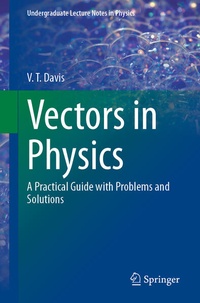
Vectors in Physics
Description

This book provides a rigorous and comprehensive exposition of vectors and vector fields, designed for advanced undergraduate students in physics. It presents detailed derivations of essential vector identities, relations involving quantum vector operators, and vector calculus theorems commonly encountered in undergraduate and graduate physics coursework. A complete catalogue of vector identities-spanning both classical and quantum contexts-is presented using index notation and the Einstein summation convention, fostering fluency with tensorial methods and streamlining complex derivations.
Core topics include vector algebra, differential and integral vector calculus, and three-dimensional Taylor expansions, supported by careful treatments of the essential underlying mathematical tools. Advanced subjects-such as the Dirac delta function, Green's functions, multipole expansions, and Cartesian tensors-are introduced with a balance of formal clarity and pedagogical accessibility. A dedicated chapter on tensor transformations, invariants, and the Levi-Civita and Kronecker symbols offers a foundation for further study in areas such as general relativity and quantum field theory. Each chapter contains numerous worked examples and end-of-chapter problems, all accompanied by complete solutions, making the text well-suited for both structured coursework and independent study.
More details
Other editions
Additional editions
Person
Dr. V. T. Davis currently serves as an Adjunct Professor and Instructor of Physics in the undergraduate and graduate physics programs at the University of Nevada, Reno. Previous positions include Assistant Professor of Physics and Director, United States Military Academy Photonics Research Center (West Point, NY); Acting Director, Office of Proliferation Detection (NA-221), Office of Nuclear Nonproliferation Research & Development, National Nuclear Security Agency, United States Department of Energy (Washington, D.C.); and Director of Scientific Operations, Nevada Terawatt Facility, University of Nevada, Reno. He has a B.S. in Nuclear Engineering from the United States Military Academy (West Point, NY), an M.S. in Strategic Studies from the United States Army War College (Carlisle, PA), and received his Ph.D. in Physics from American University (Washington, D.C.). Dr. Davis is a researcher with the Atomic, Molecular, Optical, and Chemical Physics Group at the university of Nevada, Reno. His research interests include photoelectron spectroscopy and photon-ion interactions. He is the author of the book Introduction to Photoelectron Angular Distributions: Theory and Applications. He is a veteran of the U. S. Army with over thirty years of service.
Content
Introduction.- Vector Algebra.- Vector Calculus.- Vector Expansions and the Dirac Delta Function.- Applications in Classical and Quantum Physics.- Introduction to tensors.- Solutions to Chapter Two Problems.- Solutions to Chapter Three Problems.- Solutions to Chapter Four Problems.- Solutions to Chapter Five Problems.- Solutions to Chapter Six Problems.
