

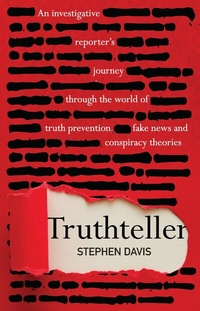
Truthteller
Description

It takes you inside the world of investigative reporting in an intimate history of a reporter's battles, won and lost, the personal and professional costs and the lives damaged along the way.
More details
Other editions
Additional editions
Person
Content
1. From the toolbox: The art of character assassination. The strange journey of Richard Tomlinson
2. From the toolbox: Shoot the messengers. If a forest is destroyed and no one is there to see it, does anyone care?
3. From the toolbox: Our conspiracy theories are better than yours. The Estonia mystery: Spies, smugglers, secret packages and Putin
4. From the toolbox: Delay, delay, delay until everyone gets bored. A murder confession is ignored
5. From the toolbox: Create your own reality. State-sponsored stories and other distractions
6. From the toolbox: Manufacture another truth. The human shields - how a cover-up was covered up
7. From the toolbox: The value of distance. An Antarctic rescue and the death of a scientist
8. From the toolbox: Official secrets and other means of suppression. How to avoid a government stopping your book being published
9. From the toolbox: Behind closed doors. Making lots of people angry in the world's friendliest country
10. A different tool: Happy endings, deception practised by journalists and other good people. Misleading the world's children
11. The assault on truth: Where to from here?
Thanks
Endnotes
Index
Introduction:
A toolbox for lies and deception
The story began with a quote from an anonymous official from the Indian state of Maharashtra. It was reported by the Press Trust of India and then revealed to a wider audience by a Republican congresswoman speaking on CNN. A few hours later it spread all over the internet and the world learnt that President Barack Obama's trip to Asia was going to cost US taxpayers $200 million a day - a staggering $2 billion dollars for the entire ten-day trip. The numbers were huge, and they grew in detail with every new version of the story.
He was taking 2000 people with him - no, it was 3000. Hundreds of hotel rooms had been booked - no, it was 870 - and they were all in five-star hotels like the one at the Taj Mahal. Thirty-four US navy war ships were accompanying the President - later, it was 10 per cent of the entire navy. It was an outrageous waste of government money.
There was just one problem - it wasn't true. It wasn't close to being true, even for those who think there are shades of truth.
The Obama story is an example of the classic political lie: a fabrication spread by Tea Party congresswoman Michele Bachmann, right-wing talk show hosts and online sites. The $200-million-a-day figure was ludicrous - the entire war in Afghanistan, with the deployment of thousands of troops, was costing less than that. Presidential trips do involve large entourages - including a huge security presence - but the cost was more like $5 million per day. The US Navy was going to be there - for exercises with allies - but not 34 ships and not 10 per cent of the navy.
While the true version of the story appeared on traditional media outlets, the false version reached many millions. It was an early example of what might now be called Trumpean falsehoods, after the serially mendacious President of the United States. Blatant lies helped to get him elected and persuaded millions of Americans to support his presidency. These attempts to distort the truth - practised by politicians of all parties and nationalities, to a greater or lesser degree - at least have the merit of being relatively easy to spot, and refute. They are put to the test and exposed by journalists asking the right questions. If you want to find out whether such a story is true, you can.
But there are other forms of government and corporate lying and deception that are harder to spot. There is a large and growing number of methods that the rich, the powerful and the elected use to prevent truth coming out - to bury it, warp it, twist it to suit their purposes. This toolbox of deception is used not only to promote their interests or defeat opponents but to conceal blunders or crimes, to cover up corruption or hide things that are just plain embarrassing.
To show how these tools work, I have used direct examples from my own reporting in stories I have investigated as an award-winning reporter, editor, foreign correspondent, television producer, documentary filmmaker and journalism educator across three decades.
Each chapter begins with the original story, so readers can understand the human consequences of truth denial. In some of these stories there are still questions to be answered and mysteries to be solved, demonstrating how successfully the tools have been deployed. I have also used examples from other media, in case histories. Despite the best efforts of dedicated reporters, the remarkable array of tools used by those in the business of deception continues to be deployed and with great success.
I hope to inspire truth seekers of the future, because the battle between those seeking to expose the truth and those seeking to prevent it is an unequal struggle. Young journalists and other concerned citizens seeking to make informed decisions are up against a huge apparatus of truth denial and distortion.
Journalists, even when working for profitable media companies, have never had the resources of governments and corporations. It is an even more one-sided contest in present-day media, as serious reporting is constrained by finances and the very question of what constitutes journalism, of what is a story, is challenged by social media. 'We are all journalists now,' declared one magazine, noting the spread of mobile phone cameras and Twitter accounts. Left unsaid was how anyone was going to verify any of the photos, videos and tweets. So you will also find here a guide to a journalist's decision making - the behind-the-scenes view that you don't often see.
Look at what passes for news on any given day. Much of it is trivia that catches people's attention, and often distracts them from what is really going on, things deliberately obscured from view and meant to stay that way. We are bombarded with imagery and words 24/7 in the news cycle - a cycle not just about news, but all kinds of other distractions.
We are on Facebook, watching carefully filtered videos and posts from friends, or YouTube, or discovering 10 Things You Didn't Know About the Moon Missions via Google. And so all that we read or hear or see has come to seem equally important, or equally unimportant.
Those who have things to hide can hide them in plain sight, a press release or news conference saying X when the real story is actually Y; a public meeting where the discussion they have after they close the doors is about something much more controversial; a corporate video of trees and birds and flowers disguising environmental destruction. Lying, cover-ups, media manipulation - these have always been with us. But now they are practised by ever more skilled, highly paid professionals and, increasingly, zealous amateurs armed with a little knowledge, social media savvy and an agenda.
They know they can get away with it because, well, we simply aren't paying close enough attention. If there is a massacre in Africa and it is not on camera, did it really happen? But a cat on a skateboard, that is real, we can click on that and watch it again and again. We filter things out or let every bit of trivia in; either way, our judgments have become too often the judgments of others. And we wake up every morning in a world where our truth is what we believe on any given day, and if we need a change then a different truth is just a click away. That is a gift for those who would deceive us.
Lie about current events, shout your lies from the rooftops, repeat them again and again with an absolutely straight face and eventually a good proportion of people will believe the lie; and if you can do that often enough, it will help sustain you in power and make it difficult for people to know what is true and what is not. Create your own reality, using your own media, and get the public to believe in that.
Even better, create your own conspiracy, to muddy the waters. People expect to be lied to - give them a conspiracy to suit. Widely read stories tell us how humans did not land on the moon, that the structure of the Louvre in Paris and its pyramid is the key to a secret society, that Mossad organized the attack on the Twin Towers to turn the world against Muslims, and the Bush White House and the CIA helped them do it.
If everything is made to look like a conspiracy then the real conspiracies, the ones that honest journalists have pursued over the years, can easily get lost in the noise. This book is for those who don't want to get lost in the noise. For democracy to function, there needs to be a free flow of facts. There needs to be an understanding that, as American politician Daniel Patrick Moynihan once said, you are entitled to your own opinions but you are not entitled to your own facts.
Good decision making, either in organizing our own lives or as responsible citizens, is based on accurate information. We must become more critical consumers of the media and for that to happen, we need to be able to recognize the tools that have been used to deceive or to hide things from us.
The historian Timothy Snyder stresses the importance of reality and truth in his cautionary pamphlet, 'On Tyranny'. 'To abandon facts,' he writes, 'is to abandon freedom. If nothing is true, then no one can criticize power because there is no basis upon which to do so. If nothing is true, then all is spectacle. The biggest wallet pays for the most blinding lights.'1
The toolbox glossary
There are many tools used to deceive. The deceivers rely on our inattention and our seemingly insatiable demand for the new, so we are often bored with a slow developing story, the steady accumulation of facts. We want instant answers - so unanswered questions are filed away. We lead busy lives so it is difficult to deal with so much detail. Often, we believe the first version of a story and miss the follow-ups. We are all guilty of this and so we are easy victims of some of the major truth-prevention tools described in this book. In some cases, multiple tools are deployed, with variations tailored to suit the lie.
Each chapter of this book describes how one or more of the tools listed below has been used to suppress the truth.
Behind closed doors: let's talk about this
You are accused of wrongdoing, or you or your agency or company has made a mistake or done something embarrassing you wish to hide. Reporters are after you, asking questions you do not wish to answer. You need to make the reporters go away or have the questions asked in such a way that you keep control of the story. You want to frame the questions. Your version of the truth needs to be the one that counts.
So you bypass the reporters and appeal to their editor,...
