

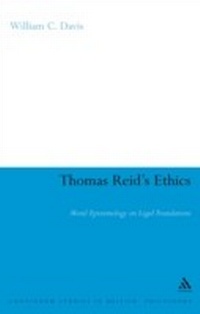
Thomas Reid's Ethics
Moral Epistemology on Legal Foundations
1st Edition
Published on 24. October 2006
192 pages
978-1-84714-443-0 (ISBN)
Description

Thomas Reid (1710-96) was one of the most daring and original thinkers of the eighteenth century. His work became the cornerstone of the Scottish School of Common Sense Philosophy, and was highly influential in nineteenth-century America; it also anticipated the thinking of such twentieth-century figures as Moore and Wittgenstein. Now, after a long period of neglect, his philosophy is again the subject of increasing attention across the world. For Reid, knowing about ethics is a matter of having 'good evidence' supplied by a sense-like moral faculty. William Davis's book shows how such a view can be both consistent and plausible in the twenty-first century.
Thomas Reid's Ethics begins by characterizing the state of moral epistemology at the time when Reid was writing. It goes on to recount Reid's central claims about the moral sense, and describes the various problems that confront those who would explain and defend his views. Davis lays the foundation for resolving these difficulties by detailing an epistemological conception of evidence which parallels the legal conception of evidence used by the Scottish courts of Reid's day. He then shows how Reid's claims about evidence and self-evidence are best understood in light of this legal model. The book concludes by responding to recent worries about 'moral sense' theories, and offers a final assessment of the success of Reid's ethical project.
The book will be of substantial interest not only to Reid scholars and historians of philosophy, but also to specialists and students in contemporary ethics.
More details
Series
Edition
1. Auflage
Language
English
Place of publication
London
United Kingdom
Publishing group
Bloomsbury Publishing PLC
Target group
Professional and scholarly
ISBN-13
978-1-84714-443-0 (9781847144430)
Copyright in bibliographic data and cover images is held by Nielsen Book Services Limited or by the publishers or by their respective licensors: all rights reserved.
Schweitzer Classification
Other editions
Additional editions
Book
10/2006
Continuum International Publishing Group Ltd.
€231.80
Shipment within 15-20 days
Person
William C. Davis teaches Philosophy at Covenant College, Georgia, USA. He is the author of numerous articles in a variety of philosophical books and journals.
WILLIAM COLUMBUS DAVIS' academic career spans more than a quarter of a century and includes positions with the University of Georgia, George Washington University, and most recently the National War College, where he served as Professor of International Affairs. He was director of Latin American Studies at all three institutions.
WILLIAM COLUMBUS DAVIS' academic career spans more than a quarter of a century and includes positions with the University of Georgia, George Washington University, and most recently the National War College, where he served as Professor of International Affairs. He was director of Latin American Studies at all three institutions.
Content
Ch 1: Background to Reid's moral epistemology
Ch 2: Reid's puzzling account of the moral faculty
Ch 3: Reid's legal conception of evidence
Ch 4: Reid's epistemology
Ch 5: Practical reason and the moral sense analogy
Ch 6: Moral knowledge
Ch 7: Queerness, disagreement, and conclusion
Bibliography
Index
Ch 2: Reid's puzzling account of the moral faculty
Ch 3: Reid's legal conception of evidence
Ch 4: Reid's epistemology
Ch 5: Practical reason and the moral sense analogy
Ch 6: Moral knowledge
Ch 7: Queerness, disagreement, and conclusion
Bibliography
Index
