

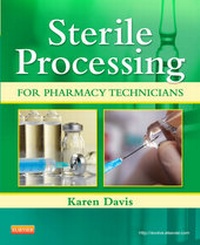
Sterile Processing for Pharmacy Technicians
1st Edition
Published on 27. December 2013
160 pages
978-0-323-29219-1 (ISBN)
Available for download
Description

Covering aseptic technique and how to prepare sterile products, Sterile Processing for Pharmacy Technicians ensures safety, accuracy, and correctness of medications. Reflecting American Society of Health System Pharmacists (ASHP) competencies, this comprehensive book provides principles and guidelines, laboratory exercises, and hands-on practice with actual institutional orders. Written by expert pharmacy technician educator Karen Davis, Sterile Processing for Pharmacy Technicians also provides checklists that map to ASHP competencies!
- Complete coverage of USP <797> guidelines, basic aseptic manipulations, and working with IVs prepares you for institutional externships and for practice.
- Unique! ASHP competency checklists allow accurate documentation of competencies.
- Lab activities allow you to perform basic, hands-on aseptic manipulations in the lab.
- Tech Notes provide hints that you can use on the job.
- Tech Alerts provide safety warnings and help you avoid common errors.
- Guidelines and objectives are consistent with the ASHP Model Curriculum for Technician Training.
- Student resources on an Evolve companion website help you review and apply what you have learned with quizzes, syringe calculations, and critical thinking exercises.
More details
Other editions
Additional editions
Karen Davis
Sterile Processing for Pharmacy Technicians
Book
09/2013
Saunders
€60.91
Article exhausted; check for reprint
Content
- Front Cover
- Sterile processing for pharmacy technicians
- Copyright page
- Reviewers
- Preface
- Table of contents
- 1 The basics of aseptic preparations
- Learning objectives
- Terms & definitions
- Introduction
- History of aseptic preparations
- Aseptic technique
- Handwashing and standard precautions
- Personal protective equipment
- Environment and responsibility of personnel
- Cleanroom and air space
- The hood
- Settings for intravenous therapy
- Review questions
- Competencies
- Bibliography
- 2 Administration of intravenous products
- Learning objectives
- Terms & definitions
- Introduction
- Parenteral medications and nutrition
- Intravenous administration
- Advantages of intravenous medications
- Disadvantages of intravenous medications
- Health-system intravenous administration
- Home infusion therapy
- Review questions
- Competencies
- Bibliography
- 3 Medications used in intravenous preparations
- Learning objectives
- Terms & definitions
- Introduction
- Pharmacokinetics for parenteral medications
- Special dosing considerations for parenteral medications
- Disease states or existing conditions
- Age
- Drug interactions
- Body weight
- Routes of administration
- References and storage information
- Review questions
- Competencies
- Bibliography
- 4 Intravenous solutions, stability, and incompatibilities
- Learning objectives
- Terms & definitions
- Introduction
- Characteristics of different solutions used in intravenous therapy
- Compatibility and incompatibility of intravenous fluids
- Temperature
- Light
- Time
- Dilution
- Compatibility
- Ph
- Intravenous solution
- Order of mixing
- Sources of information and references available
- Review questions
- Competencies
- Lab activity
- Bibliography
- 5 Calculations used in intravenous preparations
- Learning objectives
- Terms & definitions
- Introduction
- Calculations involving injectable medications
- Special considerations for parenteral medications
- Powder volume
- Formula
- Example 3
- Example 4
- Step 1.
- Step 2.
- Calculation examples for intravenous mixtures
- Preparing intravenous medications from a powder injectable
- Calculating intravenous admixture flow rates
- Pain controlled analgesia
- Review questions
- Competencies
- Lab activity
- Bibliography
- 6 Equipment and facilities
- Learning objectives
- Terms & definitions
- Introduction
- Aseptic technique and usp 797 guidelines used in intravenous therapy
- Environment, garbing, and equipment cleaning procedures
- Ante room or iso class 8 environment
- Buffer area (clean room) or iso class 7 environment
- Direct compounding area or iso class 5 environment
- Laminar airflow workbench and biological safety cabinet
- Laminar airflow workbench (hood) or direct compounding area cleaning procedure
- Garbing
- Supplies used in aseptic preparation
- Review questions
- Competencies
- Bibliography
- 7 Techniques for preparing intravenous admixtures
- Learning objectives
- Terms & definitions
- Introduction
- Equipment used in aseptic manipulations
- Removing an air bubble
- Setting up equipment in a laminar airflow workbench
- Ante area
- Buffer area
- Manipulations used in aseptic preparation
- "Staging" or preparing the admixture for the pharmacist to check
- Transferring medication using a vial with powder
- Ante area
- Buffer area
- Transferring medication from an ampule using a syringe and filter needle
- Ante area
- Buffer area
- Adding medication to a plastic bag
- Adding medications to a bottle
- Ante area
- Buffer area
- Review questions
- Competencies
- Bibliography
- 8 Total parenteral nutrition
- Learning objectives
- Terms & definitions
- Introduction
- Patient considerations and rationale for using parenteral nutrition solutions
- Solution components and special considerations when preparing admixtures
- Components
- Carbohydrates
- Fats or lipids
- Proteins
- Electrolytes
- Vitamins
- Trace elements
- Other additives
- Administration of total parenteral nutrition
- Ante area
- Buffer area
- Gravity method
- Automated compounder machines
- Micronutrients
- Special considerations
- Laboratory and other additional testing requirements
- Review questions
- Competencies
- Bibliography
- 9 Chemotherapy nutrition
- Learning objectives
- Terms & definitions
- Introduction
- Cancer and cytotoxic agents used in its treatment
- Common chemotherapy medications used in cancer treatment
- Alkylating
- Antitumor antibiotics
- Antimetabolites
- Hormones
- Enzyme inhibitors
- Immunomodulating agents
- Miscellaneous agents
- Preparation of chemotherapy agents
- Special considerations, techniques, equipment, and precautions
- Clean up
- Education and training requirements
- Review questions
- Competencies
- Bibliography
- 10 Patient administration considerations
- Learning objectives
- Terms & definitions
- Introduction
- Patient education when administering intravenous therapy in a variety of settings
- Home health care
- Types of intravenous therapy
- Infusion pumps
- Volumetric pumps
- Peristaltic pumps
- Syringe pumps
- Patient-controlled analgesia pumps
- Ambulatory pumps
- Technician responsibilities in infusion therapy
- Review questions
- Competencies
- Lab activity
- Bibliography
- 11 Quality assurance and medication error prevention
- Learning objectives
- Terms & definitions
- Introduction
- Usp 797 guidelines concerning risk levels
- Medication errors
- Patient rights of administration
- Quality assurance practices and quality control elements
- Compounded sterile preparation risk levels
- Low risk level compounded sterile preparations
- Medium risk level compounded sterile preparations
- High risk level compounded sterile preparations
- Review questions
- Competencies
- Lab activity
- Bibliography
- Glossary
- Index
- A
- B
- C
- D
- E
- F
- G
- H
- I
- J
- K
- L
- M
- N
- O
- P
- Q
- R
- S
- T
- U
- V
- W
- Z

