

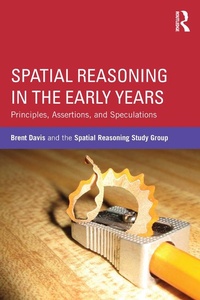
Spatial Reasoning in the Early Years
Principles, Assertions, and Speculations
Published on 17. April 2015
184 pages
978-1-317-64811-6 (ISBN)
Description

Over the past several years, "spatial reasoning" has gained renewed prominence among mathematics educators, as spatial skills are proving to be not just essential to mathematical understanding but also strong predictors of future success beyond the classroom in fields such as science, technology, and engineering. By exploring both primary and emergent dimensions, Spatial Reasoning in the Early Years helps define the concept of spatial reasoning and provides compelling evidence of the need for a clear focus within early education specifically. The authors review the research, look across current theories, and investigate implications for contemporary school mathematics pedagogy as they identify areas of inquiry necessary to bring a stronger spatial reasoning emphasis into the classroom.
The book contains many classroom- or workshop-based vignettes, highlighting the complexity of spatial reasoning in educational practice, providing an in-depth analysis of spatial reasoning as it applies to classroom practice, and offering new ways of framing lessons to help young students hone their spatial reasoning abilities. The book concludes with a forward-looking agenda that contributes to developing a greater understanding of the role spatial reasoning plays in educational contexts and beyond. Supported by plentiful visual representations, Spatial Reasoning in the Early Years skillfully integrates the conceptual and the concrete, making this text a dynamic and accessible resource.
The book contains many classroom- or workshop-based vignettes, highlighting the complexity of spatial reasoning in educational practice, providing an in-depth analysis of spatial reasoning as it applies to classroom practice, and offering new ways of framing lessons to help young students hone their spatial reasoning abilities. The book concludes with a forward-looking agenda that contributes to developing a greater understanding of the role spatial reasoning plays in educational contexts and beyond. Supported by plentiful visual representations, Spatial Reasoning in the Early Years skillfully integrates the conceptual and the concrete, making this text a dynamic and accessible resource.
Reviews / Votes
"Written by an impressive team of multi-disciplinary mathematicians and cognitive scientists, this is a cutting edge read peppered with endearing vignettes and anecdotes of children's play and their response to various learning experiences." - Martine Horvath, eye magazine"This book makes a powerful case for spatializing the elementary school mathematics curriculum. Written by an impressive interdisciplinary team of mathematicians, mathematics educators and cognitive scientists, it presents a cutting-edge and broad-ranging synthesis, set in historical and policy contexts, and illustrated with lovely vignettes of children's play and their responses to lessons." - Nora S. Newcombe, Laura H. Carnell Professor of Psychology, Temple University
"This comprehensive book fills a pernicious gap in the field of mathematics education by describing and analyzing spatial reasoning, a critical competence that is often underemphasized or ignored by educators. Educators who implement these research-based recommendations will help young students form solid foundations for later learning, not just in the more palpable cases of geometry and measurement but across the domains of number, arithmetic, and algebra as well. This book makes a clear case-including theory, research, and concrete practice- for an expanded role of spatial and geometric thinking from the earliest years, one that all educators should read and integrate into their work."- Douglas H. Clements, Kennedy Endowed Chair in Early Childhood Learning; Executive Director, Marsico Institute for Early Learning and Literacy; and Professor
More details
Language
English
Place of publication
London
United Kingdom
Publishing group
Taylor & Francis Ltd
Target group
College/higher education
Illustrations
3 s/w Tabellen
3 Tables, black and white
File size
4,16 MB
ISBN-13
978-1-317-64811-6 (9781317648116)
Copyright in bibliographic data and cover images is held by Nielsen Book Services Limited or by the publishers or by their respective licensors: all rights reserved.
Schweitzer Classification
Other editions
Additional editions
Brent Davis | Spatial Reasoning Study Group
Spatial Reasoning in the Early Years
Principles, Assertions, and Speculations
Book
04/2015
1st Edition
Routledge
€241.40
Shipment within 10-20 days
Brent Davis | Spatial Reasoning Study Group
Spatial Reasoning in the Early Years
Principles, Assertions, and Speculations
Book
04/2015
1st Edition
Routledge
€69.00
Shipment within 10-20 days
Persons
Brent Davis is Professor and Distinguished Research Chair of the Werklund School of Education at the University of Calgary, Alberta, Canada.
The Spatial Reasoning Study Group is a transdisciplinary team of researchers from across North America with its hub at the University of Calgary. Its members work in and across mathematics education, mathematics, psychology, curriculum studies, and cognitive science. The group currently includes Catherine D. Bruce, Beverly Caswell, Lissa D'Amour, Brent Davis, Michelle Drefs, Krista Francis, David Hallowell, Zachary Hawes, Donna Kotsopoulos, Lynn McGarvey, Joan Moss, Yukari Okamoto, Paulino Preciado, Nathalie Sinclair, Diane Tepylo, Jennifer S. Thom, and Walter Whiteley.
The Spatial Reasoning Study Group is a transdisciplinary team of researchers from across North America with its hub at the University of Calgary. Its members work in and across mathematics education, mathematics, psychology, curriculum studies, and cognitive science. The group currently includes Catherine D. Bruce, Beverly Caswell, Lissa D'Amour, Brent Davis, Michelle Drefs, Krista Francis, David Hallowell, Zachary Hawes, Donna Kotsopoulos, Lynn McGarvey, Joan Moss, Yukari Okamoto, Paulino Preciado, Nathalie Sinclair, Diane Tepylo, Jennifer S. Thom, and Walter Whiteley.
Content
Section 1. What is spatial reasoning and why should we care?
1. What is spatial reasoning?
2. The development of spatial reasoning in young children
3. Developing spatial thinking: implications for early mathematics education
Section 2. If spatial reasoning is so important, why has it taken so long to be noticed?
4. A history and analysis of current curriculum
5. Spatial knowing, doing, and being
Section 3. What are the curricular and pedagogical implications of spatial reasoning?
6. Spatializing the curriculum
7. Motion and markings
8. Interactions between three dimensions and two dimensions
Section 4: And so? What kind of research agenda might we need to pursue?
9. Spatializing school mathematics
References
Index
1. What is spatial reasoning?
2. The development of spatial reasoning in young children
3. Developing spatial thinking: implications for early mathematics education
Section 2. If spatial reasoning is so important, why has it taken so long to be noticed?
4. A history and analysis of current curriculum
5. Spatial knowing, doing, and being
Section 3. What are the curricular and pedagogical implications of spatial reasoning?
6. Spatializing the curriculum
7. Motion and markings
8. Interactions between three dimensions and two dimensions
Section 4: And so? What kind of research agenda might we need to pursue?
9. Spatializing school mathematics
References
Index
