

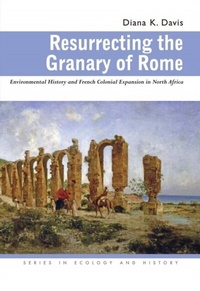
Resurrecting the Granary of Rome
Environmental History and French Colonial Expansion in North Africa
1st Edition
Published on 15. June 2007
277 pages
978-0-8214-4364-4 (ISBN)
Description

Tales of deforestation and desertification in North Africa have been told from the Roman period to the present. Such stories of environmental decline in the Maghreb are still recounted by experts and are widely accepted without question today. International organizations such as the United Nations frequently invoke these inaccurate stories to justify environmental conservation and development projects in the arid and semiarid lands in North Africa and around the Mediterranean basin. Recent research in arid lands ecology and new paleoecological evidence, however, do not support many claims of deforestation, overgrazing, and desertification in this region.
Diana K. Davis's pioneering analysis reveals the critical influence of French scientists and administrators who established much of the purported scientific basis of these stories during the colonial period in Algeria, Morocco, and Tunisia, illustrating the key role of environmental narratives in imperial expansion. The processes set in place by the use of this narrative not only systematically disadvantaged the majority of North Africans but also led to profound changes in the landscape, some of which produced the land degradation that continues to plague the Maghreb today.
Resurrecting the Granary of Rome exposes many of the political, economic, and ideological goals of the French colonial project in these arid lands and the resulting definition of desertification that continues to inform global environmental and development projects. The first book on the environmental history of the Maghreb, this volume reframes much conventional thinking about the North African environment. Davis's book is essential reading for those interested in global environmental history.
Diana K. Davis's pioneering analysis reveals the critical influence of French scientists and administrators who established much of the purported scientific basis of these stories during the colonial period in Algeria, Morocco, and Tunisia, illustrating the key role of environmental narratives in imperial expansion. The processes set in place by the use of this narrative not only systematically disadvantaged the majority of North Africans but also led to profound changes in the landscape, some of which produced the land degradation that continues to plague the Maghreb today.
Resurrecting the Granary of Rome exposes many of the political, economic, and ideological goals of the French colonial project in these arid lands and the resulting definition of desertification that continues to inform global environmental and development projects. The first book on the environmental history of the Maghreb, this volume reframes much conventional thinking about the North African environment. Davis's book is essential reading for those interested in global environmental history.
Reviews / Votes
"Diana Davis has provided an outstanding contribution to the field of comparative environmental history. Informed by history, political philosophy, anthropology, forestry, and strikingly, art history-as well as Davis's own field of geography-Resurrecting the Granary of Rome will provide a crucial touchstone for comparison to works on sub-Saharan Africa and South Asia." (African Studies Review) "In carefully cataloging the troubling and troubled colonial past of North African ecology and ideas about that ecology, Diana Davis takes seriously the problem that history shapes both physical landscapes and the power-laden narratives through which we come to know them.A tremendous contribution!"
"(I)f one had to pick a single great book early this summer, it would have to be that of American historian Diana K. Davis, Les
Mythes environnementaux de la colonisation francaise au Maghreb."
(Le Monde) "Resurrecting the Granary of Rome is an excellent piece of scholarship, well written, well researched, and well argued." (Journal of Historical Geography) "Davis's study is engagingly written, free of scientific jargon and fully documented. Forty percent of the text consists of maps, illustrations, endnotes, bibliography, index, and an appendix on the geography and ecology of the Maghreb which should be a reader's first stop." (Canadian Journal of African Studies) "Davis's study has done more than any other previous work to place the Middle East on the agenda of environmental history ... this pathbreaking book should be required reading for all those interested in the history of the Maghrib, environmental history, and the history of colonialism." (International Journal of Middle East Studies) "Relying on available paleoecological and other scientific evidence, Davis has punched holes into the declensionist narrative. Davis forcefully argues that the existing data proffers a totally different and oppositional view of the environmental history of the Mediterranean basin and immediate regions to ones constructed by the French in the eighteenth century." (Environment and History) "Diana K. Davis's rich and compelling book not only challenges the declensionist narrative on the basis of empirical evidence, but it also explains how and why that narrative came to be constructed in the context of French colonial rule.... Davis makes a powerful argument for exposing the means by which colonized peoples were exploited in the name of environmental protection...." (International History Review) "Davis deftly shows how snippets of 'history' sifted upward to inform science, legislation, and administrative practice." (Journal of Colonialism and Colonial History) "Resurrecting the Granary of Rome carefully reconstructs demographic consequences of [the 19th century French regime's] violent and coercive application of political power." (International Journal of African Historical Studies) "In this superbly documented, tightly argued study, Diana Davis reveals how French foresters and ecologists supplied the spurious 'scientific' justification for the transfer of North Africa's most valuable real estate from local populations to French colonists. The price is still being paid for a rapacious colonialism legitimated by a biased, unreflective, and complicit science, and will continue to be paid so long as we keep telling unfounded stories about deforestation, desertification, and other alleged mismanagement of land by non-Europeans." "Resurrecting the Granary of Rome integrates the local knowledge of the social scientist with a historian's examination of the colonial archives to provide a remarkably sure-handed reinterpretation of the ecohistorical aims of French colonialism in North Africa and its lasting legacy."
More details
Series
Language
English
Place of publication
Athens
United States
Target group
Professional and scholarly
ISBN-13
978-0-8214-4364-4 (9780821443644)
Copyright in bibliographic data and cover images is held by Nielsen Book Services Limited or by the publishers or by their respective licensors: all rights reserved.
Schweitzer Classification
Other editions
Additional editions
Diana K. Davis
Resurrecting the Granary of Rome
Environmental History and French Colonial Expansion in North Africa
Book
06/2007
Ohio University Press
€38.00
Shipment within 10-20 days
Person
Diana K. Davis is an associate professor of history at the University of California at Davis. She has published in Environmental History, Geoforum, Cultural Geographies, the Journal of Arid Environments, and Secheresse. She is the author of Resurrecting the Granary of Rome: Environmental History and French Colonial Expansion in North Africa.
