

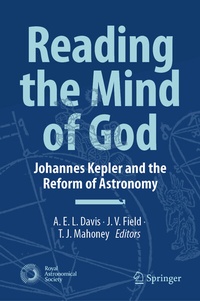
Reading the Mind of God
Description

This volume provides a wide-ranging introduction to Kepler's work, with essays on his religion, his cosmological theories, his work in astronomy, astrology, optics and mathematics and his interactions with Tycho Brahe and Galileo Galilei.
Kepler is a major figure in the history of science. His laws of planetary motion overthrew a tradition, going back as far as the ancient Greeks, of constructing the paths of planets by combinations of circles; and the derivation of the laws was revolutionary in the way it relied upon detailed agreement with observations. Moreover, the laws explicitly relate the motion and path of each planet to the Sun. Thus, when the tables that Kepler based upon the laws proved to be highly reliable over many decades, this played a crucial part in making heliocentrism acceptable. And many years after Kepler's death the laws themselves played an important part in Newton's derivation of the inverse square law of gravitation in his Principia (1687). In this respect, Kepler can look 'modern'. But his work is grounded in his religious belief that the Universe is the visible expression of the nature of the God who created it.
This book, whose chapters are written by leading scholars, is primarily addressed to undergraduate and graduate students of science and the history of science but will also appeal to the general reader with an interest in the history of science.
Reviews / Votes
"This book is an absolute joy; there is not one chapter that does not delight or surprise. It is detailed enough for the serious scholar who might want a jumping-off point to research a particular aspect of Kepler's work, but enough enthusiastic description for the amateur ... . It should be made available in all libraries wherever science is studied." (Barry Kent, The Observatory, Vol. 146 (1310), February, 2026)
More details
Other editions
Additional editions
Persons
A. E. L. Davis's (deceased) doctoral thesis (Imperial College, University of London, 1981) was about the mathematics of Kepler's New Astronomy ( Astronomia nova , 1609). This research led on to about fifty years of publishing papers on various aspects of Kepler's mathematical astronomy, in particular on his derivation of his laws of planetary motion and specifically on the intricate iterative procedures that led him to decide the orbit of Mars was elliptical, as well as some more general papers on aspects of the history of mathematics and the study of conic sections.
J. V. Field became interested in Kepler in the early 1970s while helping Arthur Beer with work on the Kepler volume of Vistas in Astronomy (1975), eventually writing a doctoral thesis on Kepler's cosmology (Imperial College, University of London, 1981), collaborating with Eric Aiton and Alistair Duncan in the translation of Kepler's Harmony of the World ( Harmonice mundi , 1619, translation published 1997) and writing extensively on various parts of Kepler's work-though firmly leaving his mathematical astronomy in the expert hands of A. E. L. Davis.
T. J. Mahoney is a scientific editor at the Instituto de Astrofísica de Canarias, where he researches on the structure of the Inner Galaxy, and the life and work of Johannes Kepler. He has edited volumes on a number of astrophysical topics. He chaired the former Johannes Kepler Working Group of the International Astronomical Union and the Johannes Kepler Task Group of the 2009 International Year of Astronomy.
Content
Kepler's place in the history of astronomy.- Religion and natural philosophy.- Late Humanism.- The geometrical cosmos.- The occult sciences.- Kepler's astrology.- Tycho Brahe and observational astronomy.- Beginning the quest for physical causes.- Kepler's theoretical astronomy: the laws of planetary motion.- Kepler's contributions to optics.- Kepler and Galileo: Copernican cosmology, telescopes and comets.- The Rudolphine Tables.- Kepler's contributions to mathematics.- Working continuously: Kepler's investigations into fluid mechanics.- 'A Warning to Astronomers'.- Somnium.- Kepler in Translation.- Kepler's personality and life.- Epilogue: Kepler and the historians.- A Kepler Chronology.
