

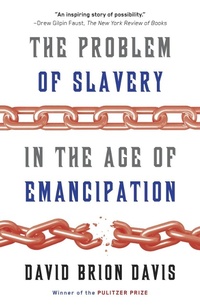
The Problem of Slavery in the Age of Emancipation
Published on 4. February 2014
448 pages
978-0-385-35165-2 (ISBN)
Description

Winner of the 2014 National Book Critics Circle Award for General Nonfiction
Shortlisted for the 2014 Cundill Prize in Historical Literature
From the revered historian, the long-awaited conclusion of the magisterial history of slavery and emancipation in Western culture that has been nearly fifty years in the making.
David Brion Davis is one of the foremost historians of the twentieth century, winner of the Pulitzer Prize, the National Book Award, the Bancroft Prize, and nearly every award given by the historical profession. Now, with The Problem of Slavery in the Age of Emancipation, Davis brings his staggeringly ambitious, prizewinning trilogy on slavery in Western culture to a close. Once again, Davis offers original and penetrating insights into what slavery and emancipation meant to Americans. He explores how the Haitian Revolution respectively terrified and inspired white and black Americans, hovering over the antislavery debates like a bloodstained ghost, and he offers a surprising analysis of the complex and misunderstood significance of colonization-the project to move freed slaves back to Africa-to members of both races and all political persuasions. He vividly portrays the dehumanizing impact of slavery, as well as the generally unrecognized importance of freed slaves to abolition. Most of all, Davis presents the age of emancipation as a model for reform and as probably the greatest landmark of willed moral progress in human history.
This is a monumental and harrowing undertaking following the century of struggle, rebellion, and warfare that led to the eradication of slavery in the new world. An in-depth investigation, a rigorous colloquy of ideas, ranging from Frederick Douglass to Barack Obama, from British industrial "wage slavery" to the Chicago World's Fair, The Problem of Slavery in the Age of Emancipation is a brilliant conclusion to one of the great works of American history. Above all, Davis captures how America wrestled with demons of its own making, and moved forward.
Shortlisted for the 2014 Cundill Prize in Historical Literature
From the revered historian, the long-awaited conclusion of the magisterial history of slavery and emancipation in Western culture that has been nearly fifty years in the making.
David Brion Davis is one of the foremost historians of the twentieth century, winner of the Pulitzer Prize, the National Book Award, the Bancroft Prize, and nearly every award given by the historical profession. Now, with The Problem of Slavery in the Age of Emancipation, Davis brings his staggeringly ambitious, prizewinning trilogy on slavery in Western culture to a close. Once again, Davis offers original and penetrating insights into what slavery and emancipation meant to Americans. He explores how the Haitian Revolution respectively terrified and inspired white and black Americans, hovering over the antislavery debates like a bloodstained ghost, and he offers a surprising analysis of the complex and misunderstood significance of colonization-the project to move freed slaves back to Africa-to members of both races and all political persuasions. He vividly portrays the dehumanizing impact of slavery, as well as the generally unrecognized importance of freed slaves to abolition. Most of all, Davis presents the age of emancipation as a model for reform and as probably the greatest landmark of willed moral progress in human history.
This is a monumental and harrowing undertaking following the century of struggle, rebellion, and warfare that led to the eradication of slavery in the new world. An in-depth investigation, a rigorous colloquy of ideas, ranging from Frederick Douglass to Barack Obama, from British industrial "wage slavery" to the Chicago World's Fair, The Problem of Slavery in the Age of Emancipation is a brilliant conclusion to one of the great works of American history. Above all, Davis captures how America wrestled with demons of its own making, and moved forward.
More details
Other editions
Additional editions
David Brion Davis
The Problem of Slavery in the Age of Emancipation
Book
01/2015
Vintage Books
€23.50
Article exhausted; check different version
David Brion Davis
The Problem of Slavery in the Age of Emancipation
Book
02/2014
Bantam Books
€47.91
Article exhausted; check different version
Person
David Brion Davis is Sterling Professor of History Emeritus at Yale University, and founder and Director Emeritus of Yale's Gilder Lehrman Center for the Study of Slavery, Resistance, and Abolition. He has written and edited sixteen books, the most recent of which was Inhuman Bondage: The Rise and Fall of Slavery in the New World. He is also a frequent contributor to The New York Review of Books. He lives outside New Haven, Connecticut.
Content
- Intro
- Title Page
- Copyright
- Dedication
- Contents
- Preface
- Introduction
- Discovering Animalization
- Some Evidence of Animalization
- 1. Some Meanings of Slavery and Emancipation: Dehumanization, Animalization, and Free Soil
- The Meaning of Animalization, Part I
- The Meaning of Animalization, Part II
- The Search for the Animalized Slave
- Domestication and Internalization
- 2. The First Emancipations: Freedom and Dishonor
- Self-Emancipation: Haiti as a Turning Point
- Freedmen and Slaves
- Freedmen's Rights
- Loss of Mastery
- The "Horrors of Haiti"
- 3. Colonizing Blacks, Part I: Migration and Deportation
- The Exodus Paradigm
- Precedents: Exiles
- Precedents: The Displaced
- 4. Colonizing Blacks, Part II: The American Colonization Society and Americo-Liberians
- Liberating Liberia
- 5. Colonizing Blacks, Part III: From Martin Delany to Henry Highland Garnet and Marcus Garvey
- Nationalism
- 6. Colonizationist Ideology: Leonard Bacon and "Irremediable Degradation"
- Bacon's "Report" of 1823
- The Paradox of Sin and "Irremediable Degradation"
- Some Black Response
- 7. From Opposing Colonization to Immediate Abolition
- Paul Cuffe and Early Proposals for Emigration
- James Forten and Black Reactions to the American Colonization Society
- The Search for Black Identity and Emigration to Haiti
- Russwurm, Cornish, and Walker
- Blacks and Garrison
- 8. Free Blacks as the Key to Slave Emancipation
- Recognition of the Issue
- Abolitionist Addresses to Free African Americans
- David Walker and Overcoming Slave Dehumanization
- James McCune Smith and Jefferson's "What further is to be done with these people?"
- 9. Fugitive Slaves, Free Soil, and the Question of Violence
- Frederick Douglass as a Fugitive
- The Underground Railroad and Runaway Slaves
- Harriet Jacobs as a Female Fugitive
- Fugitive Slaves and the Law
- 10. The Great Experiment: Jubilee, Responses, and Failure
- An Eschatological Event and America's Barriers
- The Enactment of British Emancipation
- Some American Responses to British Emancipation
- From Joseph John Gurney to the Issue of Failure
- 11. The British Mystique: Black Abolitionists in Britain-The Leader of the Industrial Revolution and Center of "Wage Slavery"
- Frederick Douglass Confronts the World
- African Americans Embrace the Mother Country
- The Problems of Race, Dehumanization, and Wage Slavery
- Joseph Sturge, Frederick Douglass, and the Chartists-the Decline and Expansion of Antislavery in the 1850s
- Epilogue
- Acknowledgments
- Notes
- Index
- A Note About the Author
- Other Books by This Author
