

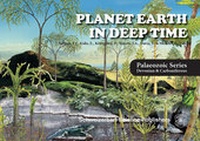
Planet Earth - In Deep Time Palaeozoic Series
Devonian & Carboniferous
1st Edition
Published on 27. May 2020
261 pages
978-3-510-65492-5 (ISBN)
Description

Devonian and Carboniferous deposits are found in many places around the world. The record of climate change preserved in them is the best (and only) resource of information on the Earth`s climate system then, at a time, when current and future climatic change is one of society`s greatest challenges. This book introduces some of the key areas of Mid-Palaeozoic sediment occurrence worldwide, authored by 114 specialists from more than 30 countries. The areas were studied as part of the UNESCO/IUGS project on climate change and biodiversity patterns in the mid-Palaeozoic (Devonian and Carboniferous). This large-scale taxonomic, stratigraphic and palaeoecological study of mid-Paleozoic floras and faunas has resulted in 86 contributions and more than 25 artistic reconstructions characterizing the biosphere of the Devonian and Carboniferous. Each contribution describes (in English and the respective national language) the scope of the IGCP project in the respective country, exemplified by representative Devonian/Carboniferous age geological sections and/or regions there. The authors intend to enhance the visibility and the perception of relevance of research on mid-Palaeozoic deposits beyond the Earth Science community.
Reviews / Votes
Ice and dust, sediments and fossils provide a record of past climate change and the evolution of life. Studying the record of periods of great change can shed light on current challenges, and help us understand how variations in our climate affect life on Earth. There were great variations in both biodiversity and climate during the Devonian and Carboniferous Periods (419 ? 229 million years ago), which were the focus of a 5-year International Geoscience Programme (IGCP) project. A new publication entitled ?Planet Earth ? In Deep Time? lays out the findings of this collaborative effort involving specialists from over 30 countries. A changing climate with a large drop in temperature and atmospheric CO2 levels, growing continental land mass as a result of very high plate tectonic activity, and great variations in biodiversity characterize the Devonian and Carboniferous Periods (419 ? 229 million years ago). Aiming to increase and refine our documentation of biodiversity mainly in tropical realms during Early Devonian-Early Carboniferous times and to identify links to climate change, the IGCP project Climate Change and Biodiversity Patterns in the Mid-Paleozoic (IGCP 596) was specifically interested in the interaction between climate change and biodiversity in this period of our Earth?s history. This was a period when terrestrial ecosystems experienced a biodiversity boom, while oceanic ecosystems suffered catastrophic extinctions. The book ?Planet Earth ? In Deep Time?, authored by 114 specialists from over 30 countries, introduces the key areas of IGCP 596?s research into earth deposits of the Devonian and Carboniferous Periods. It shows the different findings in various countries around the world, with each chapter on a specific country in both English and the national language. The project incorporated scientific as well as social purposes. On the one hand, the results of the project could help us to understand our present day situation and climate change in the future. On the other hand, the project?s novel combination of global earth system sciences and analytical paleobiology involved and educated young researchers, who will be responsible for preserving our knowledge for future generations. For over forty years, UNESCO has worked together with the International Union for Geological Sciences (IUGS) to mobilize global cooperation in the Earth sciences through the International Geoscience Programme (IGCP). This Programme has provided an important platform for scientists from across the world to push the frontiers of knowledge forward through concrete projects. IGCP has always built bridges between disciplines and between scientists, including students and early career scientists, with aims of stimulating cutting-edge research and sharing scientific knowledge for the benefit of all. United Nations Educational Scientific and Cultural Organisation 18.02.2016 - Natural Sciences Sector www.unesco.orgIm Rahmen des von 2011 bis 2015 laufenden, von der UNESCO unterstützten IGCP-Projekts 596 „Mid Palaeozoic Biodiversity Patterns and Climate Change“ entstand ein Buch, an dem sage und schreibe 114 Autoren aus mehr als 30 Ländern beteiligt waren. Auch sonst fällt dieses Buch buchstäblich aus dem Rahmen, denn es besitzt ein sehr ungewöhnliches Breitformat und ist darüber hinaus vielsprachig. Auf jeweils zwei gegenüberliegenden Seiten werden devonische und karbonische Aufschlüsse oder Landschaften vorgestellt, die stellvertretend für ein Land stehen. Manche Länder sind auch mit mehreren Aufschlüssen vertreten. Die Auswahl ist natürlich subjektiv und hat keinen Anspruch auf Vollständigkeit. Die Fotos sind zwar größtenteils von guter Qualität, allerdings finden sich auch einige unscharfe Ausreißer. Garniert wird dies mit einem typischen Fossil- oder Gesteinsfoto und mit einer kleinen Globendarstellung von Ron Blakey, auf der der Aufschluss zur Devon- oder Karbonzeit verortet ist – was heute benachbart liegt, war damals mitunter noch weit voneinander entfernt und wurde erst in der Folge plattentektonischer Prozesse zusammengeschweißt. Die vorderen Buchbeiträge sind englischsprachigen Ländern gewidmet. Dort werden zusätzlich zur Charakterisierung der Aufschlüsse im regionalen Kontext auf einer halben Seite noch grundlegende, mitunter etwas triviale Informationen zu wichtigen Tier- oder Pflanzengruppen vorgestellt. In den übrigen Beiträgen ist dieser Platz durch eine Übersetzung des englischen Texts in der jeweiligen Landessprache (z.B. Deutsch, Arabisch, Russisch, Chinesisch, Japanisch, Burmesisch, etc.) besetzt. Künstlerische Umsetzungen von marinen und terrestrischen Lebensräumen sind locker eingestreut, wobei Wiederholungen desselben Themas durch unterschiedliche Künstler durchaus ihren Reiz haben. Am Ende des Buchs finden sich zu jedem Land wichtige aktuelle Literaturhinweise und Kontaktadressen, die dem Fachwissenschaftler einen raschen und vertieften Einstieg ermöglichen. Erdgeschichte kann ein ziemlich trockener Stoff sein, wie es im vielfach aufgelegten „Brinkmann/Krömmelbein“ der Fall war: nüchterne Tabellen mit wenig aussagenden Formationsnamen. Aufschlussbilder wie in diesem Buch machen Erdgeschichte wesentlich anschaulicher, und so möchte man sich eine Fortsetzung auch für andere Perioden der Erdgeschichte wünschen. Auf die Vielsprachigkeit kann man dabei meines Erachtens getrost verzichten. Der potenzielle Leserkreis erdgeschichtlich speziell am Devon oder Karbon interessierter Wissenschaftler, Studenten oder Amateure vermag mit den fremdsprachigen Texten sicher rein gar nichts anzufangen. Der gewonnene Platz könnte für ausführlichere Informationen zu den Aufschlüssen und Regionen weit besser genutzt werden. Fossiliensammler werden übrigens explizit darauf hingewiesen, dass viele der präsentierten Aufschlüsse geschützte Geotope sind oder sich in militärischen Sperrbezirken befinden, weswegen das Einholen von Genehmigungen zum Sammeln in diesen Fällen unerlässlich ist. Die sehr gute Ausstattung und Informationsfülle des Buchs rechtfertigt den Preis. Günter Schweigert FOSSILIEN Heft 2016/2
This book is the proceedings of the International Geoscience Programme 596, which was an international cooperative program from 2011 to 2015, and concentrated on the interaction of climate change and biodiversity in the Devonian and Carboniferous periods. The volume covers a fascinating topic, as the Devonian and Carboniferous periods comprise a time in the Paleozoic in which terrestrial ecosystems started booming, with the Late Devonian featured as one of the big five mass extinctions. The first part of the book contains a very brief introduction, giving a quick background on stratigraphy, sea-level change, mass extinctions, Devonian and Carboniferous climate, plate tectonics, and the importance of paleontological collections. As a result of the brevity of the introduction, the included sections are overly simplified. A more extensive introduction would have been welcomed, especially for general readers or scientific teachers interested in the topic. The bulk of the volume presents some of the Devonian and Carboniferous outcrops that can be found around the globe. Due to the length of the book, it only presents a few localities per country, but overall the selection is nice and offers a good overview. Interestingly, the authors of the volume decided to take a multilingual approach with all locality descriptions, apart from the ones in Englishspeaking countries, in that the descriptions are in written in English and the native language of the country in which the locality resides. This feature does not appear very useful as it takes away significant amounts of space that could have been used for more detailed locality or fossil descriptions, and the majority of readers are likely to be fluent in English. All localities are presented with a locality map, outcrop, and fossil picture. This is a nice feature, however, some of the fossil pictures are out of focus, and the scale information is buried in the figure captions in the appendix, rather than near the image. Throughout the book, beautiful illustrations depicting Devonian and Carboniferous environments can be found. These artistic interpretations, together with the outcrop pictures that help with visualizing the locality, might be the highlight of the volume as they present a great teaching resource, as well as information for professionals considering fieldwork in a specific locality. The appendix offers an extensive, up-to-date, easily navigable reference list, as the references follow the layout of the book and are separated under taxonomic and geographic headings. This is useful if readers are interested in specific localities and want to dig deeper into the literature. Additionally, the contact information of all 114 authors involved in the volume and project are listed, useful for attentive readers. Planetary Earth—In Deep Time is a nice book illustrating some of the most important mid-Paleozoic localities in the world and their associated fossils. For amateurs, it provides a good introduction to the Devonian and Carboniferous and for professionals it offers great images of important outcrops and a quick reference guide to the important literature related to them. Julien Kimmig, Biodiversity Institute, University of Kansas, Lawrence, Kansas The Quarterly Review of Biology Volume 92
The time of the traditional stratigraphy has gone – is this statement true? Fortunately, not! The impressive book edited by Suttner et al. is the best confi rmation of the idea that section-based studies with only hammers in hands and knowledge in heads still matter in the 21st-century geology. This album-styled volume is an outcome from the International Geoscience Programme (IGCP) project 596 “Climate Change and Biodiversity Patterns in the Mid-Palaeozoic” realized in 2011–2015 by a team of internationally-known experts from many countries. The book deals with the Devonian and Carboniferous stratigraphy, palaeontology, and palaeoenvironments. The introductory sections present the actual version of the time scale (developed by the International Commission on Stratigraphy) with indication of the main mid-Paleozoic events and the plate tectonic reconstructions (more “fresh” models would be used – e.g., Stampfli et al. 2013). The authors also stress the importance of scientific collections. The main and the biggest part of the book is as follows. For 35 countries from all parts of the world (except for Antarctica), the key Devonian and Carboniferous localities are presented. In each case, there are one page-long explanatory text, page-sized image of the locality, image of any remarkable fossil, and insert maps showing the modern geographical and palaeogeographical position of the study area. Only one thing is lacking in this book: it would be very important to see stratigraphical column for each section/outcrop described. With the reviewed book, one can learn about the crinoid-rich Mississippian limestones from southern Kentucky, the post-Frasnian/Famennian biotic recovery in the Junggar basin of China, the Devonian nekton revolution documented in the rocks of the Rhenish Massif in Germany, the Eifelian tetrapod trackways from the Holy Cross Mountains in Poland, the rich mid-Mississippian ecosystem of tropical shelf from Vietnam, and many-many other interesting features. A typical example is as follows. The Bashkirian stratotype is an outcrop along the Yuryuzan River. On pp. 194–195, it is possible to see the general view of shallow-water carbonates, including bioclastic limestones, and to learn that these bear a lot of fossils. An additional figure illustrates pseudostaff ellid foraminifers in a thin section (scale is not provided). Yes, this book informs fi rst of all about the geological time, the fossils, and the palaeoenvironments. But its importance is not limited to these. In fact, this is a book about stratigraphical and palaeogeographical types of geological heritage that are in the focus of the present-day research (Bruno et al. 2014; Gnezdilova et al. 2016). The fact the described localities are so important for understanding of the mid-Paleozoic world means they belong to the global-scale geological heritage that should be conserved and promoted for educational and tourism purposes. The organization of the book is unusual, but nice. The countries are presented not in the alphabetic order, but according to their languages. The localities in non-English speaking countries are described in the both English and national language. Thus, the reader should not be surprised seeing Arabic, Hindi, or Thai letters. An outline of the IGCP project 596 is also given in several languages. Undoubtedly, such a principle of organization makes this book a contribution to the preservation of the world cultural diversity through the international research cooperation. In the other words, this book solves an important social task. Books like that reviewed can be either too popular and full of obvious facts (and, thus disinteresting for professionals) or too academic (in contrast, to be interesting for only professionals). Fortunately, the masterpiece edited by Suttner et al. belongs to none of these. It is very informative and attractive for the both specialists and beginners. It delivers a lot of new knowledge, but in the easy-to-understand form. The text is written talentedly, and the illustrations are large, accurate and impressive. Besides the images of locations, these include also several artist representations of the mid-Paleozoic landscapes and ecosystems. The book bears extensive reference list, and this source of essential bibliographical knowledge on the mid-Paleozoic research will be appreciated by many specialists. Well, how great would be to have such books for all intervals of the geological time! The reviewed book is a treasure for all geoscientists. Professionals can use it as a reference volume for finding information on outstanding outcrops. Students will be happy with this book as an excellent educational material. Finally, amateurs will enjoy to see outstanding geological localities depicted on impressive images. Dmitry A. Ruban, Rostov am Don Zentralblatt für Geologie und Paläontologie, Teil II, Jg. 2016 Heft 3-4
More details
Other editions
Additional editions

Thomas J. Suttner | Erika Kido | Peter Königshof
Planet Earth - In Deep Time, Palaeozoic Series
Devonian and Carboniferous
Book
01/2016
Schweizerbart'sche, E.
€49.90
Shipment within 5-7 days
Content
- Cover
- Title
- Copyrights
- Contents
- Introduction
- Kido E. and Suttner T.J. - Stratigraphy, Bioevents and Biodiversity
- Kido E. and Suttner T.J. - Continents and Plate Tectonics
- Königshof P. - What are scientific collections and why they are important?
- Planet Earth - In Deep Time: Devonian & Carboniferous
- Systematic overview of fossil groups
- Trinajstic K. - Placoderms
- Kido E. - Tabulata and Rugosa
- Suttner T.J. - Conodonts
- Meyer-Berthaud B. - Cladoxylopsida
- Decombeix A.-L. - Lignophytes
- Stephenson C.A. - Isoetalean lycopsids
- Kershaw S. - Stromatoporoids
- Seuss B. and Mapes R.H. - Cephalopoda
- Kido E. and Brett C.E. - Arthropods
- Day J. - Rhynchonellata
- Waters J.A. - Echinodermata
- Kido E. - Foraminifera and Radiolaria
- Seuss B. and Nützel A. - Gastropoda
- English translation of the IGCP 596 project summary / (Waters J.A.)
- Australia
- Trinajstic K. - The Laidlaw Range in the Canning Basin (Upper Devonian)
- George A. - Windjana Gorge in the Canning Basin (Upper Devonian)
- Trinajstic K., Hocking R. and Playton T.E. - The section at Casey Falls, Canning Basin (Upper Devonian)
- Meyer-Berthaud B. - The outcrop near Barraba in north-eastern New South Wales (Upper Devonian)
- Decombeix A.-L. - The fossil locality near Dotswood in north-eastern Queensland (Mississippian)
- Ireland
- Stephenson C.A. - Sandeel Bay on Hook Peninsula, County Wexford (Upper Devonian)
- United Kingdom
- Kershaw S. - Hope's Nose at Torbay in Southwest England (Middle Devonian)
- United States
- Brett C.E. - The Seneca Stone Quarry in central New York (Lower to Middle Devonian)
- Brett C.E. - The cliffs of Lake Erie in western New York (Middle to Upper Devonian)
- Day J. - The Rockford Quarry in north-central Iowa (Upper Devonian)
- Waters J.A. - The outcrop at Lake Cumberland in southern Kentuckey (Mississippian)
- Seuss B. - The Buckhorn Asphalt Quarry in southern Oklahoma (Pennsylvanian)
- Seuss B. and Mapes R.H. - The Finis Shale near Jacksboro in north-central Texas (Pennsylvanian)
- Arabic translation of the IGCP 596 project summary / (Ben Rahuma M.M. and Proust J.-N.)
- Libya
- Ben Rahuma M.M. and Proust J.-N. - The Awaynat Wanin Group in Western Libya (Devonian)
- Morocco
- El Hassani A. and Königshof P. - The Sabkhat Lafayrina Reef Complex in the Tindouf Basin (Middle to Upper Devonian)
- El Hassani A. - The Ain Jemaa Reef Complex in the Oulmès Area, Moroccan Meseta (Middle to Upper Devonian)
- Bosnian translation of the IGCP 596 project summary / (Coric S.)
- Bosnia and Herzegovina
- Coric S. and Hrvatovic H. - The section of Mount Vranica in the Central Dinarides (Devonian)
- Bulgarian translation of the IGCP 596 project summary / (Boncheva I. and Sachanski V.)
- Bulgaria
- Boncheva I. and Sachanski V. - The section near Gigintsi Village in the Lyubash Monocline (Upper Devonian to Mississippian)
- Burmese translation of the IGCP 596 project summary / (Aung A.K., Becker R.T. and Myint K.K.)
- Myanmar
- Aung A.K. and Königshof P. - The Pwepon Cave section near Kyadwinye Village of the Shan Plateau (Middle Devonian)
- Chinese translation of the IGCP 596 project summary / (Wang Y.)
- China
- Waters J.A., Chen X.Q., Suttner T.J. and Kido E. - The Boulongour Reservoir section in northwestern Xinjiang (Upper Devonian)
- Wang Y. - The Naqing section in the Dian-Qian-Gui Basin, Guizhou Province (Pennsylvanian)
- Czech translation of the IGCP 596 project summary / (Vodrázková S., Chadimová L., Tonarová P. and Vodrázka R.)
- Czech Republic
- Slavík L. - The Pragian GSSP at Velká Chuchle in the Prague Synform (Lower Devonian)
- Vodrázková S. - The Jirasek Quarry in the Prague Basin (Middle Devonian)
- Hladil J. and Poul I. - The Amphipora Limestone at Macocha Abyss in the Moravian Karst (Middle Devonian)
- Dutch translation of the IGCP 596 project summary / (Gouwy S.)
- Belgium
- Gouwy S. and Bultynck P. - The Couvinian stratotype at Couvin in the Ardennes (Middle Devonian)
- French translation of the IGCP 596 project summary / (Nardin E.)
- Belgium
- Da Silva A.C. and Boulvain F. - The La Boverie Quarry in the Ardennes (Upper Devonian)
- Casier J.-G. - The Beauchâteau Quarry in the Ardennes (Upper Devonian)
- France
- Gouwy S. - The Charlemont Fortress section at Givet in the Ardennes (Middle Devonian)
- Hubert B.L.M., Mistiaen B. and Pinte E. - The Parisienne Quarry in Boulonnais (Upper Devonian)
- Mistiaen B. and Hubert B.L.M. - The Parc Quarry at Etroungt in Avesnois (Upper Devonian)
- Senegal
- Sarr R. and Ngom P.M. - The Diana Malari Site in the northern Bové basin (Devonian)
- German translation of the IGCP 596 project summary / (Suttner T.J. and Königshof P.)
- Austria
- Suttner T.J. and Kido E. - The Kirchfidisch Quarry in southern Burgenland (Lower Devonian)
- Suttner T.J. and Kido E. - The Valentin Valley in the Carnic Alps (Lower Devonian)
- Kido E. and Suttner T.J. - The section at Mount Plabutsch in the Graz Palaeozoic (Middle Devonian)
- Hubmann B. and Messner F. - The section at the Weisse Wand in the Graz Palaeozoic (Middle Devonian)
- Kido E. and Suttner T.J. - The section at Mount Krone in the Carnic Alps (Pennsylvanian)
- Germany
- De Baets K., Klug C. and Poschmann M. - The Hunsrück slate in the Rhenish Massif (Lower Devonian)
- Königshof P. - The sequence of the Lahn-Dill area in the Rhenish Massif (Middle to Upper Devonian)
- Linnemann U. - The Bohlen section at Obernitz in the Saxo-Thuringian Zone (Devonian to Carboniferous)
- Hartkopf-Fröder C. - Wetlands in the Ruhr district (Pennsylvanian)
- Hindi translation of the IGCP 596 project summary / (Bhargava O.N.)
- India
- Bhargava O.N. and Draganits E. - The sedimentary sequence of the Tethyan Himalaya (Devonian)
- Italian translation of the IGCP 596 project summary / (Corriga M.G. and Corradini C.)
- Italy
- Corriga M.G., Corradini C. and Mossoni A. - The "Amphipora Limestone" at Mount Zermula in the Carnic Alps (Middle Devonian)
- Simonetto L. and Corradini C. - The Rio del Museo section at Cason di Lanza, Carnic Alps (Pennsylvanian)
- Scanu G.G., Corriga M.G., Pillola G.L. and Corradini C. - The mining area near Iglesias in southwestern Sardinia (Pennsylvanian)
- Japanese translation of the IGCP 596 project summary / (Kido E., Kurihara T. and Tsukada K.)
- Japan
- Kurihara T. - The section in the Hikoroichi area of the South Kitakami Belt (Lower to Middle Devonian)
- Tsukada K. and Manchuk N. - The section in the Fukuji-Hongo-Furukawa area of the Hida Gaien belt (Devonian to Carboniferous)
- Higa K. and Nagai K. - The Akiyoshi Limestone of the Akiyoshi Accretionary Terrane (Carboniferous to Permian)
- Latvian translation of the IGCP 596 project summary / (Luksevics E. and Stinkulis G.)
- Latvia
- Luksevics E. and Stinkulis G. - The Liepa Clay Pit in northern Latvia (Middle Devonian)
- Luksevics E. and Stinkulis G. - The Remine Quarry in central Latvia (Upper Devonian)
- Luksevics E. and Stinkulis G. - The Salaspils Quarry in central Latvia (Upper Devonian)
- Luksevics E. and Stinkulis G. - The Pavari Site at the Ciecere River, south-western Latvia (Upper Devonian)
- Lithuanian translation of the IGCP 596 project summary / (Lazauskiene J.)
- Lithuania
- Lazauskiene J., Baliukevicius A. - The Petrasiunai Quarry at the Pakruojis district (Devonian)
- Malaysian translation of the IGCP 596 project summary / (Meor H.A.H.)
- Malaysia
- Hunter A.W., Bashardin A. and Meor H.A.H. - The Pulau Langgun section in the north-western Terrain (Upper Devonian)
- Mongolian translation of the IGCP 596 project summary / (Sersmaa G.)
- Mongolia
- Sersmaa G., Ariunchimeg Ya., Kido E., SuttnerT.J., Waters J.A., Atwood J.W. and Webster G.D. - The Samnuuruul Formation section of the Baruunhuurai Terrane (Upper Devonian)
- Ariunchimeg Ya. - The section at Hoshoot of the Khovd Terrane (Pennsylvanian)
- Persian translation of the IGCP 596 project summary / (Sardar Abadi M.)
- Iran
- Bahrami A. and Corradini C. - The Ghale-Kalaghu section in the Shotori Range (Devonian to Carboniferous)
- Sardar Abadi M., Da Silva A.C. and Mossadegh H. - The Shahmirzad section in the Alborz Mountains (Mississippian)
- Polish translation of the IGCP 596 project summary / (Racki G.)
- Poland
- Narkiewicz K. and Narkiewicz M. - The Zachelmie Quarry in the western Holy Cross Mountains (Middle Devonian)
- Racki G. - The Kowala Quarry near Kielce in the Holy Cross Mountains (Upper Devonian)
- Wójcik K. - The Ostrówka Quarry in the Holy Cross Mountains (Upper Devonian)
- Skompski S. - The Ostrówka Quarry in the Holy Cross Mountains (Mississippian)
- Skompski S. - The Raclawka Valley in the Cracow Region (Mississippian)
- Russian translation of the IGCP 596 project summary / (Izokh N.G. and Obut O.T.)
- Russia
- Artyushkova O.V. and Mavrinskaya T.M. - The outcrop at the Belaya River in the Southern Urals (Lower Devonian)
- Artyushkova O.V. and Kulagina E.I. - The Irendyk Range in the Southern Urals (Upper Devonian)
- Artyushkova O.V. and Tagarieva R.Ch. - The Ryauzyak section in the Southern Urals (Upper Devonian)
- Izokh N.G. and Obut O.T. - The outcrop near Razdol'noe Village in the Rudny Altai (Upper Devonian)
- Kulagina E.I. and Pazukhin V.N. - The Sikaza section in the Southern Urals (Mississippian)
- Kulagina E.I. and Nikolaeva S.V. - The Kugarchi section in the Zilair Zone of the Southern Urals (Mississippian)
- Kulagina E.I. and Nikolaeva S.V. - The Bashkirian stratotype at Yuryuzan River in the Southern Urals (Pennsylvanian)
- Slovenian translation of the IGCP 596 project summary / (Novak M.)
- Slovenia
- Novak M. - The section at Dovzan Gorge in the Southern Karavanke Mountains (Pennsylvanian)
- Kolar-Jurkovsek T. and Jurkovsek B. - The outcrop at Ljubljana Castle Hill (Pennsylvanian)
- Spanish translation of the IGCP 596 project summary / (Valenzuela-Rios J.I. and Liao J.-C.)
- Argentina
- Cingolani C.A., Uriz N.J., Manassero M.J. and Morel E.M. - The section near Uspallata-Caracoles de Villavicencio, Precordillera (Lower Devonian)
- Siccardi A., Uriz N.J., Cingolani C.A. and Morel E.M. - The section of the Sierra de la Ventana Range (Middle Devonian)
- Amenábar C.R. - The Chinguillos Group east of Blanco River in the Western Precordillera (Middle Devonian)
- Amenábar C.R. - The section in the Rio Blanco Basin of the Western Precordillera (Upper Devonian to Mississippian)
- Spain
- Valenzuela-Rios J.I. and Liao J.-C. - The Compte-I section in the Central Pyrenees (Lower Devonian)
- Liao J.-C. and Valenzuela-Rios J.I. - The Renanué section in the Central Pyrenees (Middle to Upper Devonian)
- Uruguay
- Uriz N.J., Siccardi A., Portillo N., Cingolani C. and Blanco G. - The outcrop near the town of Blanquillo, Paraná Basin (Lower Devonian)
- Thai translation of the IGCP 596 project summary / (Charoentitirat T., Nantasin P. and Sardsud A.)
- Thailand
- Sardsud A., Königshof P. and Charoentitirat T. - The Mae Sariang section in northwestern Thailand (Upper Devonian)
- Turkish translation of the IGCP 596 project summary / (Yalçın M.N.)
- Turkey
- Yalçın M.N. - The sequence of the Arabian Plate and the Taurids (Devonian)
- Yalçın M.N. - The sequence of the Pontids (Devonian)
- Ukrainian translation of the IGCP 596 project summary / (Grytsenko V.)
- Ukraine
- Grytsenko V. - The limestone quarry near Dzvenigorod Village in the Dniester River area (Upper Silurian to Lower Devonian)
- Grytsenko V. - The outcrop near Khoudykivtsy Village in the Dniester River area (Lower Devonian)
- Grytsenko V. - The outcrop near Nyrkiv Village in the Dniester area (Lower Devonian)
- Vietnamese translation of the IGCP 596 project summary / (Ta Hoa P.)
- Vietnam
- Doan Nhat T. and Ta Hoa P. - The Lung Cu - Ma Le section of the Dong Van Karst Plateau (Lower Devonian)
- Doan Nhat T., Ta Hoa P. and Königshof P. - The section on Cát Bà Island (Mississippian)
- Appendix
- Recommended Literature
- Figure captions
- Authors
- Acknowledgements
