

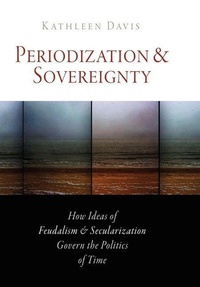
Periodization and Sovereignty
How Ideas of Feudalism and Secularization Govern the Politics of Time
Published on 12. March 2012
200 pages
978-0-8122-0741-5 (ISBN)
Description

Despite all recent challenges to stage-oriented histories, the idea of a division between a "medieval" and a "modern" period has survived, even flourished, in academia. Periodization and Sovereignty demonstrates that this survival is no innocent affair. By examining periodization together with the two controversial categories of feudalism and secularization, Kathleen Davis exposes the relationship between the constitution of "the Middle Ages" and the history of sovereignty, slavery, and colonialism.
This book's groundbreaking investigation of feudal historiography finds that the historical formation of "feudalism" mediated the theorization of sovereignty and a social contract, even as it provided a rationale for colonialism and facilitated the disavowal of slavery. Sovereignty is also at the heart of today's often violent struggles over secular and religious politics, and Davis traces the relationship between these struggles and the narrative of "secularization," which grounds itself in a period divide between a "modern" historical consciousness and a theologically entrapped "Middle Ages" incapable of history. This alignment of sovereignty, the secular, and the conceptualization of historical time, which relies essentially upon a medieval/modern divide, both underlies and regulates today's volatile debates over world politics.
The problem of defining the limits of our most fundamental political concepts cannot be extricated, Davis argues, from the periodizing operations that constituted them, and that continue today to obscure the process by which "feudalism" and "secularization" govern the politics of time.
This book's groundbreaking investigation of feudal historiography finds that the historical formation of "feudalism" mediated the theorization of sovereignty and a social contract, even as it provided a rationale for colonialism and facilitated the disavowal of slavery. Sovereignty is also at the heart of today's often violent struggles over secular and religious politics, and Davis traces the relationship between these struggles and the narrative of "secularization," which grounds itself in a period divide between a "modern" historical consciousness and a theologically entrapped "Middle Ages" incapable of history. This alignment of sovereignty, the secular, and the conceptualization of historical time, which relies essentially upon a medieval/modern divide, both underlies and regulates today's volatile debates over world politics.
The problem of defining the limits of our most fundamental political concepts cannot be extricated, Davis argues, from the periodizing operations that constituted them, and that continue today to obscure the process by which "feudalism" and "secularization" govern the politics of time.
Reviews / Votes
"Everyone should read this book. There are at least two reasons I think so. The first is the sheer intellectual pleasure to be had in grappling with its challenging and complex argument. The second is the exciting way the book models the kind of comparative, cross-field, interdisciplinary projects that everyone values but that few of us are trained to do."-Criticism"An outstanding achievement that shows why medievalists and postcolonial scholars would benefit from working together. The point has been made before but Davis's is the most rigorous demonstration so far of this proposition. She is able to point out where postcolonial analysis has been seriously impaired by ignorance of European debates about the medieval (and debates in the so-called medieval period). The book leaves the reader with an overall impression not only of the solid and imaginative scholarship on display here but also of an author who wants to think big and think creatively without sacrificing any of the rigor or meticulousness of her scholarly equipment."-Dipesh Chakrabarty, University of Chicago
"Kathleen Davis's learned and thoughtful book makes a strong argument for scholars to avoid the simplistic and reified invocation of categories and historical processes, like feudalism, sovereignty, and secularization, in their work. While these categories and processes have frequently been employed to mark temporal stages in so-called historical progress, she demonstrates that scholars and social critics have often used them as inappropriate though powerfully consequential conceptual markers of other social and political formations of the colonial and postcolonial world. This is an intellectually demanding book, but one that handsomely rewards attentive reading."-William Chester Jordan, Princeton University
"Kathleen Davis is a shrewd and indispensable commentator on the operations of 'political theology' in the Middle Ages and more modern periods as well."-Paul Strohm, Columbia University
"This book has the potential to eliminate the problematic term 'feudalism' from historical discussions of the 'Middle Ages.' Davis has brought to light new material concerning the origins and early development of the concept and has synthesized her insights into a blockbuster argument concerning the triumph of feudalism as a result of feudal historiography's entanglement with colonialism during the eighteenth century."-Felice Lifshitz, University of Alberta
"This is an exceptionally smart, sophisticated, and wide-ranging book. Its argument is theoretically ambitious and its discussion of evidence is thorough, precise, and compelling."-Carolyn Dinshaw, New York University
"Kathleen Davis, a skilled scholar of Anglo-Saxon and medieval English literature, and a courageously committed dialogist of medieval and postcolonial studies, has crafted a critical analysis of the political-theology of periodization. Her study is as dynamically precise as the structure of a protein. Composed in two parts, it intentionally folds in on itself in order to mark performatively the double bind of periodization-a mimesis of temporality and a Western juridical concept of sovereignty. Her aim is to explicate how the time of periodization is the time of sovereignty, or, put another way, sovereignty is a mode of temporality."-The Medieval Review
More details
Series
Language
English
Place of publication
Pennsylvania
United States
Target group
College/higher education
File size
1,12 MB
ISBN-13
978-0-8122-0741-5 (9780812207415)
Copyright in bibliographic data and cover images is held by Nielsen Book Services Limited or by the publishers or by their respective licensors: all rights reserved.
Schweitzer Classification
Other editions
Additional editions
Kathleen Davis
Periodization and Sovereignty
How Ideas of Feudalism and Secularization Govern the Politics of Time
Book
12/2017
University of Pennsylvania Press
€28.50
Shipment within 10-20 days
Kathleen Davis
Periodization and Sovereignty
How Ideas of Feudalism and Secularization Govern the Politics of Time
Book
05/2008
University of Pennsylvania Press
€64.38
Article exhausted; check different version
Person
Kathleen Davis is Professor of English at the University of Rhode Island and the author of Deconstruction and Translation.
Content
Introduction
PART I. FEUDALISM
1. Sovereign Subjects, Feudal Law, and the Writing of History
2. Feudal Law and Colonial Property
PART II. SECULARIZATION
3. The Sense of an Epoch: Secularization, Sovereign Futures, and the "Middle Ages"
4. A Political Theology of Time: The Venerable Bede and Amitav Ghosh
Epilogue
Notes
Works Cited
Index
Acknowledgments
PART I. FEUDALISM
1. Sovereign Subjects, Feudal Law, and the Writing of History
2. Feudal Law and Colonial Property
PART II. SECULARIZATION
3. The Sense of an Epoch: Secularization, Sovereign Futures, and the "Middle Ages"
4. A Political Theology of Time: The Venerable Bede and Amitav Ghosh
Epilogue
Notes
Works Cited
Index
Acknowledgments
