

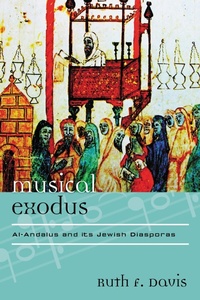
Musical Exodus
Al-Andalus and Its Jewish Diasporas
1st Edition
Published on 17. September 2015
1 pages
979-8-8818-4984-9 (ISBN)
Description

For nearly eight centuries - from the Muslim conquest of Spain in 711 to the final expulsion of the Jews in 1492 - Muslims, Jews and Christians shared a common Andalusian culture under alternating Muslim and Christian rule. Following their expulsion, the Spanish and Arabic- speaking Jews joined pre-existing diasporic communities and established new ones across the Mediterranean and beyond. In the twentieth century, radical social and political upheavals in the former Ottoman and European-occupied territories led to the mass exodus of Jews from Turkey and the Arab Mediterranean, with the majority settling in Israel.
Following a trajectory from medieval Al-Andalus to present-day Israel via North Africa, Italy, Turkey and Syria, pausing for perspectives from Enlightenment Europe, Musical Exodus: Al-Andalus and its Jewish Diasporas tells of diverse song and instrumental traditions born of the multiple musical encounters between Jews and their Muslim and Christian neighbors in different Mediterranean diasporas, and the revival and renewal of those traditions in present-day Israel. In this collection of essays from Philip V. Bohlman, Daniel Jütte, Tony Langlois, Piergabriele Mancuso, John O'Connell, Vanessa Paloma, Carmel Raz, Dwight Reynolds, Edwin Seroussi, and Jonathan Shannon, with opening and closing contributions by Ruth F. Davis and Stephen Blum, distinguished ethnomusicologists, cultural historians, linguists and performers explore from multidisciplinary perspectives the complex and diverse processes and conditions of intercultural and intracultural musical encounters. The authors consider how musical traditions acquired new functions and meanings in different social, political and diasporic contexts; explore the historical role of Jewish musicians as cultural intermediaries between the different faith communities; and examine how music is implicated in projects of remembering and forgetting as societies come to terms with mass exodus by reconstructing their narratives of the past.
The essays in Musical Exodus: Al-Andalus and its Jewish Diasporas extend beyond the music of medieval Iberia and its Mediterranean Jewish diasporas to wider aspects of Jewish-Christian and Jewish-Muslim relations. The authors offer new perspectives on theories of musical interaction, hybridization, and the cultural meaning of musical expression in diasporic and minority communities. The essays address how music is implicated in constructions of ethnicity and nationhood and of myth and history, while also examining the resurgence of Al-Andalus as a symbol in musical projects that claim to promote cross-cultural understanding and peace. The diverse scholarship in Musical Exodus makes a vital contribution to scholars of music and European and Jewish history.
Following a trajectory from medieval Al-Andalus to present-day Israel via North Africa, Italy, Turkey and Syria, pausing for perspectives from Enlightenment Europe, Musical Exodus: Al-Andalus and its Jewish Diasporas tells of diverse song and instrumental traditions born of the multiple musical encounters between Jews and their Muslim and Christian neighbors in different Mediterranean diasporas, and the revival and renewal of those traditions in present-day Israel. In this collection of essays from Philip V. Bohlman, Daniel Jütte, Tony Langlois, Piergabriele Mancuso, John O'Connell, Vanessa Paloma, Carmel Raz, Dwight Reynolds, Edwin Seroussi, and Jonathan Shannon, with opening and closing contributions by Ruth F. Davis and Stephen Blum, distinguished ethnomusicologists, cultural historians, linguists and performers explore from multidisciplinary perspectives the complex and diverse processes and conditions of intercultural and intracultural musical encounters. The authors consider how musical traditions acquired new functions and meanings in different social, political and diasporic contexts; explore the historical role of Jewish musicians as cultural intermediaries between the different faith communities; and examine how music is implicated in projects of remembering and forgetting as societies come to terms with mass exodus by reconstructing their narratives of the past.
The essays in Musical Exodus: Al-Andalus and its Jewish Diasporas extend beyond the music of medieval Iberia and its Mediterranean Jewish diasporas to wider aspects of Jewish-Christian and Jewish-Muslim relations. The authors offer new perspectives on theories of musical interaction, hybridization, and the cultural meaning of musical expression in diasporic and minority communities. The essays address how music is implicated in constructions of ethnicity and nationhood and of myth and history, while also examining the resurgence of Al-Andalus as a symbol in musical projects that claim to promote cross-cultural understanding and peace. The diverse scholarship in Musical Exodus makes a vital contribution to scholars of music and European and Jewish history.
More details
Other editions
Additional editions
Book
09/2015
Rowman & Littlefield Publishers
€127.50
Shipment within 10-20 days
Person
Ruth F. Davis is University Reader in Ethnomusicology and Fellow and Director of Studies in Music at Corpus Christi College, University of Cambridge. She has published extensively on the music of North Africa, the Middle East and the wider Mediterranean, especially on her fieldwork in mainland Tunisia and in the Jewish community of Djerba, and on Robert Lachmann's archive projects in Mandatory Palestine. Her edition of Lachmann's "Oriental Music" broadcasts was published by A-R Editions in 2013, with accompanying CD set of digitally restored recordings.
Content
Acknowledgments
Introduction: Musical Exodus, Musical Incoming
Chapter 1: Jews, Muslims, and Christians, and the Formation of Medieval Andalusian Music
by Dwight F. Reynolds
Chapter 2: Judeo-Spanish melodies in the liturgy of Tangier, Morocco: Feminine Imprints in a Masculine Space
by Vanessa Paloma Elbaz
Chapter 3: The Place of Music in Early Modern Italian Jewish Culture
by Daniel Jütte
Chapter 4: Fiore d'eterno: Music and Liturgy of the Jews of San Nicandro Garganico
by Piergabriele Mancuso
Chapter 5: Enlightenment Andalus-Herder's Search for Mediterranean Modernity in the Jewish Past
by Philip V. Bohlman
Chapter 6: Modal Trails, Model Trials: Musical Migrants and Mystical Critics in Turkey
by John Morgan O'Connell
Chapter 7: Jewish Fingers and Phantom Musical Presences: Remembrance of Jewish Musicians in 20th C. Aleppo, Syria
by Jonathan H. Shannon
Chapter 8: Jewish Musicians in the "Musique Orientale" of Oran, Algeria
by Tony Langlois
Chapter 9: Tafillalt's "Soulmate
Introduction: Musical Exodus, Musical Incoming
Chapter 1: Jews, Muslims, and Christians, and the Formation of Medieval Andalusian Music
by Dwight F. Reynolds
Chapter 2: Judeo-Spanish melodies in the liturgy of Tangier, Morocco: Feminine Imprints in a Masculine Space
by Vanessa Paloma Elbaz
Chapter 3: The Place of Music in Early Modern Italian Jewish Culture
by Daniel Jütte
Chapter 4: Fiore d'eterno: Music and Liturgy of the Jews of San Nicandro Garganico
by Piergabriele Mancuso
Chapter 5: Enlightenment Andalus-Herder's Search for Mediterranean Modernity in the Jewish Past
by Philip V. Bohlman
Chapter 6: Modal Trails, Model Trials: Musical Migrants and Mystical Critics in Turkey
by John Morgan O'Connell
Chapter 7: Jewish Fingers and Phantom Musical Presences: Remembrance of Jewish Musicians in 20th C. Aleppo, Syria
by Jonathan H. Shannon
Chapter 8: Jewish Musicians in the "Musique Orientale" of Oran, Algeria
by Tony Langlois
Chapter 9: Tafillalt's "Soulmate
