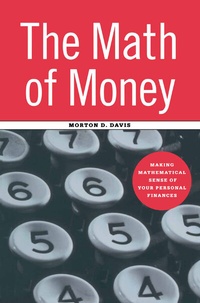
The Math of Money
Description

Reviews / Votes
From the reviews:
¿Money is peculiar stuff¿Or has been until now. Morton Davis¿s book is subtitled ¿Making Mathematical Sense of Your Personal Finances,¿ but as he points out in the introduction, this is not a how-to book. Its focus is on understanding the structure of financial transactions and the principles that underlie them. Each of the book¿s nine chapters takes a subject¿and trenchantly and readably demystifies it¿This is a clear and fascinating book, and anyone curious about the subject of money should read it.¿ ¿Plus Online Magazine, Cambridge University, U
"Davis offers a mathematician's view of certain areas of economics and finance. For instance, he helps readers understand how interest compounds, how the stock market works, and how anyone can save enough money for retirement. . Each chapter begins with a section called 'Test your intuition' that brings such matters to light. Many other scenarios and exercises in the text put money matters into the context of everyday life." (Science Now, March, 2002)
"This book is a very unusual and very entertaining introduction to financial mathematics to readers with a modest mathematical background. Each chapter begins with a section entitled Test Your Intuition. A few multiple choice questions are presented; the reader is invited to guess the answer. . Then the chapter goes on to present the related basic notions and ideas . . I warmly recommend the book to anyone who wants to learn the basic ideas of financial mathematics in a very enjoyable way." (László I. Szabó, Acta Scientiarum Mathematicarum, Vol. 68, 2002)
"This book presents, in the author's own words, a mathematician's point of view about basic issues of finance: mortgages, interest rates, investment futures, options and so on. . The main purpose of the book is to challenge (wrong) intuitions about some basic financial issues and to teach how to think mathematically . . This book isintended for the general reader. . The math of money is full with delightful explanations and insights and it is very lively ... ." (José Lúis Fernandez Perez, Zentralblatt MATH, Vol. 983, 2002)
"This book covers the range of topics that one would expect to find in an undergraduate course on financial mathematics . . the material is treated at a level that would be understood by anyone who has studied mathematics to the final year of high school. Most of the material is treated by means of concrete examples . . I quite enjoyed this book and I would have no hesitation in recommending it to students as preliminary reading for finance and derivative courses." (W. P. Wood, The Australian Mathematical Society Gazette, Vol. 29 (1), 2002)
"Each of the book's nine chapters takes a subject - 'Interest' or 'Statistics', for example - and trenchantly and readably demystifies it. ... Though the explanations are simple, they are not simplified, and indeed several examples are included ... . The examples are, though, are carefully chosen to help the story along, not merely stuck in for the sake of it. ... this is a clear and fascinating book, and anyone curious about the subject of money should read it." (Mark Wainwright, www.plus.math.org, Issue 16, 2002)
More details
Other editions
Additional editions