

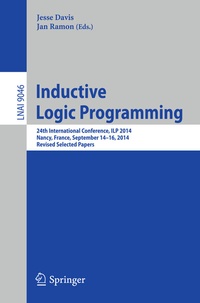
Inductive Logic Programming
Description

This book constitutes the thoroughly refereed post-conference proceedings of the 24th International Conference on Inductive Logic Programming, ILP 2014, held in Nancy, France, in September 2014.
The 14 revised papers presented were carefully reviewed and selected from 41 submissions. The papers focus on topics such as the inducing of logic programs, learning from data represented with logic, multi-relational machine learning, learning from graphs, and applications of these techniques to important problems in fields like bioinformatics, medicine, and text mining.More details
Other editions
Additional editions
Content
Reframing on Relational Data.- Inductive Learning using Constraint-driven Bias.- Nonmonotonic Learning in Large Biological Networks.- Construction of Complex Aggregates with Random Restart Hill-Climbing.- Logical minimisation of meta-rules within Meta-Interpretive Learning.- Goal and plan recognition via parse trees using prefix and infix probability computation.- Effectively creating weakly labeled training examples via approximate domain knowledge.- Learning Prime Implicant Conditions From Interpretation Transition.- Statistical Relational Learning for Handwriting Recognition.- The Most Probable Explanation for Probabilistic Logic Programs with Annotated Disjunctions.- Towards machine learning of predictive models from ecological data.- PageRank, ProPPR, and Stochastic Logic Programs.- Complex aggregates over clusters of elements.- On the Complexity of Frequent Subtree Mining in Very Simple Structures.
