

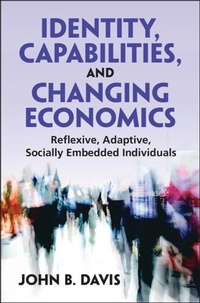
Identity, Capabilities, and Changing Economics
Reflexive, Adaptive, Socially Embedded Individuals
Published on 24. January 2024
304 pages
978-1-009-43828-5 (ISBN)
Description

Mainstream economics assumes economic agents act and make decisions to maximize their utility. This model of economic behavior, based on rational choice theory, has come under increasing attack in economics because it does not accurately reflect the way people behave and reason. The shift towards a more realistic account of economic agents has been mostly associated with the rise of behavioral economics, which views individuals through the lens of bounded rationality. Identity, Capabilities, and Changing Economics goes further and uses identity analysis to build on this critique of the utility conception of individuals, arguing it should be replaced by a conception of economic agents in an uncertain world as socially embedded and identified with their capabilities. Written by one of the world's leading philosophers of economics, the book develops a new approach to economics' theory of the individual, explaining individuals as adaptive and reflexive rather than utility maximizing.
Reviews / Votes
'This book significantly narrows the gap in Amartya Sen's capability approach between what agency is and what agency does. Or the gap between who people are and what people choose. It is therefore not only an important elaboration of agency for the capability approach, but, at the same time, the book invites social economists to engage with the notion of capabilities. It is therefore one of those rare books that genuinely try to engage with different economic approaches with the purpose of refining both.' Irene van Staveren, Professor of Pluralist Development Economics at Erasmus University Rotterdam 'Economics today is still dominated by utility-maximizing 'economic man.' Despite drawing attention to his errors, the new behavioral economics keeps utility maximization as a baseline concept. John Davis calls for a fundamentally different approach. It has long been recognized that utility maximization cannot deal with major issues such as the construction of individual identity. Davis develops this critique and points to a constructive alternative. This is a major treatise, addressing the need to build economics on different foundations.' Geoffrey M. Hodgson, Emeritus Professor in Management at Loughborough University London 'Recommended.' M. H. Lesser, CHOICE 'Davis has filled an essential gap in the literature ... you should have this book on your shelf.' Valentina Erasmo, History of Economic Thought and PolicyMore details
Language
English
Place of publication
Cambridge
United Kingdom
Illustrations
Worked examples or Exercises
File size
1,93 MB
ISBN-13
978-1-009-43828-5 (9781009438285)
Copyright in bibliographic data and cover images is held by Nielsen Book Services Limited or by the publishers or by their respective licensors: all rights reserved.
Schweitzer Classification
Other editions
Additional editions
John B. Davis
Identity, Capabilities, and Changing Economics
Reflexive, Adaptive, Socially Embedded Individuals
Book
02/2024
Cambridge University Press
€101.50
Shipment within 15-20 days
Person
Content
Preface; Acknowledgements; Part I. The Failed Pathway and Exit Strategies: Introduction; 1. Objectivity in economics and the problem of the individual; 2. The untenability of the unembedded Homo economicus; 3. The 'reconciliation problem' and an individuality reconstruction problem; Part II. Rebuilding the Individual Conception: Introduction; 4. Adaptive reflexive individuals: a capabilities conception of the person; 5. A general theory of social economic stratification: stigmatization, exclusion, and capability shortfalls; 6. Roads not taken yet to be taken: enhancing capabilities; Part III. Value and Subjectivity: Introduction; 7. Economics as a normative discipline: value dis-entanglement in an objective economics; 8. Individual realization? Rethinking subjectivity in economics; 9. Change in and changing economics; References; Index.
