

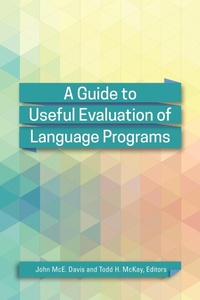
A Guide to Useful Evaluation of Language Programs
Description

Departments and language programs often are asked to evaluate the efficacy of their own programs and make curricular decisions on the basis of evidence. This guide, designed to help language educators meet the needs of program evaluation and assessment often requested by their institutions, provides step-by-step advice to help language educators conduct evaluation and assessment and to show how it can lead to meaningful programmatic decisions and change. With discussions about evaluation planning, advice for selecting data-collection tools, explanations for data analysis, examples based on actual evaluations, and more, this book provides everything you need to complete a successful language program evaluation that will give educators useful data on which to base curricular decisions. This short book is practical and timely and will find an audience in instructors of all languages and all levels.
More details
Other editions
Additional editions
Persons
John McE. Davis is John McE. Davis is Research Scientist at the Center for English Language Learning and Assessment at the Educational Testing Service, USA. His research interests include language program evaluation, language assessment, and questionnaire research methods.
Todd H. McKay is a Ph.D. candidate in applied linguistics and research assistant with the Assessment and Evaluation Language Resource Center at Georgetown University. His research interests include language assessment, language program evaluation, and applied measurement, with emphases on the less commonly taught languages and language programs in South Asia.
Content
List of Illustrations
Preface
John McE. Davis
Chapter 1. An Introduction to Useful and Used Evaluation in Language Education
John McE. Davis
Chapter 2. Best Practices for Langauge Program Evaluation Success
John McE. Davis
Chapter 3. Planning for Useful Evaluation: Users, Uses, Questions
Todd H. McKay and John McE. Davis
Chapter 4. Indentifying Indicators for Evaluation Data Collection
Francesca Venezia
Chapter 5. Selecting Methods and Collecting Data for Evaluation
Todd H. McKay and John McE. Davis
Chapter 6. Conducting Focus Groups for Evaluation
Lara Bryfonski
Chapter 7. Conducting Evaluation Interviews
Jorge Mendez Seijas, Janire Zalbidea, and Cristi Vallejos
Chapter 8. Questionnaires for Evaluation
Amy I. Kim and John McE. Davis
Chapter 9. Analyzing Evaluation Data
John McE. Davis
Chapter 10. Key Points to Remember for Useful Evaluation
John McE. Davis
Chapter 11. Example Evaluation Plan
Todd H. McKay
References
List of Contributors
