

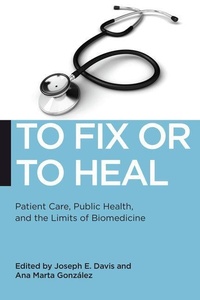
To Fix or to Heal
Patient Care, Public Health, and the Limits of Biomedicine
1st Edition
Published on 26. February 2016
277 pages
978-1-4798-8415-5 (ISBN)
Description

Do doctors fix patients? Or do they heal them? For all of modern medicine's many successes, discontent with the quality of patient care has combined with a host of new developments, from aging populations to the resurgence of infectious diseases, which challenge medicine's overreliance on narrowly mechanistic and technical methods of explanation and intervention, or "fixing' patients. The need for a better balance, for more humane "healing" rationales and practices that attend to the social and environmental aspects of health and illness and the experiencing person, is more urgent than ever. Yet, in public health and bioethics, the fields best positioned to offer countervailing values and orientations, the dominant approaches largely extend and reinforce the reductionism and individualism of biomedicine.
The collected essays in To Fix or To Heal do more than document the persistence of reductionist approaches and the attendant extension of medicalization to more and more aspects of our lives. The contributors also shed valuable light on why reductionism has persisted and why more holistic models, incorporating social and environmental factors, have gained so little traction. The contributors examine the moral appeal of reductionism, the larger rationalist dream of technological mastery, the growing valuation of health, and the enshrining of individual responsibility as the seemingly non-coercive means of intervention and control. This paradigm-challenging volume advances new lines of criticism of our dominant medical regime, even while proposing ways of bringing medical practice, bioethics, and public health more closely into line with their original goals. Precisely because of the centrality of the biomedical approach to our society, the contributors argue, challenging the reductionist model and its ever-widening effects is perhaps the best way to press for a much-needed renewal of our ethical and political discourse.
The collected essays in To Fix or To Heal do more than document the persistence of reductionist approaches and the attendant extension of medicalization to more and more aspects of our lives. The contributors also shed valuable light on why reductionism has persisted and why more holistic models, incorporating social and environmental factors, have gained so little traction. The contributors examine the moral appeal of reductionism, the larger rationalist dream of technological mastery, the growing valuation of health, and the enshrining of individual responsibility as the seemingly non-coercive means of intervention and control. This paradigm-challenging volume advances new lines of criticism of our dominant medical regime, even while proposing ways of bringing medical practice, bioethics, and public health more closely into line with their original goals. Precisely because of the centrality of the biomedical approach to our society, the contributors argue, challenging the reductionist model and its ever-widening effects is perhaps the best way to press for a much-needed renewal of our ethical and political discourse.
Reviews / Votes
"An important and provocative contribution to a growing debate over the nature and social impact of what the authors describe as a dysfunctionally reductionist medical enterprise. This book questions the boundaries and moral implications of what many of us have come to accept as a necessarily medicalized world, a world of fixable individual bodies. It deserves a broad readership." - Charles Rosenberg, author of Our Present Complaint: American Medicine, Then and Now "Just when you thought nothing new could be said about reductionism and holism in biomedicine, To Fix or To Heal appears and proves otherwise. Balanced and non-polemical, this collection shows how many recent biomedical developments, however much they seem to marginalize questions of value, morality, and social responsibility, often end up evoking them and making their consideration more urgent than ever." - Robert Aronowitz, author of Unnatural History: Breast Cancer and American Society "I thoroughly recommend this book for anyone who is interested in competing models in contemporary medicine." (Sociology of Health & Illness) "[To Fix or To Heal] may help to enlighten those interested in policy to appreciate the historical dimensions of contemporary debates. Conversely, it could be useful reading for historians who want to think about how their research could play a role in ongoing discussions about tensions between reductionism and holism for health and health care." (Bulletin of the History of Medicine) "To Fix or to Heal is an exciting and interestingly eclectic volume and a valuable contribution to the scholarship on ethics, public health, and justice." (New Genetics and Society)More details
Series
Language
English
Place of publication
New York
United States
Target group
Professional and scholarly
File size
3,52 MB
ISBN-13
978-1-4798-8415-5 (9781479884155)
Copyright in bibliographic data and cover images is held by Nielsen Book Services Limited or by the publishers or by their respective licensors: all rights reserved.
Schweitzer Classification
Other editions
Additional editions
Joseph E. Davis | Ana Marta Gonzalez
To Fix or to Heal
Patient Care, Public Health, and the Limits of Biomedicine
Book
02/2016
New York University Press
€117.80
Shipment within 10-20 days
Joseph E. Davis | Ana Marta Gonzalez
To Fix or to Heal
Patient Care, Public Health, and the Limits of Biomedicine
Book
02/2016
New York University Press
€36.50
Shipment within 10-20 days
Persons
Joseph E. Davis is Research Associate Professor of Sociology and Director of Research at the Institute for Advanced Studies in Culture at the University of Virginia. He is the Publisher of The Hedgehog Review and is the author or editor of three books, including Accounts of Innocence: Sexual Abuse, Trauma, and the Self.
Ana Marta Gonzalez is Associate Professor of Moral Philosophy at the University of Navarra, Spain, where she is the Director of the Emotional Culture and Identity project at the Institute for Culture and Society. She is also the Academic Director of the Social Trends Institute. Her publications include Care Professions and Globalization: Theoretical and Practical Perspectives.
Ana Marta Gonzalez is Associate Professor of Moral Philosophy at the University of Navarra, Spain, where she is the Director of the Emotional Culture and Identity project at the Institute for Culture and Society. She is also the Academic Director of the Social Trends Institute. Her publications include Care Professions and Globalization: Theoretical and Practical Perspectives.
Content
- Cover
- Contents
- Acknowledgments
- Introduction: Holism against Reductionism
- PART I. REDUCTIONIST MEDICINE IN CULTURAL CONTEXT
- 1. Reductionist Medicine and Its Cultural Authority
- 2. The Problem of Suffering in the Age of Prozac: A Case Study of the Depression Memoir
- 3. After Medicine: The Cosmetic Pull of Neuroscience
- 4. Reductionism, Holism, and Consumerism: The Patient in Contemporary Medicine
- PART II. REDUCTIONIST MEDICINE AND THE DISEASE BURDEN
- 5. After the Therapeutic Revolution: The Return to Prevention in Medical Policy and Practice
- 6. Digitized Health Promotion: Risk and Personal Responsibility for Health and Illness in the Web 2.0 Era
- 7. The Global Threat of (Re)emerging Diseases: Contesting the Adequacy of Biomedical Discourse and Practice
- 8. Replacing the Official View of Addiction
- PART III. THE NEED FOR A MORE HOLISTIC ETHICAL DISCOURSE
- 9. Bioethics and Medicalization
- 10. The Dominion of Medicine: Bioethics, the Human Sciences, and the Humanities
- 11. In Search of an Ethical Frame for the Provision of Health
- Conclusion: Limits in the Interest of Healing
- About the Contributors
- Index
- A
- B
- C
- D
- E
- F
- G
- H
- I
- J
- K
- L
- M
- N
- O
- P
- Q
- R
- S
- T
- U
- V
- W
- Y
- Z
