

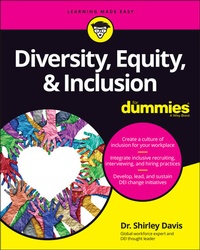
Diversity, Equity & Inclusion For Dummies
Description

The global workforce and marketplace will continue to undergo dramatic demographic shifts--redefining the workplace, the workers, and how work gets done. Organizations that want to attract and retain the best talent and to capitalize on the full breath of their perspectives and experiences must first reflect our society as a whole, and secondly, must create the right kind of work environment where ALL talent can thrive. That means valuing diversity, creating more equitable policies and practices, and fostering a welcoming and inclusive culture.
In Diversity, Equity & Inclusion For Dummies, global workforce expert, and three-time Chief Diversity and Inclusion Officer Dr. Shirley Davis unveils her extensive collection of real-world experiences, stories, case studies, checklists, assessments, tips, and strategies that will give you a deeper understanding of the business impact of DEI and how your role as a leader can contribute to your company's long term success.
You'll learn:
* The fundamentals of DEI and how it drives business performance and impact
* How to conduct comprehensive DEI organizational assessments to identify systemic and institutional inequities
* Tactics and strategies for having necessary but difficult conversations, and how to make them impactful
* Skills and competencies that every leader needs in order to effectively lead the new generation of workers
* How to operationalize DEI across your organization, measure its impact, and sustain it long term
Diversity, Equity & Inclusion For Dummies is a must-read guide for any leader at any level who wants to ready themselves for the workplace of the future and reap the benefits of a full spectrum diverse ideas, backgrounds, and experiences. It also belongs on the reading lists of human resources and DEI professionals actively seeking to go broader, deeper, and have greater impact in their DEI work.
More details
Other editions
Additional editions
Person
and Diversity & Inclusion thought leader, a certified leadership coach, and veteran executive. She has been featured on NBC's Today, USA Today, National Public Radio, the Wall Street Journal, Essence magazine, Fast Company, the Washington Post, and more.
Content
Part 1: Getting Started with Diversity, Equity, and Inclusion 7
Chapter 1: Understanding the Fundamentals of Diversity, Equity, and Inclusion 9
Chapter 2: Exploring Key Demographic Trends that Are Redefining the Workplace 31
Chapter 3: Cultivating Skills and Competencies for Leading Today's Workers 47
Chapter 4: Making the Case for DEI 75
Chapter 5: Hiring a Chief Diversity, Equity, and Inclusion Officer 87
Part 2: Examining DEI in the Workplace 95
Chapter 6: Assessing Your Organization's Culture 97
Chapter 7: Exposing Common Organizational Barriers to DEI 107
Chapter 8: Positioning DEI as an Organization's Strategic Priority 119
Part 3: Implementing and Operationalizing DEI Across the Organization 131
Chapter 9: Finding and Recruiting Diverse Talent 133
Chapter 10: Developing, Coaching, Promoting, and Retaining Diverse Talent 149
Chapter 11: Leading Diverse Teams for Maximum Performance 163
Chapter 12: Tracking, Measuring, and Reporting the Progress of DEI Efforts 175
Chapter 13: Embedding DEI in Other Key Areas of the Organization 185
Chapter 14: Launching DEI Councils and Employee Resource Groups 201
Part 4: Sustaining DEI in Your Organization 217
Chapter 15: Understanding Implicit Bias and Its Impact in the Workplace 219
Chapter 16: Moving from Unconscious Bias to Inclusive Leadership 235
Chapter 17: Enhancing Cultural Competence 247
Chapter 18: Cultivating a Culture of Inclusion, Equity, and Belonging 263
Part 5: The Part of Tens 289
Chapter 19: Ten Common Myths about Diversity and Inclusion 291
Chapter 20: Ten Ways That Boards Can Influence DEI in the Organization 297
Chapter 21: Ten Things Underrepresented Talent Wish Leaders Knew 303
Index 311
Introduction
Welcome to Diversity, Equity, and Inclusion For Dummies. As I write this, the timing for this book couldn't be more perfect given the predictions about the workplace of the future. I can't tell you what an honor is to write the first-ever book of this type in this series. I'm Dr. Shirley Davis, and I've spent over 30 years in Human Resources and as a Chief Diversity and Inclusion Officer, a corporate executive, and now a global workforce consultant. I believe that all my experiences (both professional and personal) have prepared me to contribute this body of work.
Since the 2010s, the global workforce, marketplace, and communities have undergone significant demographic shifts, making workplaces more diverse than ever before. And research reveals that this trend will continue. Diversity, equity, and inclusion have taken a front seat for organizations seeking to capitalize on new talent - more women, greater ethnicity, five generations, and different abilities, backgrounds, experiences, thinking styles, beliefs, and ways of working - and build world-class cultures. They recognize that in order to attract, engage, and retain top talent and new customers, clients, and members, they must have strong leaders who can work effectively across differences, and they must foster a work environment where all talent enjoys a sense of belonging and inclusion and has an equal opportunity to succeed.
Most organizations aren't there yet, though, and most leaders still aren't comfortable or knowledgeable about diversity, equity, and inclusion. Transforming a rigid, hierarchical, and homogeneous culture to a world-class one can take years. The same goes for developing inclusive, first-rate leaders. But you can get there with intentionality and a commitment of time, effort, and resources. And trust me; this new generation of top talent is demanding it.
So leaders at all levels (from the boardroom to the C-suite to the mid-level supervisor) have a unique opportunity right now to embrace these new realities. You can begin by first developing the skills, competencies, and behaviors needed to lead effectively across differences. Then you can start implementing the proven strategies that position your organization to be an employer of choice and a great place to work and do business.
About This Book
Diversity, equity, and inclusion (DEI) work can't be a nice thing to do or a check-the-box exercise that provides a temporary fix until the cameras go away and the noise is quieted. True and sustainable culture transformation requires bold, innovative, and courageous leadership, long-term commitment, and accountability.
Diversity, Equity, and Inclusion For Dummies is the one-stop resource guide you need to get a comprehensive understanding of what this work is all about, how it contributes to the organization's success, what your role is as a leader, and how to implement DEI in every area of your organization. In this book, I explain everything from the common terminology to the continued evolution of DEI to how the demographics continue to change, plus strategies for tasks like the following:
- Sourcing and recruiting diverse talent and growing the skills to lead a diverse workforce
- Assessing your organization's current culture and cultivating and sustaining one of inclusion, equity, and belonging
- Making the business case for DEI and addressing the obstacles to DEI
- Aligning DEI with your strategic priorities and creating a DEI strategic plan
- Measuring the success of your DEI efforts
- Launching DEI councils and employee resource groups
In this book, I share from my 30-plus years of experiences, proven strategies, and results achieved as a human resources veteran and a former chief diversity, equity, and inclusion officer for several large global organizations. I also share from a personal perspective as someone who personally experienced being marginalized, oppressed, discriminated against, overlooked, and undervalued in my rise to the C-suite. And what I've come to realize is that my stories are still the reality for so many workers today who report that they're experiencing these same things in their workplaces and from their leaders.
I also understand the value of building a diverse team and capitalizing on the different perspectives, experiences, and talents of that team (to which I dedicate Chapter 11). So I modeled this mindset and sought out three other DEI thought leaders, researchers, and educators to contribute to this body of work so that it offers even broader and more comprehensive tips, strategies, and proven practices.
One person, whom I've known and worked with in DEI and implicit bias for ten years, brings a unique perspective as a young, white, gay, male educator and consultant who grew up all over the world as the child of a military family. Another contributor identifies as an African American, cisgender, heterosexual, Christian. She holds a PhD and is a college professor and practitioner of leadership development, DEI, and HR, and she came highly recommended through my network. And so did my third contributor, a 70-year-old, white, Jewish, LGBTQ woman from the Bronx in New York. And because of this diverse team of contributors, the final product is much better.
This book contains answers to the many questions that leaders ask and the plethora of concerns and misnomers that exist, and it demystifies DEI to make it practical, understandable, and implementable. It speaks directly to middle managers and leaders at the top who may not have the title of chief diversity and inclusion officer but do have the responsibility to lead diverse teams; recruit, hire, and develop diverse talent; serve diverse customers; and foster a welcoming, inclusive, and high-performing workplace culture. In other words, all leaders at all levels can benefit from this book.
What this book isn't: It isn't meant to represent the views, experiences, and practices of all DEI thought leaders around the world. That's the point of this book and the beauty of this work. Everyone brings different lenses, models, frames of reference, and unique experiences that inform their decisions. This book is also not designed to be a prescription for implementing the strategies and tips in the same way. Every organization is at (and in) a different place, working at a different pace, and has varying degrees of resources, complexities, and levels of commitment. Therefore, this book isn't a one-size-fits-all reference guide. Use to find information, ideas, and guidance for where you are and to help you get to where you want to go on your DEI journey. This book is only one source; I refer to many others throughout the book that can supplement your development.
I also want to quickly point out a few things that may help you better navigate and use this book:
- Whenever I introduce a new important term in a chapter, I place it in italics and follow with a quick definition or explanation.
- Keywords and action steps in lists appear in bold.
- Sidebars (look for the gray shaded boxes) feature content that is interesting and informative but not essential to your understanding of a topic. If you're wanting to get in and out quickly, you can safely skip them.
Foolish Assumptions
I know what they say about making assumptions, but for the sake of this book I did make a few of them so that I could best serve your needs. I assumed the following:
- You're working at an organization in a manager or leader role.
- You recognize that the world of work is changing demographically, and you want to better understand it.
- You have little or no knowledge and experience in leading DEI initiatives and want to pick up the fundamentals.
- You may have reservations and discomfort about DEI. You may even wonder why it's getting so much focus.
- You want to develop into a more effective and inclusive leader.
Icons Used in This Book
Throughout this book, you find icons that help you pick up what I'm laying down. Here's a rundown of what they mean:
This icon alerts you to helpful hints. Tips can help you save time and avoid frustration before, during, and after your transition out of the military.
This icon reminds you of important information you should read carefully.
This icon flags actions and ideas that may cause you problems. Often, warnings accompany common mistakes or misconceptions people have about the transition process.
Beyond the Book
This book contains lots of ideas, strategies, checklists, tools, resources, references, best practices, and other sources that give you more than enough to work with. But there's more! It includes an online Cheat Sheet that provides guidance and tips for spotting and dealing with common DEI barriers, a list of questions to test your cultural competence, and ways to help employee resource groups (ERGs) success so that they can, in turn, help aid your DEI efforts. To access this handy Cheat Sheet, go to dummies.com and type Diversity, Equity, and Inclusion For Dummies Cheat Sheet in the search box.
Additionally, if you, your team, or members of your organization need DEI training, coaching, a keynote speaker, or consulting on any of the processes I share in this book, or want to obtain a certificate in DEI, you can access information on my website at...
