

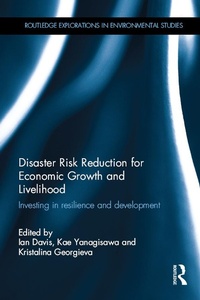
Disaster Risk Reduction for Economic Growth and Livelihood
Investing in Resilience and Development
Published on 22. May 2015
312 pages
978-1-317-57853-6 (ISBN)
Description

The prevalence of natural disasters in recent years has highlighted the importance of preparing adequately for disasters and dealing efficiently with their consequences.
This book addresses how countries can enhance their resilience against natural disasters and move towards economic growth and sustainable development. Covering a wide range of issues, it shows how well thought-out measures can be applied to minimize the impacts of disasters in a variety of situations. Starting with the need for coping with a rapidly changing global environment, the book goes on to demonstrate ways to strengthen awareness of the effectiveness of preventive measures, including in the reconstruction phase. The book also covers the roles played by different actors as well as tools and technologies for improved disaster risk reduction. It focuses on a variety of case studies from across Asia, Africa and Latin America, drawing out lessons that can be applied internationally.
This book will be of great interest to professionals in disaster management, including national governments, donors, communities/citizens, NGOs and private sector. It will also be a highly valuable resource for students and researchers in disaster management and policy, development studies and economics.
This book addresses how countries can enhance their resilience against natural disasters and move towards economic growth and sustainable development. Covering a wide range of issues, it shows how well thought-out measures can be applied to minimize the impacts of disasters in a variety of situations. Starting with the need for coping with a rapidly changing global environment, the book goes on to demonstrate ways to strengthen awareness of the effectiveness of preventive measures, including in the reconstruction phase. The book also covers the roles played by different actors as well as tools and technologies for improved disaster risk reduction. It focuses on a variety of case studies from across Asia, Africa and Latin America, drawing out lessons that can be applied internationally.
This book will be of great interest to professionals in disaster management, including national governments, donors, communities/citizens, NGOs and private sector. It will also be a highly valuable resource for students and researchers in disaster management and policy, development studies and economics.
Reviews / Votes
"We cannot eliminate extreme poverty and boost shared prosperity without building resilience to climate change and natural disasters. This book combines an excellent overview of lessons learnt and sound analysis that provide a valuable contribution to the global discussions around the post-Hyogo Framework for Action to reduce the devastating impact of disasters on countries and communities"Jim Yong Kim, President, World Bank
"The International Federation of Red Cross and Red Crescent Societies strongly supports the Hyogo Framework for Action 2 (HFA2) and will set ambitious targets to improve community resilience programming. This book will add great value to discussions around the implementation of the HFA2, particularly actions that address underlying risks and vulnerabilities and underpin sustainable development efforts."
Tadateru Konoe, President, International Federation of Red Cross and Red Crescent Societies
"This publication offers innovative solutions to building resilience to disaster, focusing on three essential components: protecting development through risk informed decision-making; managing uncertainties linked to unstainable growth patterns and climate change; and strengthening the enabling environment through advanced risk governance processes. It is a worthwhile contribution to the discussions on the post-2015 frameworks for disaster risk reduction and development."
Helen Clark, Administrator, United Nations Development Programme
More details
Series
Language
English
Place of publication
London
United Kingdom
Publishing group
Taylor & Francis Ltd
Target group
College/higher education
Product notice
Reflowable
Illustrations
56 s/w Abbildungen, 25 s/w Tabellen, 18 s/w Photographien bzw. Rasterbilder, 38 s/w Zeichnungen
25 Tables, black and white; 38 Line drawings, black and white; 18 Halftones, black and white; 56 Illustrations, black and white
File size
5,13 MB
ISBN-13
978-1-317-57853-6 (9781317578536)
Copyright in bibliographic data and cover images is held by Nielsen Book Services Limited or by the publishers or by their respective licensors: all rights reserved.
Schweitzer Classification
Other editions
Additional editions
Ian Davis | Kae Yanagisawa | Kristalina Georgieva
Disaster Risk Reduction for Economic Growth and Livelihood
Investing in Resilience and Development
Book
02/2017
1st Edition
Routledge
€74.60
Shipment within 10-20 days
Ian Davis | Kae Yanagisawa | Kristalina Georgieva
Disaster Risk Reduction for Economic Growth and Livelihood
Investing in Resilience and Development
Book
01/2017
Routledge
€62.09
The article will not be published
Ian Davis | Kae Yanagisawa | Kristalina Georgieva
Disaster Risk Reduction for Economic Growth and Livelihood
Investing in Resilience and Development
Book
05/2015
1st Edition
Routledge
€232.20
Shipment within 10-20 days
Persons
Ian Davis, an architect, is a Visiting Professor in Disaster Risk Management in Copenhagen, Kyoto, Lund and Oxford Brookes Universities. He works in Disaster Risk Reduction and Recovery. In 1996 he received the UN Sasakawa Award for his contribution to Disaster Prevention. He has been on the board of four NGO's, advised Governments/ UN Agencies and is author or editor of 17 books.
Kae Yanagisawa is Vice President of Japan International Cooperation Agency. She has a long-term career in international development at JICA and UNDP. She gained knowledge and experience in disaster risk reduction while she was leading the disaster relief operations of JICA. She is a Visiting Professor in development cooperation at Meiji University.
Kristalina Georgieva is Vice President of the European Commission. From 2010 to 2014, she was the European Commissioner for International Cooperation, Humanitarian Aid and Crisis Response.?Before joining the European Commission, she held various positions at the World Bank including Director for Sustainable Development and Vice President and Corporate Secretary. In October 2014, she was recognized as a Champion of Disaster Risk Reduction by the secretariat of International Strategy for Disaster Reduction.
.
Kae Yanagisawa is Vice President of Japan International Cooperation Agency. She has a long-term career in international development at JICA and UNDP. She gained knowledge and experience in disaster risk reduction while she was leading the disaster relief operations of JICA. She is a Visiting Professor in development cooperation at Meiji University.
Kristalina Georgieva is Vice President of the European Commission. From 2010 to 2014, she was the European Commissioner for International Cooperation, Humanitarian Aid and Crisis Response.?Before joining the European Commission, she held various positions at the World Bank including Director for Sustainable Development and Vice President and Corporate Secretary. In October 2014, she was recognized as a Champion of Disaster Risk Reduction by the secretariat of International Strategy for Disaster Reduction.
.
Content
Forewords Preface Introduction Part 1: Resilience ifor sustainable development in a changing environment 1. Building resilience to disasters and climate change in the age of urbanization 2. Climate change and disaster risk reduction: Adaptation to uncertainties of changing climate 3. From drought to resilience Part 2: Building awareness for disaster risk reduction 4. Effective planning for disaster risk reduction 5. Economic analysis of investment in DDR measures 6. Institutionalizing and sharing the culture of prevention: The Japanese experience Part 3: Achieving build back better in recovery and reconstruction 7. Recovery and reconstruction: An opportunity for sustainable growth through "Build Back Better" 8. Lessons from promoting "Build Back Better" in the post-tsunami recovery of Aceh Part 4: Increasing the roles of stakeholders 9. Community empowerment and good governance: The way forward for DRM in developing countries 10. The role of the private sector in disaster risk management following catastrophic events 11. Disaster risk governance and the principles of good governance Part 5: Tools and technologies for disaster risk reduction 12. National disaster databases: An essential foundation for disaster risk reduction policies and disaster-realted sustainable development goals and targets 13. Disaster intelligence: Using geospatial technology to improve resilience in developing countries
