

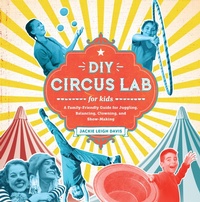
DIY Circus Lab for Kids: Volume 14
A Family- Friendly Guide for Juggling, Balancing, Clowning, and Show-Making
Published on 15. February 2018
152 pages
978-1-63159-585-1 (ISBN)
Description

Produce your own circus! Make your own stilts, juggling sticks, and tightrope, then learn to use them; master the human pyramid; discover how to create your own circus acts and shows; and much more with DIY Circus Lab for Kids. Companion online video tutorials for every prop and skill make learning easy.
Veteran circus educator Jackie Leigh Davis takes you, step by step, through the props and skills you need to perform all the major circus arts:
Acrobatics, acrobalance, and human pyramids
Balance arts
Clowning
Gyroscopic and toss juggling
You'll learn how to make juggling balls, a hoola hoop, a rola bola, a clown nose and hat, and a pair of poi, among other circus essentials. With these props, you'll learn how to juggle, hoop, balance, perform clown gags, and more. Photo demonstrations, numbered steps, and online tutorials ensure you'll understand exactly how to make the props and perform the skills.
Did you know that a tight rope walker in Ancient Greece was called a funambulus? Or that female jugglers can be found pictured in 4,000-year-old hieroglyphs on the wall of an Egyptian tomb? DIYCircus Lab for Kids includes the history of each family of circus skills. "Circademics" sidebars explore the science and academics behind the circus activities, like how the brain changes when you learn how to juggle.
"Circussecrets" sidebars throughout connect circus arts to social and emotional skills, like listening, persistence, and asking for and giving help. Many of the skills in this book are safe enough for kids to do themselves, with a few requiring an adult "spotter" so families or classes can enjoy them together.
Once you've learned how to create your own circus with DIY Circus Lab for Kids, you can also: host a circus prop-making party, start a juggling club at school, clown at a senior center or daycare, start a community circus meet-up in a park, or integrate circus themes into your school's curriculum-the opportunities for circus fun are endless.
The popular Lab for Kids series features a growing list of books that share hands-on activities and projects on a wide host of topics, including art, astronomy, clay, geology, math, and even bugs-all authored by established experts in their fields. Each lab contains a complete materials list, clear step-by-step photographs of the process, as well as finished samples. The labs can be used as singular projects or as part of a yearlong curriculum of experiential learning. The activities are open-ended, designed to be explored over and over, often with different results. Geared toward being taught or guided by adults, they are enriching for a range of ages and skill levels. Gain firsthand knowledge on your favorite topic with Lab for Kids.
Veteran circus educator Jackie Leigh Davis takes you, step by step, through the props and skills you need to perform all the major circus arts:
Acrobatics, acrobalance, and human pyramids
Balance arts
Clowning
Gyroscopic and toss juggling
You'll learn how to make juggling balls, a hoola hoop, a rola bola, a clown nose and hat, and a pair of poi, among other circus essentials. With these props, you'll learn how to juggle, hoop, balance, perform clown gags, and more. Photo demonstrations, numbered steps, and online tutorials ensure you'll understand exactly how to make the props and perform the skills.
Did you know that a tight rope walker in Ancient Greece was called a funambulus? Or that female jugglers can be found pictured in 4,000-year-old hieroglyphs on the wall of an Egyptian tomb? DIYCircus Lab for Kids includes the history of each family of circus skills. "Circademics" sidebars explore the science and academics behind the circus activities, like how the brain changes when you learn how to juggle.
"Circussecrets" sidebars throughout connect circus arts to social and emotional skills, like listening, persistence, and asking for and giving help. Many of the skills in this book are safe enough for kids to do themselves, with a few requiring an adult "spotter" so families or classes can enjoy them together.
Once you've learned how to create your own circus with DIY Circus Lab for Kids, you can also: host a circus prop-making party, start a juggling club at school, clown at a senior center or daycare, start a community circus meet-up in a park, or integrate circus themes into your school's curriculum-the opportunities for circus fun are endless.
The popular Lab for Kids series features a growing list of books that share hands-on activities and projects on a wide host of topics, including art, astronomy, clay, geology, math, and even bugs-all authored by established experts in their fields. Each lab contains a complete materials list, clear step-by-step photographs of the process, as well as finished samples. The labs can be used as singular projects or as part of a yearlong curriculum of experiential learning. The activities are open-ended, designed to be explored over and over, often with different results. Geared toward being taught or guided by adults, they are enriching for a range of ages and skill levels. Gain firsthand knowledge on your favorite topic with Lab for Kids.
Reviews / Votes
Davis is a long-time circus instructor and her experience is immediately evident in her clear instructions, which are broken into written steps with photo illustrations featuring actual youth circus artists, while website links provide video demonstrations of prop/apparatus construction and the skills themselves. [. . .] A niche but exemplary resource. * Booklist, starred review * Davis notes that the "circus is for everyone"-an inclusive message echoed by the activities, which align with different ability levels and interests, from tight rope walking to designing T-shirts. * Publishers Weekly * DIY Circus Lab for Kids is a perfect circus classroom resource and also a tool for children who are interested in learning circus skills but who live in places where there is no access to circus classes. * Fiona Bradley, Circus Talk * A well-conceived how-to book [...] ideal for collections where tweens and teens want to learn how to put on a show. * School Library Journal * This is an excellent book, expertly done, and deserves a place on the bookshelf of any child interested in exploring the circus arts. * International Jugglers' Association * A hands-on, step-by-step guide with easy instructions and clear photos that demonstrate each juggling, balancing, clowning, and show-making activity. -- Vivian Kirkfield * Picture Books Help Kids Soar blog * The book allows children to learn the basics of juggling, balancing, clowning and show-making, each skill paired with tutorials on how to hand-make props they might need at a cheaper cost than purchasing ready-made equipment. Whether it's juggling balls from tennis balls filled with sand and covered with colorful balloons suitable for kids of any age, or a plywood tight-rope frame that may need some adult assistance, the idea is to create an environment of inclusivity. * Monadnock Ledger-Transcript * A great reference book for school libraries [. . .] It's also a great hands-on gift for adventurous youth, and for video game-obsessed or artistic youth who need to know that not all physical activity is highly competitive or sports based! * CircusTalk *More details
Series
Language
English
Place of publication
Beverly
United States
Publishing group
Quarto Publishing Group USA Inc
Target group
Children/juvenile
US School Grade: From Third Grade to Seventh Grade, Interest Age: From 9 to 14 years
Illustrations
250 color photos
ISBN-13
978-1-63159-585-1 (9781631595851)
Copyright in bibliographic data and cover images is held by Nielsen Book Services Limited or by the publishers or by their respective licensors: all rights reserved.
Schweitzer Classification
Other editions
Additional editions

Jackie Leigh Davis
DIY Circus Lab for Kids: Volume 14
A Family- Friendly Guide for Juggling, Balancing, Clowning, and Show-Making
Book
02/2018
Quarry Books
€38.59
Article exhausted; check different version
Person
Jackie Leigh Davis, EdM., is a circus education pioneer, teacher, and advocate. She was a founding member of the American Youth Circus Organization (AYCO), the first national youth circus advocacy organization in the country. Founded in 1999, AYCO hosts biennial national festivals and educator conferences to promote the participation of youth in circus arts.
In 1995, Jackie established the circus arts curriculum for grades 1-8 at the Pine Hill Waldorf School in Wilton, NH. The program culminates in the annual Hilltop Circus, created and performed in collaboration with Pine Hill's middle school students. Jackie also founded the Silver Lining Circus Camp (1997), a summer day camp for children ages 7-14, and the Flying Gravity Circus (1999), a teen troupe that brought performances and workshops to school communities from Pennsylvania to Toronto. Jackie has coached juggling, balance skills, and performance/clowning at the Circus Smirkus summer camp in Vermont.
She merged her interests in circus arts and academics to become a circademic, earning a Master of Education degree in Human Development & Psychology in 2009 from the Harvard Graduate School of Education. At Harvard she identified circus as a vehicle for physical, social-emotional, and cognitive development and constructed her theory of developmental circus arts (DCA).
Prior to her teaching and writing careers, Jackie was a professional mime who studied with Marcel Marceau, performed for nearly 4 years at Walt Disney World's EPCOT Center, and taught at New York University. She currently resides and writes in New Hampshire. Her adult daughters, Erin and Ellie, live nearby.
In 1995, Jackie established the circus arts curriculum for grades 1-8 at the Pine Hill Waldorf School in Wilton, NH. The program culminates in the annual Hilltop Circus, created and performed in collaboration with Pine Hill's middle school students. Jackie also founded the Silver Lining Circus Camp (1997), a summer day camp for children ages 7-14, and the Flying Gravity Circus (1999), a teen troupe that brought performances and workshops to school communities from Pennsylvania to Toronto. Jackie has coached juggling, balance skills, and performance/clowning at the Circus Smirkus summer camp in Vermont.
She merged her interests in circus arts and academics to become a circademic, earning a Master of Education degree in Human Development & Psychology in 2009 from the Harvard Graduate School of Education. At Harvard she identified circus as a vehicle for physical, social-emotional, and cognitive development and constructed her theory of developmental circus arts (DCA).
Prior to her teaching and writing careers, Jackie was a professional mime who studied with Marcel Marceau, performed for nearly 4 years at Walt Disney World's EPCOT Center, and taught at New York University. She currently resides and writes in New Hampshire. Her adult daughters, Erin and Ellie, live nearby.
Content
- Cover
- Half Title
- Title
- Copyright
- Dedication
- Contents
- Preface
- A Little Story
- The Circus Skills
- What's in This Book?
- UNIT 1 SPINNING AND FLOWING
- INTRODUCTION: ABOUT SPINNING AND FLOWING, CIRCADEMICS, AND CIRCUSSECRETS
- MAKE YOUR OWN: Juggling Sticks
- ABCS OF: Juggling Sticks
- MAKE YOUR OWN: Diabolo
- ABCS OF: Diabolo
- MAKE YOUR OWN: Hoop
- ABCS OF: Hooping
- MAKE YOUR OWN: Poi
- ABCS OF: Poi
- UNIT 2 TOSS JUGGLING
- INTRODUCTION: ABOUT JUGGLING, CIRCADEMICS, AND CIRCUSSECRETS
- ABCS OF: Scarf Juggling
- MAKE YOUR OWN: Juggling Balls
- ABCS OF: Three-Ball Juggling
- ABCS OF: Armpit Juggling
- UNIT 3 BALANCE
- INTRODUCTION: ABOUT BALANCE, CIRCADEMICS, AND CIRCUSSECRETS
- MAKE YOUR OWN: Rola Bola
- ABCS OF: Rola Bola
- MAKE YOUR OWN: Tie-On Stilts
- ABCS OF: Stilt Walking
- MAKE YOUR OWN: Tightrope
- Rig the Tightrope
- ABCS OF: Tightrope Walking
- UNIT 4 PARTNER ACROBATICS AND HUMAN PYRAMIDS
- ABOUT PYR AMIDS, CIRCADEMICS, AND CIRCUSSECRETS
- MAKE YOUR OWN: Circus T-Shirt
- The Secret Language of Pyramids
- ABCS OF: Partner Acrobatics
- ABCS OF: Human Pyramids
- UNIT 5 Clowning
- INTRODUCTION: ABOUT CLOWNING, CIRCADEMICS, AND CIRCUSSECRETS
- MAKE YOUR OWN: Clown Nose
- MAKE YOUR OWN: Clown Hat
- ABCS OF: Clowning
- ABCS OF: Fun with Your Hat
- ABCS OF: A Running Gag
- UNIT 6 Making a Show
- INTRODUCTION: ABOUT THE TOOLBOX FOR WORKING TOGETHER AND CIRCUSSECRETS
- ABCS OF: Building an Act
- ABCS OF: Building a Show
- Growing Circus in Your Community
- APPENDIX A: Circus as a Serious Tool for Learning
- CircusSecrets and Social and Emotional Learning
- APPENDIX B: The Origins of Youth Circus
- Social Circus
- APPENDIX C: Youth and Social Circus Worldwide
- Resources
- About the Circus Lab Kids
- About the Team (and Spotters!): Photographer, Videographer, and Makerspace Director
- About the Author
- About Circus Smirkus
- Acknowledgments
- Index
- A
- B
- C
- D
- E
- F
- G
- H
- I
- J
- K
- L
- M
- N
- O
- P
- R
- S
- T
- V
- W
- X
- Y
- Z
