

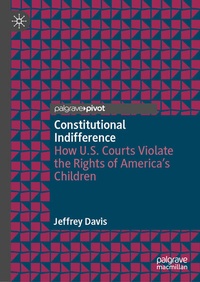
Constitutional Indifference
Description

This book shows how U.S. courts have failed to protect the human rights of America's children. The Supreme Court has constructed a constitutional identity rooted in American exceptionalism and libertarianism. It has used this identity to disregard human rights law, claiming it is foreign to uniquely American constitutional values and that the very nature of the Constitution is restrictive. Children in the United States suffer as a result. Compared to other democracies, the United States has the highest or nearly the highest rates of under-five mortality, child poverty, juvenile incarceration, and child deaths by homicide. Through interviews with advocates, case studies, and a comparative analysis of other democracies, the book shows how the Court has marginalized the rights of children and it contrasts this to the human rights-centered approach taken by other national and regional courts. Chapter by chapter it demonstrates how U.S. courts consistently fail to protect children's rights to life and safety, their rights in the criminal justice system, and their rights to an education, health, and housing. Human rights are completely consistent with the U.S. Constitution, and the book sets out a plan to incorporate human rights into U.S. law.
Reviews / Votes
"In Constitutional Indifference, Jeffrey Davis offers a devastating and meticulously researched account of how U.S. courts have failed America's children. This book is essential reading for anyone who believes that constitutional law should protect the most vulnerable among us." (Shani M. King, Rutgers Law School)
"Jeffrey Davis hits the nail on the head when he attributes the Supreme Court's rejection of human rights to the twin errors of libertarianism and exceptionalism. This is a bold, original, and important work." (Jamie Mayerfeld, University of Washington)
"
Constitutional Indifference
offers a careful and timely examination of how U.S. courts have approached questions of children's rights. Drawing on close doctrinal analysis, comparative human rights perspectives, and well-chosen cases, Jeffrey Davis clarifies why gaps in constitutional protection persist and why they matter. This is a valuable contribution for scholars, practitioners, and policymakers interested in law, rights, and child welfare." (Salvador Santino Regilme, Leiden University)
More details
Other editions
Additional editions
Person
Jeffrey Davis is a Professor in the Political Science Department at the University of Maryland, Baltimore County (UMBC) and a Research Professor at the Institut Barcelona d'Estudis Internacionals (IBEI). He is the author of Seeking Human Rights Justice in Latin America (2014) and Justice Across Borders: The Struggle for Human Rights in U.S. Courts (2008).
Content
Chapter 1: Introduction - A Cruel Constitutional Identity.- Chapter 2.- The Rights to Life, Personal Security, and the Positive Obligation to Protect Rights.- Chapter 3.- Children Behind Bars.- Chapter 4: Extreme Inequality.- Chapter 5.- Moving Forward and Conclusion.
